Showing posts with label key themes. Show all posts

Wednesday, June 22, 2016

Literature that Deals with Human Diversity: Helping to overcome fear of the 'other'

People have a tendency to fear the unknown, and this includes people who are different to us. I have argued in previous posts (here & here) that literature can teach us a great deal about life, including giving us greater understanding of people of other races, personalities, genders, faiths and so on.  Literature brings great pleasure but it also teaches us and can impact on us emotionally. It passes on aspects of our cultural traditions, it introduces us to other cultures and it teaches us about our world, its history, its people and what it is to be human. A piece of literature is more than just a good story. I wrote in one of my books (Pathways to Literacy, Cairney 1995, p.77-78) that literature can act as:

  • A mirror to enable readers to reflect on life problems and circumstances
  • A source of knowledge
  • A source of ideological challenge
  • A means to peer into the past, and the future
  • A vehicle to other places
  • A means to reflect on inner struggles
  • An introduction to the realities of life and death
  • A vehicle for the raising and discussion of social issues
In this post I revisit (essentially re-publish a previous older post) to look at a group of books that I would loosely term books that help children to become aware of the 'other'. The concept of 'otherness' has its roots in continental philosophy. The German philosopher Hegel was one of the first to use the concept. The notion of the 'Other' is important in defining our sense of self.  In the social sciences it is also used to help us understand the way we exclude groups within our society or across broad cultural boundaries.  The emergence of a sense of the ‘other’ is one of the ways that children first become aware of those who are different and to differentiate between that which can create fear, and that which is familiar and certain. Lithuanian-French philosopher Emmanuel LĂ©vinas helped to popularise the term in modern times and suggested that a sense of the other comes before our need to respond by ignoring, rejecting, helping and so on.


Hans Christian Andersen's classic fairy tale 'The Ugly Duckling' first published in 1843 is a fairytale that speaks directly to this theme.  As the young ducks grew older they could see that the last 'duck' was not like them: 'He's too big!" "You're appallingly ugly!" "I wish you were miles away". They struggle to work out how to deal with his difference, "But why should we care so long as you don't marry into our family?"  While the 'Ugly Duckling' and other stories often speak of many things, some have the wonderful quality of shifting children's focus beyond themselves, to become aware of the other, to understand their difference, and to re-shape their sense of self as they see themselves in relation to those who are 'other' than themselves.

The books that follow are just a 'light' sample of the many books available for young readers. I have mainly chosen picture books but there are many children's novels that include this theme. I may re-visit this theme for older readers later. I have also used some sub-headings to offer a sense of just some of the senses of 'difference' that are brought into focus.

1. The Aged

'Remember Me' by Margaret Wild & Dee Huxley (illustrator)

Margaret Wild's delightful book centres on the first person narrative of a grandmother who talks about her life and how frustrating it is when she forgets things. Her granddaughter is her little helper, enabling her to survive the day. While Wild's intent is to look specifically at memory loss and how it impacts on the aged, it also offers an insight into how this is read and responded to by others. In time the woman even forgets her granddaughter; but by mentally reliving her experience of the little girl (from birth to the present) she remembers her and the little girl promises that she'll be around to help her remember.  The older person with failing memory is not a problem, but someone to be loved, supported and learned from. And of course, in the process, our lives are enriched.

Other examples in this category include 'Wilfrid, Gordon McDonald Partridge' by Mem Fox & Julie Vivas (illustrator). This is probably my favourite Mem Fox book.  Another example is 'Waiting for May' by Thyrza Davey. In this wonderful story a social worker wants an old man 'Old Alec' living on a houseboat in Queensland with his dog to move to a retirement home. He 'escapes' to avoid this fate but in escaping his fate, a fierce storm and a little young boy change everything.

2. The person of different race or ethnicity

'The Burnt Stick' (1995) by Anthony Hill & Mark Sofilas (illustrator)

This novel for younger readers (8-10 years) is set in Australia prior to the 1960s.  It is the story of a young Australian aboriginal boy named John Jagamarra, who had been taken (like thousands of other Indigenous children) from his family. John was taken from his mother by the Welfare Department of the day, and sent to live with his white Father at the Pearl Bay Mission for Aboriginal Children. He grew up in this beautiful place, but he knew it was not like being home with his mother and his people.  He remembers how the 'Big Man from Welfare' had come and taken him away. His story illustrates how well intentioned government policy at the time failed to deal with the problems of Indigenous communities and failed to understand the full needs of people 'other' than themselves. While the story positions us as reader to see the tragedy of the 'Stolen Generation' through John's eyes, at the same time it offers child and adult readers the chance to consider the issues of racial difference and how we understand, live with and when necessary, reach out to people other than ourselves.

Mark Sofilas' wonderful charcoal images add a haunting and powerful additional dimension to the story. The Children's Book Council of Australia named it Book of the Year for Younger Readers in 1995.

Another more recent exploration of this theme is Matt Ottley's epic picture book 'Requiem for a Beast' (which I have reviewed HERE), that uses story (in picture book form), image and music to explore the painful experiences of the 'Stolen Generation' and in the process helps us to learn much about ourselves and how the non-Indigenous are positioned relative to Indigenous Australians. This book is a picture book for secondary aged readers, not young children.

Yet another wonderful book that offers a greater understanding of Indigenous Australians is 'Playground' (2011) that was compiled by Nadia Wheatley with illustrations and design by Ken Searle. It was short-listed for the 2011 Children's Book Council of Australia (CBCA) Awards. This is an unusual book isn't quite a graphic novel, but then again, it isn't simply a reference book.  Drawing on the stories of 80 Indigenous Australian Elders, 20 Indigenous secondary students and with Indigenous Historian Dr Jackie Huggins as adviser and critical friend, Nadia Wheatley has created a unique collaborative work.  The book offers a wonderful insight into experiences of childhood for Aboriginal and Torres Strait Islander people from 1900 to the present.

With stunning photographs and illustrations, it takes us into the daily life of Indigenous children (past and present) who are connected with their land from birth. The stories and drawings help the reader to understand Indigenous life in all its facets - learning, playing, understanding and respecting the earth, the first days of life, relationships in families, what 'home' was, languages, daily food gathering and hunting, the place of song, dance, art and ceremony.  With the arrival of European people there have been adaptations, but Indigenous children remain embedded in their culture. Daily life is different, but Indigenous children are still learning from country and community. This book would be a good introduction for readers who want to know more about Indigenous people not simply read their stories.

I have written more about Indigenous literature here.

From the difficult, to the simpler rendering of this theme, Dr Seuss has also written a number of examples that touch on 'otherness'.  'The Sneetches' is an obvious one that tells of two types of creatures (Sneetches) one with a Star on their bellies and the other without. Needless to say one felt superior and the other inferior. One day a man arrives with the perfect solution, a machine that can add a star to the belly. But without the stars how could the 'superior' group differentiate itself? The man had the solution, his machine could take the stars off (!) the Sneetches who were the original 'Star Belly' kind.

But perhaps an example even closer to the theme is 'What was I scared of?' a funny story about a small creature who while walking at night is confronted by a pair of pale green pants that are out walking by themselves. He is terrified when on each walk he sees them. But of course it turns out that the pants were just as scared of him and finally all is resolved:

And, now we meet quite often,
Those empty pants and I,
And we never shake or tremble.
We both smile
And, we say
"Hi!"


3. The person in different social circumstances

'Way Home' by Libby Hathorn & Gregory Rogers(illustrator)

This is the story of Shane, a young street kid (which isn't revealed until the end of the story), who finds a lost kitten. The story takes us through the city streets to Shane’s ‘house’; which the kitten will share with him. The illustrations by Gregory Rogers portray Sydney at night. They show the constant shift (which is part of Shane's life) from busy streets ablaze with lights to dark and sometimes threatening back alleyways. There are hazards and dangers for Shane and the tiny kitten at every turn. The story offers an insight into the life of the homeless and is a poignant story of two survivors. Suitable for 7-10 years olds.

4. Understanding the 'other' gender 

There have been many books that look at differences of gender. A recent author who has focused on this theme is Aaron Blabey. His first book 'Pearl Barley and Charlie Parsley' is about friendship and relationships. Pearl Barley and Charlie Parsley are the best of friends, but they are different in almost every way. Pearl likes solving mysteries and moves rather fast in the world; Charlie likes taking baths and watching his garden grow. So how can Pearl Barley and Charlie Parsley be such good friends? Because that which is in the 'other' can complement that which is in him or her.  The book won the Children's Book Council Award for Picture Book of the year in 2009.

Blabey continues tangentially with a variation on theme in his second and third books 'Sunday Chutney' and 'Stanley Paste'.  In these, his first person narratives are more focused on how the child copes with their difference rather than us coping with the other. The rather unusual girl Sunday Chutney is always moving from school to school due to her Dad's jobs, coping with difference and awkwardness all the time. 

In 'Stanley Paste' we learn of the very small boy (Stanley Paste), who hates his size, until one day a new girl arrives at school who is very tall. Like Stanley, she hates the way she is. They become good friends and see different things in each other than many of the other kids at school who have made their lives miserable.

Summing Up

Each of the books above does much more than just present the theme that I have pointed to. In high schools teachers might also include books that deal with sexual orientation as part of the English curriculum for older students. The concept of 'otherness' is important and books such as the above offer children the opportunity to consider how do they situate themselves relative to the 'other'.

Other posts

All previous 'Key Themes' posts HERE

Tuesday, March 15, 2016

21 Great Picture Books With Environmental Themes

There are many ways that authors have explored environmental issues. In some books it is central to the book, while in others, it is secondary to the narrative and other themes. Here are just some of the ways children's books explore environmental issues:
  • The relationship of people to the environment
  • The negative impact of humanity on the environment
  • A celebration of the environment, its beauty and wonder
  • Environment as creation and the metaphysical experience of our world

1. The relationship of people to the environment

This first category includes books that tell of the fine balance between humanity and the environment and the disastrous consequences when we get this balance wrong. In these varied picture books it is not a matter of deliberate action, but rather ignorance and failure to plan effectively, which leads to the destruction of environments whose beauty was once a lure to people.

'All the World' by Liz Garton Scanlon & illustrated by Marla Frazee (Beach Lane Books)

This wonderfully simple picture books for readers aged 3-7 years was a Caldecott Honour book in 2010. Using delightfully simple everyday images of a family interacting with their world and precision language, Scanlon tells a powerful story of how we 'softly' interact with and mark our world. It is a simple, yet profound book. The author sets out to affirm "the importance of all things great and small, from the tiniest shell on the beach, to warm family connections, to the widest sunset sky". She succeeds with the brilliant illustrator Marla Frazee to do just this.


'Can We Save the Tiger?' by Martin Jenkins & illustrated by Vicky White (Walker Books, 2011) 

This is a stunning book which was nominated for the Kate Greenaway Medal in 2012. Conservationist Martin Jenkins and Vicky White celebrate some of the world's most endangered species in this book and show us why we must try to save them. Martin is a conservation biologist and consultant for the UN conservation organisation WCMC. Vicky White had experience as a zookeeper at the Cheshire Zoo caring for great apes. This is Vicky's second book; her first was 'Ape'.

The book has stunning images and a punchy text that confronts the reader. It begins with the matter of fact reminder that some of the animals and plants we have shared the planet with "...have coped with the changes very well. But some haven't. In fact, some have coped so badly that they're not here any more. They're extinct". Jenkins then introduces us to five species that are extinct, the Dodo, Steller's Sea Cow, the Tasmanian Tiger (Marsupial Wolf), Great Auk and Broad-faced Potoroo, before another challenge, "and then there are all those species that are still around, but only just." Like the tiger!

This is without a doubt one of the best conservation picture books that I've seen. White's illustrations are fine-grained pencil sketches, some in colour and some simply black and white, and are wonderful. They invite you to gaze and browse for the pictures alone. Children aged 5 to 12 will love the book. 

'Window', by Jeannie Baker

Jeannie Baker is a wonderful artist who is a master of collage who tells her stories with wonderful illustrations and a minimum of words. This book is in fact wordless that tells the story of a changing place when viewed from a boy's window. He grows from a baby to a man with the view changing from dense bush and diverse wildlife to suburbia, before he moves on to a new place on the urban fringe where no doubt the process begins afresh.


'Flute’s Journey: The Life of a Wood Thrush'
, by Lynne Cherry
Flute is a wood thrush who migrates from North America to Costa Rica. The story traces the hatching and travels of Flute and in the process introduces the reader to issues of endangered species, environmental hazards, toxic waste, loss of habitats and co on.


'The World that Jack Built', by Ruth Brown

This is an interesting picture book that plays on the idea of the well-known rhyme 'This is the house that Jack built'; but with a twist. The narrative follows the main character who is a black cat chasing a butterfly. The cat's trail moves from Jack's house in the idyllic English countryside, to the trees that gave the raw materials, the stream that flowed nearby, the woods etc. The cat eventually finds its way to a much different stream that flows by the factory that guess who built?


'Kenju's Forest', by Junko Morimoto

This book is the opposite message of 'Window', and tells how a boy with a vision to plant some trees in a rural farming environment sees his dream become a reality over his lifetime. And as it does, the forest becomes the playground for the town that eventually was to grow near his forest. It tells a more positive story about how humanity can improve the environment rather than just degrading it.


'The Earth and I'  by Frank Asch

This is an ideal book for young preschool readers. It tells the story of the friendship between a child and the earth. They play together, listen to each other, and nourish each other. When the earth is sad, the child is sad. The child sets out to find a way to make his 'friend' happy. This is a beautifully illustrated book which shows in word and image a tender and special relationship between a child and their world. 


2. The negative impact of humanity on the environment

Stories in this category reflect man's careless destruction of the environment motivated by greed and ignorance. These are stories that tell of humanity's failure to see environmental damage and act to prevent it. They also tend to have a much stronger ideological message.

'One Plastic Bag: Isatou Ceesay and the Recycling Women of the Gambia', by Miranda Paul & illustrated by Elizabeth Zunon (Milbrook Press)

Plastic bags are cheap and an easy way to package and carry things. But when they are discarded they quickly multiply in any environment. They pile high, become mixed in garbage of all kinds, become breeding grounds for mosquitoes and other insects and vermin. Soon we have an environmental disaster. This beautifully illustrated book tells the story of how one woman Isatou Ceesay began to recycle the bags in Gambia and in the process encouraged others to join her. The outcome is an environmental success worth sharing. A wonderful environmental picture book for children aged 5-9 years.

'Where the Forest Meets the Sea', by Jeannie Baker

This is another wonderful book by Jeannie Baker (perhaps her best). It tells the story of a boy and his Dad who go regularly to a wonderful beach in northern Queensland at a place where the ocean meets the edge of the Daintree Rainforest. This threatened landscape has been shrinking for decades. As the boy explores the rainforest he imagines what it might have been like 100 million years before when dinosaurs roamed. He finishes the day cooking fish on the beach and contemplates coming again someday. But in the background we see a landscape overlain by ghostly images of what it might be like when he comes back again, should development do in this place what it has done in many other parts of the Daintree.

'The Sign of the Seahorse: A tale of Greed and High Adventure', by Graeme Base

This wonderful ballad tells of the exploitation of an underwater world by a corrupt and evil Groper, his side kick Swordfish and a band of 'henchfish', who pollute a reef to drive out its inhabitants, secure their 'land' at rock bottom prices, and then sell them new homes on another reef. A tale of greed, corruption, and environmental exploitation, where good eventually wins out.

'The Lorax', by Dr Seuss

Many of the books of Dr Seuss offer a social commentary (see my post on Seuss here). In this story a small boy notices at the end of a desolate street on the edge of town, a ramshackle house with a memorial to the 'Lorax'. What was it he wonders as he gazes at the home of the Once-ler? The Once-ler drops his Whisper-ma-Phone and for a small fee tells the boy the story of the Lorax and the once beautiful Truffula trees that covered the landscape, and the creatures that enjoyed the environment they helped to sustain. The story of greed, excess, and environmental destruction ends with the Once-ler giving the boy the last seed of a Truffula tree. Perhaps, just perhaps, in his young hands there may be hope for this place once more.

'Lester and Clyde', James H. Reece

This is the story of two frogs one a young and mischievous youngster (Lester) and the other an older stayed frog named Clyde. Lester plays just one too many tricks and is kicked out of their beautiful wetland and heads off to find his own way in the world. He is shocked to find that not all ponds are like his, and in fact some have been destroyed and made unsuitable for frogs. He returns repentant and is embraced by Clyde and the story ends happily with the words of Clyde: "try not to worry, although it's so wrong, at least we're safe here...until Man comes along!"

3. A celebration of the environment, its beauty and wonder

Books in this category celebrate the world's biodiversity and beauty without pointing to problems or making strong comments about human action. These are books where often the environment is secondary to the story, but where everything about the book reinforces the value, beauty and wonder of our world.

'The Elephant Scientist' by Caitlin O'Connell & Donna M. Jackson (Houghton Mifflin)


This multi award winning book tells how the author became interested in science and set her on a quest to protect threatened species. Years later camouflaged and peering through binoculars, Caitlin O'Connell an American scientist traveled to Namibia to study African elephants in their natural habitat. She couldn't believe what she was seeing.

As the mighty matriarch scanned the horizon, the other elephants followed suit, stopping midstride and standing as still as statues. The observation would be one of many to guide O'Connell to a groundbreaking discovery!

"Children will be interested in O'Connell's growing interest in science, how family and teachers encouraged her, and her efforts to protect these threatened animals. This amazing presentation is a must-have for all collections." -- School Library Journal

'Aranea: A Story About a Spider', by Jenny Wagner & Ron Brooks (Illustrator)

This (as the name suggests) is the story of a back yard spider who weaves its wonderful web each night using its skill and the elements to survive. Its encounter's with man is just one of life's challenges, just as dangerous is nature's elements of storm, wind and rain.


'Wind in the Willows', Kenneth Grahame

The Wind in the Willows is one of my favourite books (see my previous post on it here). Kenneth Grahame manages to tell a wonderful tale of animals of the English wood and riverbank. It opens in spring, and the weather is fine and animals are stirring from their winter slumber. We first meet the good-natured and uncomplicated Mole discards his spring cleaning and leaves his underground home. He reaches the river, a thing he had never seen before and meets the wise and worldly Ratty (in reality it was a ‘water vole’), who sees life as something that must be lived along the river. A parade of rich characters is introduced against a backdrop of the wonderful physical world. Otter and Badger, Toad, Stoats and Weasels are introduced as he weaves his wonderful tale of friendship, devotion and the challenges and 'human' frailties of life. There are many wonderful versions including the more recent illustrated version with Robert Ingpen's wonderful art (here).

'The Little Island', Golden McDonald and Leonard Weisgard


This classic picture book was the winner of the Caldecott Medal in 1947. It is a fine example of a book that had its genesis in a place that formed part of the author’s life. Weisgard loved this island where he explored its waters. His wonderful illustrations capture the beauty and rich biodiversity of this place.


'S is for Save the Planet: A How to be Green Alphabet', by Brad Herzog and Linda Holt Ayriss (Illustrator)

This is a book for the very young. It is an alphabet book that focuses on environmental issues. The illustrations support the clever use of simple text to raise environmental issues and suggest ways to save the planet from environmental disaster. Suitable for children aged 3-6 years.

4. Environment as creation and the metaphysical experience of our world

There are a number of children's books that simply celebrate the world as creation. Some of these books simply focus on the beauty of nature, while others offer creation accounts, myths and metaphysical explanations of the world and humanity's connection to it.

'The Waterhole' by Graeme Base

This beautifully illustrated book is centred on a waterhole that is progressively drying up. While the book is a counting book for young children, the constant focus on the waterhole and its diminishing size as the water is used by an international collection of animals, is used by Base to show how water is essential to life. Without it the land withers and dies and life is lost, but as the first drops of replenishing rains return life begins to emerge again.


'Enora and the Black Crane', Arone Raymond Meeks

The Aboriginal artist who wrote and illustrated this book tells the story of a young man who lived in a rainforest at peace and in harmony with the physical world. That is, until one day after encountering a flock of amazing birds he accidentally kills a crane with dramatic consequences. Enora and his world lose their innocence.

'The Rainbow Serpent', by Dick Roughsey

This is another Australian Aboriginal legend that tells the Dreamtime story of a time when there were only people and how Goorialla, the great Rainbow Serpent travels across the country with a dramatic transformation of the land and the resulting creation of animal life.

'The Fisherman and the Theefyspray', Paul Jennings & Jane Tanner (Illustrator)

This story tells of the encounter of a fisherman with a strange fish and its mother. He catches young fish from deep within the sea, just after its mother has given birth to this, the last young, of its species. The old man looks at the beautiful creature as its colour and beauty begin to fade away in the bottom of his boat and he returns it to the sea. It survives and he is changed by the encounter.


The Whales' Song, Dyan Sheldon (Author) & Gary Blythe (Illustrator)

This is the story of Lilly and how she is captured by the story of the Whales' song that is told to her by her grandmother. A species once so plentiful that her grandmother would hear them sing at night, but now they are just a memory of an era of whaling that has gone. Lilly's mystical connection with the whales is the focus of the story.


Monday, August 31, 2015

How About a Literature Unit on Cats? 20 books & ideas to get started!

I've written many posts about Key Themes in children's literature. While cats haven't taken over the children's literature field quite as much as they've seized the Internet, there are MANY books about them. Here is a sample. I'd love to hear of some of your favourites as well.

A unit on cats would be a lot of fun. There would be so many angles. You could consider:
  • the adventures of cats
  • ways cats 'change' our world
  • the many personalities of cats
  • cats from many nations
  • their relationship to people
  • the world through the eyes of cats


1. 'Sam, Bangs & Moonshine' by Evaline Ness

Sam (short for Samantha) is a fisherman's daughter who dreams wonderful dreams, Her father calls them moonshine. But when her 'stretched' stories bring a disaster to her friend Thomas (and her cat Bangs). Sam learns finally to judge the difference between reality and moonshine.

Sam, Bangs & Moonshine was the winner of the 1967 Caldecott Medal


2. 'Moses the Kitten' by James Herriot and illustrated by Peter Barrett

James Herriot is well known to us as a storyteller. 'Moses the Kitten' is a story about a tiny and scruffy kitten found beside a frozen pond. It is nursed back to health on a nearby farm.


3. 'The Cat in the Hat' by Dr Seuss

Dick and Sally are stuck inside on a cold and wet day with nothing to do. That is until a very large cat in an absurd hat turns up. This transforms a dull day into a crazy adventure that almost wrecks the house while their mother is out.

'The Cat in the Hat Comes Back'

This is a follow on from 'The Cat in the Hat'. It’s a snowy day and Dick and Sally are stuck shovelling . . . until the Cat in the Hat arrives to liven things up (to say the least!).

4. 'The Tale of Tom Kitten', Beatrix Potter

This Beatrix Potter classic tale is set in the cottage garden Beatrix created herself at Hill Top, the farm she owned near the village of Sawrey. It is the 8th book in her well-known 23 book series of little books. Tom and his sisters look so smart in their new clothes. But when their mother sends them outside, she couldn't possibly guess what a mess they will get themselves into.

'The Tale of Ginger and Pickles'

Ginger (a dog) and Pickles (a ginger cat) have a very popular shop. Their customers loved to buy their provisions there, but they don't like to pay and are always after credit. The Tale of Ginger and Pickles is book 18 in Beatrix Potter series.

5. 'Catwings' by Ursula K. Le Guin and illustrated by S.D. Schindler

Mrs Tabby can't quite explain why her four kittens were born with wings. But she is grateful that they use their flying skills to soar away from the dangerous city also have its difficulties.

6. 'Slinky Malinki' by Lynley Dodd

Slinky Malinki is a character that first appeared in Dodd's famous story of 'Hairy Maclary from Donaldson's Dairy'. This rascally cat gets up to lots of mischief.  At night he turns into a thief.  There have been a number of other Slinky Malinki stories from Dodd (here).


7. 'Where Is Catkin?' by Janet Lord and illustrated by Julie Paschkis

Catkin jumps off Amy's lap and heads out for his daily hunt. He hears the creatures hidden in the yard cricket, frog, mouse, snake but cant find them. But the hunter becomes the hunted before Catkin gets safely back home.

8. 'My Cat Likes to Hide in Boxes' by Eve Sutton and illustrated by Lynley Dodd

The Internet is filled with cats from around the world that do exciting things. This simple picture book tells of some of the many and simple adventures cats can have. This ordinary house cat, likes to hide in boxes. This is a wonderful rhyming story that is perfect for beginning readers.

9. 'The Boy Who Drew Cats: A Japanese Folktale' by Arthur A. Levine and illustrated by Frédéric Clément

This is a mystical traditional Japanese tale. In it, we follow Kenji on a journey to a mysterious mountain, an eerie, abandoned temple, and the threat of the terrible Goblin Rat. The beautiful illustrations (paintings) add greatly to drama of the story.

10. 'The Church Mouse' written and illustrated by Graham Oakley

This was Oakley's first book in the series of books about the life and adventures of some mice that live in an old church and get up to many adventures and was written in 1972. Since this many have followed including 'The Church Mice Adrift' and 'The Church Cat Abroad'. In the initial book Arthur the church mouse is living in the Wortlethorpe church vestry, but he gets very lonely with only Sampson the church cat for company. So he decides to search for some new companions.


11. 'Come down, cat!' by Sonya Hartnett and illustrated by Lucia Masciullo

The day is ending, night is falling, and Nicholas's cat won't come down from the roof! She licks her paws while he worries about her. How will he coax her back to his safe and warm house?

12. 'Madeline and the Cats of Rome' (from the Madeline series) by John Bemelmans Marciano

This is one of the well-known Madeline books. The Paris skies are grey, so Miss Clavel and the twelve little girls are leaving for the better weather of spring in Rome. As well as the great sites of Rome Madeline has an unexpected adventure, that involves a thief, a chase, and many, many cats.


13. 'No Kiss for Mother' by Tomi Ungerer

Tomi Ungerer is a genius as an author and illustrator. This book might not be as well known to some as some of his other works, but it is a wonderful book. The central character is Piper Paw, a feisty and mischievous cat. Hi rebellious ways are a challenge to his parents with some interesting outcomes.

14. 'The Lighthouse Keeper's Lunch' by Ronda and David Armitage

I've always loved this book, and so does every child who hears it or reads it. It's a simple plot, The lighthouse keeper gets his lunch every by flying fox that holds a basket that his wife has prepared for him and sends down the wire from home on the cliffs to the lighthouse. But the seagulls begin to steal it so serious steps need to be taken to solve the problem. This includes one with Hamish the cat.


15. 'Dog In, Cat Out' by Gillian Rubinstein and illustrated by Ann James

This delightful word concept book is as simple as its title suggests, but there is linguistic complexity in the words and depth to every illustration. Cat and dog jostle for favour and precedence in this family. So, if Dog is out, Cat will slip in. And on it goes. The book has just four words. 'Dog in, cat out', with just one variation, on the last page just one is in. You'll need to read the book to see who it is.


16. 'John Brown, Rose and the Midnight Cat' by Jenny Wagner and illustrated by Ron Brooks

This is one of my favourite picture books by a star team. Rose lives alone with her faithful dog John Brown, but one day things change when Rose sights a black cat out side and wants to invite it in. John Brown doesn't think Rose needs a cat and so resists her efforts to bring it in. Once day Rose just refuses to get up. This is a story with many levels of meaning that will suit readers from 4-8 years.


17. 'Mog the Forgetful Cat' written and illustrated  by Judith Kerr

Mog is always in trouble because she is very forgetful. She forgets that she has a cat flap, and even when she has already had dinner. One night when an uninvited visitor turns up her forgetfulness is helpful. In every book that has followed, Mog gets into a different situation with another new character. 
 
Judith Kerr wrote her very popular 'Mog' series over a period of 42 years. She finally killed off this delightful little cat in 2002 ('Goodbye, Mog') as she neared the age of 80. In her final Mog book she dies of old age and goes to heaven. She based her illustrations on her own family home in London. The two children in the books were named after her middle names.


18. 'The World that Jack Built' by Ruth Brown

This wonderful book draws on the well-known rhyme and gives it a significant twist and an ecological theme. We follow a cat as it chases a butterfly across a section of its world and as we do so we see a transformation in the ecology of the world 'that Jack built'. In stark contrast to the beauty at the start is a world polluted and degraded by the end of the book.

19. 'Crikey and Cat' by Chris McKimmie

This is a story centred on a cat that speaks of the centrality of creativity and friendship to life. It is an intriguing and captivating book. When the stars don't come out, sometimes all you need to fix it is a ladder, some friends and a hardware store.


20.  'Millions of Cats' by Wanda Gag    

There was an old man and an old woman who were lonely. They seek a cat, but the old man finds not one cat, hundred and thousands, millions and billions and trillions of cats. How can he decide which one will be the best pet? He brought them all home. A tale about an old couple and how they came to have just one cat to call their own. This is classic story that has been loved by many generations. Winner of the Newbery Medal in 1929.


Friday, August 14, 2015

Race, Racism & Equality: Children's Books for all Ages

It is difficult to grow up in any urban area within any open society without being confronted by people different from yourself. Whether it's social class, race, ethnicity and language, we can all feel isolated and different. In fact, even different cultural and social practices as basic as fashion and popular culture, can make us feel unequal.  I've written previously on racism, civil rights and also 'The Other' because these are critical themes for children to tussle with. I suspect that while schools have been good at stressing and celebrating multiculturalism, there is potential and perhaps an imperative to push the boundaries to more explicitly address racism and equality. We need to do more than just make children aware that other races exist, there is a need to encourage them to understand people and gain some sense of what it might mean to live in their shoes. As I've suggested in various previous posts on this blog literature can do many things including serving as "a vehicle to other places", "a source of ideological challenge", "a mirror to enable readers to reflect on life problems and circumstances" and a means for the "discussion of social issues" (here).

Below I look briefly at some books that offer the potential to consider these issues. Many of them have appeared on this blog at some earlier stage and some are new. I hope that as a collection they will be a good resource. At the end of the post I offer some ideas for how the books might be used. I have included a range of books from simple picture books to adolescent novels.

1. Young Readers (aged 4 to 8 years)

'My Two Blankets' written by Irena Kobald and illustrated by Freya Blackwood (Little Hare Books)

This is the story of a young girl called Cartwheel. She leaves her war-ravaged country and heads for somewhere seen as safe. But the new country is so strange and foreign that she is confused and wonders who she is. She finds comfort in a metaphorical blanket. This is a blanket of words and sounds. A young girl offers her friendship and teaches her some words. Cartwheel takes these words and begins to create a new blanket. This is a blue-grey blanket of angular sounds. And from these words and sounds she learns new things. At first it is all too hard, but over time her angular world develops a smoother and more comfortable form and is as warm and familiar as her old blanket.

Freya Blackwood is a brilliant illustrator and she takes this complex text and weaves her magic to create a very special book. In the illustrator's words:

"The metaphorical blanket was a difficult concept to illustrate and took me a long time to solve. But I was really attracted to the idea of a visual interpretation of feelings, sounds and words."

'The Sneetches' by Dr Seuss

Dr Seuss has written a number of stories that deal with the difficult topic of racism. 'The Sneetches' is an obvious one that tells of two types of creatures (Sneetches) one with a Star on their bellies and the other without. Needless to say one felt superior and the other inferior. One day a man arrives with the perfect solution, a machine that can add a star to the belly. But without the stars how could the 'superior' group differentiate itself? The man had the solution; his machine could take the stars off (!) the Sneetches who were the original 'Star Belly' kind.

But perhaps an example even closer to the theme is 'What was I scared of?' a funny story about a small creature who while walking at night is confronted by a pair of pale green pants that are out walking by themselves. He is terrified when on each walk he sees them. But of course it turns out that the pants were just as scared of him and finally all is resolved.

'Henry's Freedom Box', by Ellen Levine & illustrated by Kadir Nelson

Henry 'Box' Brown lived in 19th century America and was a slave who escaped to freedom by mailing himself to some northern Philadelphian Abolitionists who were against slavery. This brilliantly illustrated picture book for readers aged 5 to 8 years is a retelling of the true story. Henry Brown doesn't know how old he is because nobody keeps records of slaves' birthdays. He dreams about freedom, but that dream seems farther away than ever when he is torn from his family and put to work in a warehouse. When Henry grows up and marries, he is again devastated when his family is sold at the slave market. Then one day, as he lifts a crate at the warehouse, he knows exactly what he must do: He will mail himself to the North. After an arduous journey in the crate, Henry finally has a birthday — his first day of freedom.

The book was a 2008 Caldecott Honour Book.

'The Resurrection of Henry Brown' Wiki Commons

Let the Celebrations Begin!”, Margaret Wild and Julie Vivas (1991).

This wonderful Australian picture book was inspired by some simple toys made by Polish women held in the Nazi prison camp of Belsen. It tells of the life in Hut 18 and the planning of celebration as they anticipate their liberation from the camp towards the end of the Second World War. This is a narrative with a setting that is so specific that the narrator (Miriam) identifies her bed number (Hut 18, bed 22). This powerful story could not be told without the place, and yet, the place (or setting) is very much secondary to the story told.

'Where the Buffaloes Begin' by Olaf Baker and illustrated by Stephen Gammell

This is a mystical story that is a retelling of an old North American Blackfoot Indian legend. It was originally published in 1915 and retells a Blackfoot Indian tale. A young boy is curious about Nawa, the wise man, who tells a story about the origins of sacred buffaloes from the centre of a nearby lake. The fearless young boy, Little Wolf, sneaks away in the middle of the night to keep watch over the lake. He waits with his pony for the buffalo to appear from beneath the waters. As he does, he contemplates the fate of his tribe if the enemy Assiniboins should attack. As he watches, the myth of the buffaloes becomes a reality and he runs as the buffaloes stampede towards him. Little Wolf tries to outrun them, but notices that suddenly the buffaloes surround him; he has become part of the stampede.
Stephen Gammell's illustrations are wonderful. The use of lead pencil sketches of great detail adds greatly to this mystical tale.

The Story of Ruby Bridges by Robert Coles
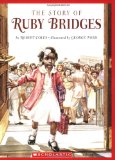
When Ruby Bridges was 6-years-old, she was the only African American student to attend a newly desegregated school in Louisiana.  Her extraordinary ability to withstand a hostile environment while viewing her tormentors (adult and child) with forgiveness makes her an inspiration to us all. I devoted an entire post to this story as well as books about this remarkable life that demonstrates how racism can be conquered. My post on Ruby Bridges and civil rights can be read HERE.


'The Beatitudes: From Slavery to Civil Rights' by Carole Boston and illustrated by Tim Ladwig

Since the earliest days of slavery, African Americans have called on their religious faith in the struggle against oppression.  In this book the Beatitudes -- from Jesus' famous Sermon on the Mount -- form the backdrop for Carole Boston Weatherford's powerful free-verse poem that traces the African American journey from slavery to civil rights.

Tim Ladwig's stirring illustrations showcase a panorama of heroes in this struggle, from the slaves shackled in the hold of a ship to the first African American president taking his oath of office on the steps of the United States Capitol. 


This is a remarkable picture book that can be read at many levels. Tim Ladwig's stunning images of the oppressed African Americans in the 18th century as they clung to all that they had, life and a faith based on love and hope are set against the famous text of the Beatitudes. Carole Boston takes the beatitudes and addresses them to African Americans of these dark times:


I was with Harriet Tubman when she fled slavery.
As she led others out of bondage,
I was the star guiding them north.....

Suitable for readers aged 6 to 12 years

2. Independent Readers (aged 9 to 12 years)

'Courage Has No Color: The True Story of the Triple Nickles. America’s First Black Paratroopers' Tanya Lee Stone (Candlewick Press, 2013)


This is a true story that has been a long time coming. It tells in a fair but powerful way of the racism that has often existed in armed forces around the world. Americans may well have heard of the Tuskegee Airmen, but few would know of the 555th Parachute Infantry Battalion - the Triple Nickle. These were the first US black paratroopers. They showed that black soldiers could do anything their white counterparts could do. The text and over 100 carefully labelled photographs in this 150 page book offer us an insight into how some brave and persistent African American men paved the way for others to be a full part of the US armed forces.

Tanya Lee Stone (author of 'Almost Astronauts') has done extensive research to tell her true story for readers of all ages. Boys in particular will love reading and looking at the historic photos. The work took Stone almost 10 years and the meticulous care and passion shows in this wonderful book. This amazing story will challenge all readers irrespective of age, race or ethnicity. The book recently won the YALSA Award for Excellence in Nonfiction. It is a very worthy winner.

'The Burnt Stick' (1995) by Anthony Hill & Mark Sofilas (illustrator)

This novel for younger readers (8-10 years) is set in Australia prior to the 1960s.  It is the story of a young Australian aboriginal boy named John Jagamarra, who had been taken (like thousands of other Indigenous children) from his family. John was taken from his mother by the Welfare Department of the day, and sent to live with his white Father at the Pearl Bay Mission for Aboriginal Children. He grew up in this beautiful place, but he knew it was not like being home with his mother and his people.  He remembers how the 'Big Man from Welfare' had come and taken him away. His story illustrates how well intentioned government policy at the time failed to deal with the problems of Indigenous communities and failed to understand the full needs of people 'other' than themselves. While the story positions us as reader to see the tragedy of the 'Stolen Generation' through John's eyes, at the same time it offers child and adult readers the chance to consider the issues of racial difference and how we understand, live with and when necessary, reach out to people other than ourselves.

Mark Sofilas' wonderful charcoal images add a haunting and powerful additional dimension to the story. The Children's Book Council of Australia named it Book of the Year for Younger Readers in 1995.

'The Jacket' by Andrew Clements & illustrated by McDavid Henderson

A white boy (Phil) wrongly accuses an African-American boy of stealing his brother's jacket. He realises that he is racist and asks his mother the question: "How come you never told me I was prejudiced?" This incident forces Phil to confront his inner prejudices and ultimately leads to a great opportunity to learn for the sixth grade boy. He recognises that there is prejudice in his neighbourhood, his family and even himself. In the process he finds a new friend in the process and is changed. The book is suitable for children aged 8 to 12 years.


'Peaceful Protest: The Life of Nelson Mandela' by Yona Zeldis McDonough & illustrated by Malcah Zeldis

This is a biography written for upper primary children (aged 8-11) that tells the story of Nelson Mandela. It commences with his childhood and ends with his retirement in 1999. It covers the major events you would expect, including his imprisonment for opposing apartheid, his election as the first black president of the Republic of South Africa, and his award of the Nobel Peace Prize for his struggle against racism and apartheid.

Mother and daughter Malcah Zeldis and Yona Zeldis McDonough have worked together to create a wonderful and challenging tribute to Nelson Mandela's “long road to freedom” that helped to free an entire nation. The illustrations by McDonough are striking and unusual, using gouache on watercolour paper. 

'When Hitler Stole Pink Rabbit', by Judith Kerr

Anna was only 9 years old in 1933 when Adolf Hitler emerged in the Germany of her youth. But as a Jewish girl she was soon to find that her world had changed when her father went missing. With a leader filled with hatred for an entire race of people, and determined to see them eliminated Germany is transformed.  Anna's father is a well-known Jewish writer, and someone warns him, just in time that he might soon lose his passport. Her father leaves by night for Switzerland and Anna, her brother and mother are left behind in Berlin. He sends for his family to meet him in Switzerland and they escape just a day before the German elections. Hitler sweeps to power all Jewish property is seized in Berlin and they are now refugees in Switzerland, with no way back. This wonderful story tells the story of the horror of Germany in the reign of Hitler through the eyes of a little girl.

3. Older Readers (Aged 12 to 14+ years)

'Claudette Colvin: Twice Toward Justice' by Phillip Hoose.

This multi-award winning book - including being named as a Newbery Honour book in 2010 - is about Claudette Colvin. On March 2, 1955, this inspirational teenager, fed up with the daily injustices of Jim Crow segregation, refused to give her seat to a white woman on a segregated bus in Montgomery, Alabama. Instead of being celebrated, as Rosa Parks would be just nine months later, fifteen-year-old Claudette Colvin found herself shunned by her classmates and dismissed by community leaders. Undaunted, a year later she dared to challenge segregation again as a key plaintiff in Browder v. Gayle, the landmark case that struck down the segregation laws of Montgomery and swept away the legal underpinnings of the Jim Crow South.

The Watsons Go to Birmingham - 1963 by Christopher Paul Curtis

This is a wonderful work of historical fiction written by Christopher Paul Curtis in 1995. It was republished in 1997. It tells the story of an African-American family living in the town of Flint, Michigan that goes to their grandmother’s home in Birmingham, Alabama. This middle-class black family move to Grandma's because she's strict and they hope she will sort him out over summer. But they happen to be in Birmingham when Grandma’s church is blown up, the 16th Street Baptist Church.

The book was Curtis’ first novel, and was named as a Newbery Honour book and won the Coretta Scott King Award. Curtis is also the author of the Newbery Award winner Bud, Not Buddy. 

It was released as a film in 2013 HERE


'Requiem for a Beast' by Matt Ottley

Another more recent exploration of this theme is Matt Ottley's epic picture book 'Requiem for a Beast' (which I have reviewed in full here). Essentially, Ottley wrote, drew, and composed a work that uses the Australian Stockman’s life as the centrepiece of a work that offers a different story of this much romanticised figure in the Australian psyche. In his own words, shared just after the award announcement when responding to some of the controversy surrounding the choice of the book, he suggested that:
"We have a romanticised view of what a stockman's life is like, a Man From Snowy River-view, and I wanted to present life in a stock camp as it really is, in all its grittiness."
And ‘gritty’ it is. As he explores the parallel lives of a young man working on an outback station coming face to face with a rogue bull, the story of his childhood, and the stories of dispossessed Aboriginal people. Within this narrative he explores other significant themes - the stolen generation (international readers might need this link), conquering one’s demons, loss, separation, guilt and forgiveness, separation and loneliness, family and community.

The book is in four parts, each with a title in Latin. Part one is Dies Irae (Day of wrath), presumably tied intertextually with the 13th Century hymn about the day of God's judgement. The opening pages, with its five magnificent oil paintings of the Australian landscape and three haunting statements, offer some clear clues to the reader:
It’s our memories that make us
This country, these hills you see; this is my mother’s country, and her mother’s too.”
I’m supposed to be a fully initiated woman, but that knowledge, that memory, is gone. Aboriginal Elder”
Ottley's ambitious work is set against the backdrop of Indigenous suffering and alienation. Ottley weaves multiple narratives of the boy’s life and Indigenous memories. This work is a riot of rich visual and verbal imagery.

The book won the 2008 Children’s Book Council of Australia Awards for a Picture Book. 

'Roll of Thunder, Hear My Cry' (1976) by Mildred Taylor

This book won the 1977 Newbery Medal Award, tells the story of a poor African American family living in Mississippi during the Great Depression. This novel is set in the Depression-era in Mississippi and centres on the lives of the Logans, an African-American family Logan family. The Logans are fortunate compared to many African-Americans and own their own land when many black and white Americans are working as sharecroppers on plantations owned by others. It is a time when racially-motivated crimes are common. The 'Berry Burnings' mentioned the first chapter and the act of tarring and feathering Mr Tatum were incidents that were sadly not uncommon as 'nightmen' took the law into their own hands at the expense of African-Americans. It is a novel that traces the life of young Cassie Logan as she learns the hard realities of life for African-Americans.  This is a moving and confronting novel.

The book has a sequel, Let the Circle Be Unbroken, which was released in 1981. It also has a prequel written in 1975, Song of the Trees and a related prior book The Land that tells the story of the Logan grandfather who purchased the land that is central to this novel. It is suitable for readers aged 11-14 years.

'Somehow Tenderness Survives: Stories of Southern Africa', by Hazel Rochman

This South African book is about the reality of Apartheid and the impact on real people. It shows the ugliness of racism played out in the stories of people who suffered and experienced violence. It includes ten stories and autobiographical accounts by a range of writers from southern Africa writers of various races (five black and five white). It includes well-known writers like Nadine Gordimer, Mark Mathabane and Doris Lessing as well as writers who mostly won't be known outside South Africa. The stories together and individually are a moving and challenging set of narratives that do not hide the ugly side of racism. At times they offer a shocking and powerful portrait of life under the oppression of racism that is sustained by the law.

'Sounder', by William H. Armstrong

This is the story of an African-American boy who lives with his family. The boy's father is a sharecropper and the family is struggling through hard times. He has a dog, named 'Sounder', mixed a coon/bulldog. Sounder goes out hunting with the boy's father each and every night they come back empty handed. But one morning, to his amazement the boy wakes to the unfamiliar smell of his mother cooking a hambone. Everyone is overjoyed, but a few days later the joy is shattered as three white men arrive and take his father for stealing a ham. The sheriff cruelly shoots Sounder who chases the cart that takes his father away and life suddenly becomes even harder. But he hungers for an education and his resilience and perseverance is remarkable.

'Sounder' won the Newbery Award in 1970, and was made in to a motion picture in 1972.


'The Slave Dancer' by Paula Fox

This book tells the story of a boy called Jessie Bollier who witnessed first-hand the savagery of the African slave trade. The book not only includes an historical account, but it also touches upon the emotional conflicts felt by those involved in transporting the slaves from Africa to other parts of the world. The book received the Newbery Medal in 1974.


'Number the Stars', by Lois Lowry


This fictitious story recounts the real life salvation of 8,000 Danish Jews who escaped to Sweden by sea. It is 1943, during the German occupation of Denmark, and ten-year-old Annemarie learns how to be brave and courageous when she helps shelter her Jewish friend from the Nazis. Annemarie and Ellen are best friends. Their life is ordinary. Annemarie is Christian and Ellen is Jewish and they are good friends. But there is a great threat from the Nazi soldiers who have invaded and are on their streets. The girls believe that the Danish King Christian will protect them. One night their families learn that all Jews of Denmark are about to be sent to concentration camps. With the help of Danish Resistance Annemarie’s family hides Ellen and attempt to get her to safety in Sweden. This is a gripping tale that will be enjoyed by 10-14 years old children.

Using the books in the classroom

The major purpose of the post is to show that there are many good books for children of all ages that focus on the theme of racism. My aim in presenting such books is straightforward.

a) I want children to experience books that offer narratives that deal authentically with the issue of racism.  The initial aim is simply for children to enjoy the books as good stories.

b) I also want children to engage with the story at a deeper level and be able to see the characters as authentic and at times to even to identify with them. This might be as a victim, or as someone who struggles to understand and deal with people other than themselves.

c) My aim is not to indoctrinate, but I do want to raise the issues, provide historical and factual details as appropriate as supplementary material.

d) I want children to have an opportunity to respond and discuss the literature as narrative and in relation to the themes and issues raised.  This might involve a variety of formats for response:
  • Structured and guided response in discussion groups
  • Free written response
  • Aesthetic response through drama, music, drawing (see for example 'Sketch to Stretch' here)
  • Opportunities for further research on time periods, events and people
One final comment. All literature needs to be experienced as narrative not as enabling material for lessons on topics that may or may not be related to the author's story and intent. I always want to trust the story to teach and try to avoid turning a wonderful narrative, with an authentic treatment of an important issue, into a series of decontextualised lessons. Such lessons can easily destroy the enjoyment of the story and fail to engage children at the deep level necessary to grasp and deal with complex life themes.

Other related resources

All previous posts on 'Key Themes in Children's Literature' HERE

Ann M. Neely (2011). Literature of Social Transformation: Helping Teachers and Students Make Global Connections. Language Arts, Vol. 88, No. 4, pp 278-287.