Indigenous Australians were the original inhabitants of the continent we know today as Australia. They include Aboriginal Australians and Torres Strait Islanders. Together they make up 2.5% of Australia's population today. It is believed that they are amongst the oldest races on earth with estimates suggesting that they first arrived on this continent between 40,000 and 125,000 years ago. They are an ancient people with a rich and unique culture. There is enormous diversity across the many nations and clans, with an estimated 250-300 spoken languages with 600 dialects. Sadly fewer than 200 of these languages remain and most are in danger of being lost. Like many non-Indigenous Australians I see the preservation of Indigenous languages and their stories as of critical importance. Recently, while travelling in Central Australia this was brought into sharp focus for me.
An encounter with the 'The Three Caterpillars'
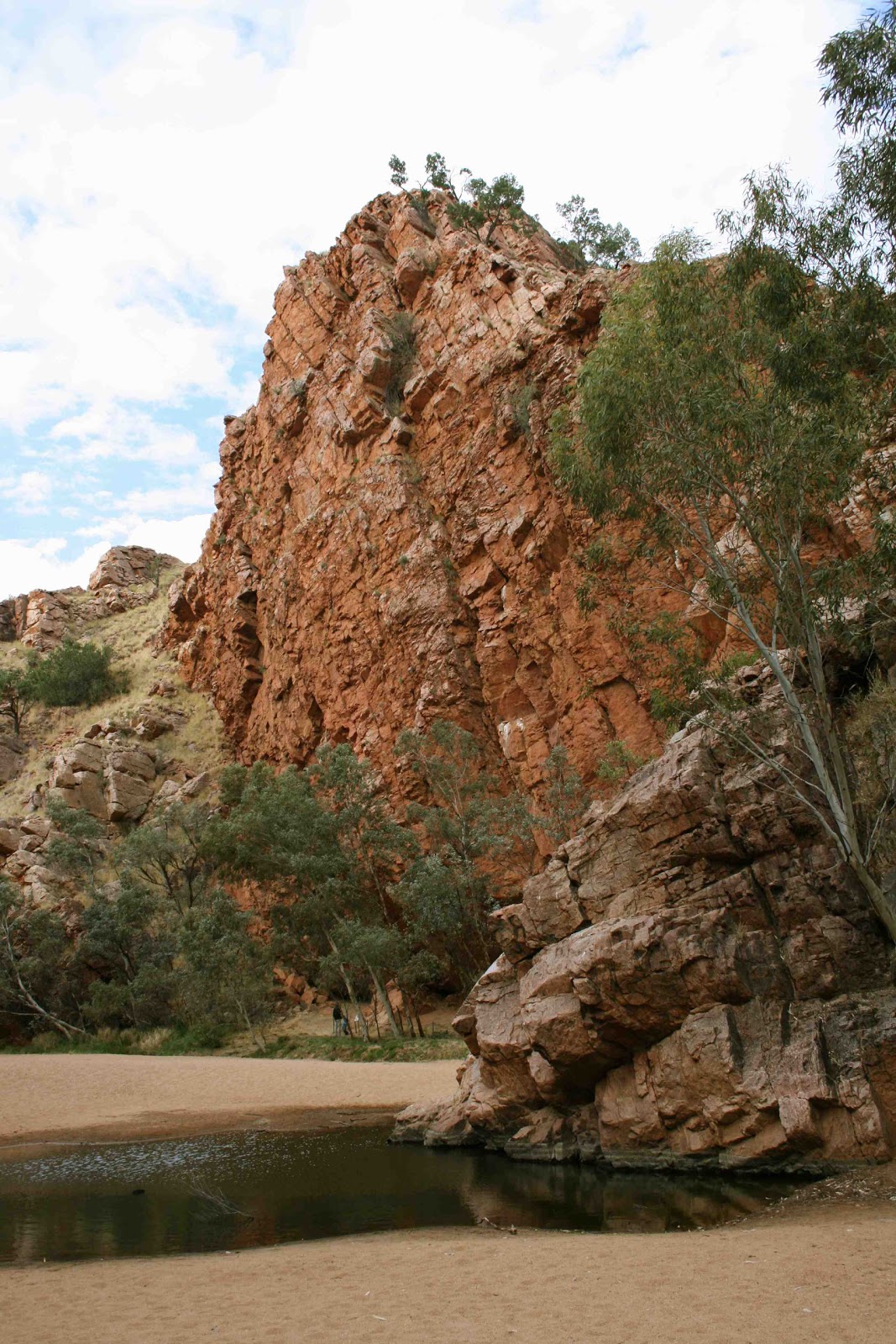
Mparntwe or Alice Springs is home to the Arrernte people, Indigenous Australians who have called this beautiful place home for at least 45,000 years. It is at the geographical centre of Australia. The photo opposite is of a place called 'Emily Gap' that I visited in July while exploring Central Australia. At this place you will find Indigenous rock art that tells the story of how three caterpillars named Yeperenye, Ntyarlke and Utnerrengatye created the MacDonnell Ranges.
The Arrernte people, believe the ranges were formed by giant caterpillars that entered this world through one of the gaps in the escarpment of the area. In traditional stories the caterpillar ancestors, Yeperenye, Utnerrengatye and Ntyarlke are the major creation forces of the Alice Springs area. These stories tell how they arrived from all directions, first stopping at Mparntwe, a particularly sacred site in Alice Springs, where they battled with the Irlperenye (green stink bug).
'Three Caterpillars' - Emily Gap
The Caterpillars fled when the Irlperenye (stink bug) started to kill them. The ranges around Alice Springs are the seen as the remains of the many caterpillars. The gaps in the ranges like Emily Gap indicate where the stink bugs tore the heads from the bodies of the caterpillars. The rock formations around the area are and the few surviving Yeperenye went on to sculpt the rivers and trees along the tops of the ranges.
'The Three Caterpillars' were painted on the cliff face at some point in time. The dark red and light orange stripes were created by red ochre and white lime blended with animals fats and applied to the rock surface.
Indigenous Dreamtime stories are associated with specific Indigenous clans and nations and their lands and these stories are passed on to younger generations by elders and storytellers. They have survived for thousands of years but the loss of traditional languages and the separation of many Indigenous people from their traditional land is a threat to their survival. While some of these stories are secret, or are seen as of such a sacred nature that they are only told by specific people to certain people (e.g. told by men to men, or by women to women), in the last 40 years many Indigenous Dreamtime stories have been shared through children's books.
As a non-Indigenous Australian I love these stories and would like to see more of them written down by the people who own these stories so that others can enjoy them. Thankfully, many are being recorded but just as many aren't. For example, to date I haven't come across a written version of 'The Three Caterpillars' that I learned of when exploring Alice Springs.
Some of my favourite Indigenous Stories
Some of my favourite Indigenous Dreamtime stories have been passed down to all Australian children through the storytelling and wonderful art of Dick Roughsey (1924-1985) or Goobalathaldin to use his tribal name. He was from the island of Langu-narnji in the Gulf of Carpentaria in northern Australia. His first picture book 'The Giant Devil Dingo' received wide acclaim for the richness of the storytelling, the distinctiveness of his painted illustrations, with their vibrant colours, fascinating detail, and the integration of art and word. It tells of Old Eelgin, the grasshopper woman who was evil and had taught her giant dingo Gaiya to kill men for food. But one day Gaiya meets his match in the Chooku-Chooku (butcher-bird) brothers.
Another of my favourite works by Roughsey is 'The Rainbow Serpent' first published in 1975 and still available. It won the Children's Book Council of Australia award for best picture book in 1976. Goorialla (the Rainbow Serpent) travelled across Australia to find his tribe. As he travelled his tracks formed the mountains, the creeks, lagoons and rivers. The Bil-bil brothers plot to kill him. When Goorialla's anger is spent and he disappears into the sea the world is changed.
Dick Roughsey and Percy Trezise (1923-2005) formed a strong partnership to produce many wonderful books together. While Trezise was not Indigenous he became Roughsey's brother in a traditional Aboriginal ceremony and was given the name 'Warrenby'. Roughsey lived with his wife and their six children on Mornington Island, but often spent half the year on the North Queensland mainland. He and Percy Trezise discovered and studied the art of Aboriginal cave galleries in the Laura region of Cape York. The Quinkin gallery inspired the award-winning books 'The Quinkins' and 'Turramulli' the 'Giant Quinkin'.
'The Quinkins' is a wonderful story that tells of the Yalanji tribe of Cape York and their encounters with the Quinkins, spirit people of the land with two tribes: Imjim and the Timara. Imjim were small fat-bellied fellows who stole children while Timara were funny and whimsical spirits who like to play tricks. They were tall and very thin and lived in the cracks of the rocks, and they didn't like the Imjim. This is the story of two children, Boonbalbee and Leealin. This book was an IBBY Honour book in 1980, and was the Children's Book Council Book of Australia Picture Book of the Year in 1979. As I travelled through northern Australia and looked at the crevices in the rocks the echoes of this story made me think, "could these be Quinkin rocks?"
There are so many of their titles that I love and have enjoyed sharing with children. These include 'The Cave Painters' by Percy Trezise (1988) which tells of the experiences of two Bullanji children Nonda and Mayli as they travel to visit their mother's people, the Yalanji who live in 'Quinkin Country'. 'The Magic Firesticks' (Trezise & Roughsey) is another story of the Yalanji people in Cape York and tells how the people discovered the way to light fires, not simply sustain fires once they were alight. After monsoonal fires quenched all their fires two young men (Bandicoot and Curlew) travel to a far off Fire Mountain where it was said Didmunja (a wise man) had magic sticks which could produce fire when you wanted it.
'Banana Bird and the Snake Man' (Trezise & Roughsey) tells of a time when people who were later to become birds, animals, plants and reptiles were still in human form. The snake men of Cape York were cannibals who would kill people and hang them in trees to be collected later when they were hungry. This story tells of the triumph of Coucal the brother of Banana Bird man who avenges his brother's death and destroys the Snake men.
Another wonderfully simple book is 'When the snake bites the sun' told by David (Bungal) Mowaljarlai, which was retold and illustrated by Pamela Lofts. This delightful story of the Ngarinyin tribe of Western Australia, tells the story of the sun and why it is as it is today. This was one of a series of simple picture books for preschool children produced in the 1980s some of which are still available. Other books in the series included 'Dunbi the owl', 'Echidna and the shade tree' and 'How the birds got their colours'. We owe Pamela Lofts (who lives in Alice Springs) a great debt for recording and illustrating many Indigenous stories. You can find a full list here.
Tiddalik Rock (Wollombi NSW)
'What made Tiddalik Laugh' has been produced in various versions of varied authenticity. It is based on the 'Cylorana platycephala' (or Water-holding Frog) that swells as it swallows water. It is sometimes referred to as 'Molok' as well as 'Tiddalik'. The version I first read was Joanna Troughton's beautifully (and amusingly) illustrated version, although this might not be the most authentic traditional version of the story. Tiddalik woke up one morning with an unquenchable thirst. He began to drink all the fresh water he could find till he was satisfied and every creek and billabong was dry. All the creatures and plant life began to die, so the other animals decided to do something about it. But how could they get the water back? Wombat had the answer, make him laugh? But how? The amusing solution involved Platypus in Troughton's version of the story. The story is said to have originated in South Gippsland Victoria but is common along the Eastern seaboard of Australia, so this is unclear. The photo of this rock (opposite) known as Tiddalik rock is located near Wollombi in NSW.
'Enora and the Black Crane', by Arone Raymond Meeks is another fine example of a traditional story being turned into a picture book. Arone Meeks is a member of the Kokoimudji tribe from the Laura area of far North Queensland. This story tells of Enora and how his killing of a crane led to birds acquiring their colours and him becoming the black crane. Winner of Australian IBBY Award for Children's Literature (1994), CBCA picture book of the year (1992) and UNICEF Ezra Jack Keats International Award Silver medal (1992). Arone Meeks also illustrated Catherine Berndt's wonderful book 'Pheasant and Kingfisher' (1987) that was shortlisted by the CBCA in 1988 and won the Crichton Award for Meeks in the same year.
A more recent book which I love is the 'Papunya School Book of Country and History' (2001). This isn't really a Dreamtime story, it is the story of the Anagu people of Central Australia. It offers a balanced telling of the people, their place, their culture and history. It does a good job in speaking of some of the difficult issues arising from the impact of white settlers. It is a wonderful collaboration between well-known non-Indigenous advocate Nadia Wheatley and Indigenous writers, storytellers and artists from the staff and students of Papunya School.
Another more recent community collaboration is 'Our World: Bardi Jaawi: Life At Ardiyooloon' (2011) by One Arm Point Remote Community School. Ardiyooloon is home to the Bardi-Jaawi people and sits at the end of a red dirt road at the top of the Dampier Peninsula, 200km north of Broome in the north-west of Western Australia. 'Our World: Bardi-Jaawi Life at Ardiyooloon' takes readers inside the lives of the children of a remote Indigenous community; lives that are very different to those experienced by most Australians. Worthy Honour book in the CBCA awards for 2011 in the 'Eve Pownall Award' for Information Books.
Yet another wonderful collaborative book is 'Playground' (2011) compiled by Nadia Wheatley with illustrations and design by Ken Searle, has been short-listed for the 2011 Children's Book Council of Australia (CBCA) Awards. This is an unusual book isn't quite a graphic novel, but then again, it isn't simply a reference book. Drawing on the stories of 80 Indigenous Australian Elders, 20 Indigenous secondary students and with Indigenous Historian Dr Jackie Huggins as adviser and critical friend, Nadia Wheatley has created a unique collaborative work. The book offers a wonderful insight into experiences of childhood for Aboriginal and Torres Strait Islander people from 1900 to the present.
With stunning photographs and illustrations, it takes us into the daily life of Indigenous children (past and present) who are connected with their land from birth. The stories and drawings help the reader to understand Indigenous life in all its facets - learning, playing, understanding and respecting the earth, the first days of life, relationships in families, what 'home' was, languages, daily food gathering and hunting, the place of song, dance, art and ceremony. With the arrival of European people there have been adaptations, but Indigenous children remain embedded in their culture. Daily life is different, but Indigenous children are still learning from country and community. This book would be a good introduction for readers who want to know more about Indigenous people not simply read their stories.
Some other great resources
Based on an Aboriginal Dreamtime story of Waatji Pulyeri (the Blue Wren)
Lovely example of Indigenous Storytelling, 'How the Kangaroo Got its Pouch' A Wirrajuri tale
Some brief further notes on Indigenous Australians
In Central Australia the Indigenous people are called the Anangu. Within this group there are many different language groups including the Pintupi, Warlpiri, Anmatyerre, Pitjantjatjara and Arrente. All Indigenous Australians come from different 'Ngurra' (homelands or traditional countries) and within their rich cultural traditions have stories, drawings, dances other cultural practices that have been passed down through the generations for millennia. There has been a wonderful balance and 'bond' between people and their land. They see their ancestors as their teachers and for thousands of years they have taught their children the knowledge of ancestors and a history seen within the very rocks, water courses, hills, fauna and flora of their place. This has been passed down often (but not exclusively) through story. Often these stories are told in the context of place and have been oral, but in the last century some of these stories have been written down so that they can enrich all people, even if perhaps not understanding their full significance.
There is a deep sadness that many non-Indigenous Australians feel that there has been some loss of language and stories of these unique people. It was with a mixture of joy and sadness that I caught glimpses of the rich connection between Indigenous people and their land while I travelled across Central Australia. The joy comes from the richness I could see in this connection, but the sadness is that for many Indigenous Australians this connection is made more difficult by their dislocation from traditional lands. My hope is that more Indigenous stories will be captured in written and spoken forms.
Can you recall a special place where you played as a child? An object, structure or piece of equipment that always seemed to be a point at which children would congregate? As a child I can remember many such spaces. There was a narrow strip of ground between the southern side of our house and a low fence. It was a place to hide, and the site of numerous 'lean-to' cubbies. And it was a place of imaginary play alone, and sometimes a place to share secrets and stories with others in our 'clubhouse'. I can recall a tree over-hanging the creek near my house as a child where we spent hours climbing it, jumping off it and talking under it. The photo opposite taken in recent times show that it still has the same use 50 years later. I can also recall a line of seats around a large gum tree on our school playground which we'd jump, use as balance beams, and use as the walls of a great imaginary fort holding out the enemy forces closing in as part of lunchtime battles.
What games did this site once host?
Have you ever noticed that some spaces attract children and others seem to repel them? Some park playgrounds seem to work and others leave children disinterested? There is a special relationship between space, objects and children's play.
A school Principal and a researcher on play made an interesting discovery at a Melbourne school recently. As part of the development of a new masterplan for the school playground the researcher discovered that an unusual structure near the front gate of Princes Hill Primary School had special significance. It is made of steel and timber, and looks like a long disused bike stand. But while the structure was inconsequential (and probably ready to be removed), at lunchtime it would be the site of an unusual game. A group of pupils would gather around it to begin a ritual that it would seem has been going on in this school, at this place, using this object, for generations.
They call the game 'Cat and Mouse'. The researchers found that while it has similarities to other games of chasey, there are unique elements. The children form a circle and one child chants the traditional counting rhyme "Dip, dip" to see who will be "it". But the game is only ever played around the unusual structure. The structure is well worn, with metal railings polished to a shiny brilliance by generations of children. And yet, the exact purpose originally is now unclear. But for 'Cat and Mouse' the rules are clear. Grade 6 students have been teaching them to the Prep (Grade 1) children for generations.
As I said in a post on the imagination some months ago, imagination and creativity are fundamental to human advancement and are qualities to be valued and nurtured. It is important not to constantly constrain and conform our children with a resultant loss of originality, innovation and discovery. The example at Princes Hill Primary School is a good reminder of why we need to remember this.
I have quoted John Holt before, but I want to do it again, because he expresses this point so well:
What children need is not new and better curricula but access to more and more of the real world; plenty of time and space to think over their experiences, and to use fantasy and play to make meaning out of them; and advice, road maps, guidebooks, to make it easier for them to get where they want to go (not where we think they ought to go), and to find out what they want to find out. (John Holt, 1981)
Other links and posts
You can read the newspaper report on Princes Hill Primary HERE
'Stimulating Children's Imaginations' HERE
Story on June Factor and the Australian Children's Folklore Collection HERE
'Australian Children's Folklore Collection' HERE
Dr Ken Ginsburg & Dr Marilyn Benoit Speaking on Play
Sandy Fussell lives south of Sydney (Wollongong) with her husband and two sons. She studied mathematics at university. But it has been history that has been a major inspiration for her writing. She shares in the interview below that she has been interested in history from a very young age. She now works in IT. She is something of an "accidental writer". In her words, "when my eldest son stopped reading in Year 4, I panicked. How could a child of mine not love books?"
Her efforts to work with her son on his reading and writing led her to write for herself. She proceeded to write manuscripts for practice. She wrote nine in quick succession. She showed her eighth effort to a number of people and received good feedback. Her ninth manuscript was 'Samurai Kids' which was accepted for publication in 2006 and was published as her first novel in 2008.
The Samurai Kids series has gone on to be very successful. Book 3, 'Shaolin Tiger' was named as a Notable Book by the Children's Book Council of Australia (CBCA) for Younger Readers in 2010. It was also short-listed in the Speech Pathology Awards in 2010 (Upper Primary Category). 'Polar Boy', was her first stand-alone novel and was short-listed in 2009 for the CBCA awards for Younger Readers. Her second stand-alone novel, 'Jaguar Warrior' was published in 2010 and has received good reviews.
Interview with Sandy Fussell
1. TC: Could you tell the readers of this blog why you wanted to be a writer of children’s books? Was there a special motivation or someone who inspired you to do it?
I am an accidental writer. When my eldest son stopped reading in Year 4, I panicked. How could a child of mine not love books? After failing to find anything he would read, I asked him to write a story to show me what sort he would like. To my surprise he said yes, as long as I transcribed. I’m embarrassed to admit it but I kept interfering. In the end he became so exasperated with me; I was sent packing to write my own story. I haven’t stopped writing since.
2. TC: Do you find the writing process difficult? Which aspects of your writing are most challenging?
It is hard to juggle writing with family and work. If the words are flowing, I have to force myself to put the manuscript aside to attend to other things – like feeding the troops and paying the bills. For me, the most challenging part of writing is chapter 5. That is the point at which I know what happens right through to the end, and I get a little bored with the process of continuing to put words to paper. I’m always tempted to start something new. But in the end I want to share the story so I keep going. From chapter 6 onwards it’s a downhill ride!
3. TC: You write historical fiction, could you tell us why this genre is important to you? What about the characters, from where do they ‘spring’?
I have been fascinated by early history ever since I was a child. I would imagine what it was like to live in a different place at a different time and in particular, what it was like to a kid then. Children had very different lives, responsibilities and adventures hundreds of years ago. A fourteen-year-old boy was a fully fledged samurai fighting for his lord. Most readers think of Ananasanq (Nana) from Polar Boy as very old. When I visit schools I often ask students to guess her age. They hover around 100 years old! But the life expectancy in the polar north was much less than that and Nana was more likely to be about 32.
4. TC: What is the research process like for the writing of one of your novels?
I love research and spend the first month doing nothing else. Then I continue researching as I write. Most of the information doesn’t make it into the book but it creates a sense of time and place which is absorbed almost osmotically into the story.
I pay close attention to the everyday life of my characters - how they lived, what they wore and what they ate. In terms of context, often my readers find these small details more interesting than the big historical events.
For me it is always thrilling when history validates my storyline. I can’t claim it is deliberate but it just keeps happening. For instance in Samurai Kids book 7 which is set in Cambodia, I did not think there were any Japanese people there at the time. That didn’t mean I couldn’t write them in. But then I discovered there is an inscription on the walls of the Temple of Angkor Wat in Japanese dated to exactly the time period I am writing in!
When I was writing Polar Boy it initially began as the story of a boy facing his greatest fear – the polar bear. I also wanted a cultural confrontation. As I researched I discovered the Vikings were coming down from Greenland at the same time and they were called ‘berserkers’ or ‘the bears’. So the bear in Nana’s prophecy about Iluak was really a person all along! Writing historical fiction is about connecting the research dots to form a story.
5. TC: How do you choose the historical periods and the places that you do?
I choose places I’m interested in. I studied Ancient History in high school and at university so sometimes I have a lot of general knowledge about the period such as Samurai Japan or Aztec Mexico. Alternatively it might be a period that has a magical almost exotic appeal for me – even though I may not know many details. I also like to choose periods that are on the edge of well-known times and have drafted a story set in Nubia. Nubia was a black African civilisation that preceded pharaohonic Egypt so while it is not itself well-known; it has a certain geographic and cultural familiarity for young readers who know a lot about Ancient Egypt.
I like to write about a period that is close to a well researched period because it gives me a solid historical base but also allows room for a wider imagining. Samurai Kids is set in the mid 17th century which in Cambodia (the setting for book 7) is the Dark Ages. Not a lot of information is known so I can draw imaginative inferences as long as they are plausible.
6. TC: Of your 8 books, which one was most satisfying for you and why?
That question is so hard. I am always pleased with each novel I finish although I don’t necessarily think my latest is always the best. What will be my most satisfying book is probably unfinished at this point. I have been working on it since 2007 and it has been evolving with me as I (hopefully) develop into a better writer.
7. TC: What has been the most memorable experience in your writing career?
In 2008 I was asked to be the Guest of Honour at the Henry Lawson Festival of the Arts, the longest running arts festival in Australia. Guests are usually high profile members of the arts community but when the chosen guest had to withdraw due to family illness, they couldn’t find anyone to come to Grenfell at short notice. My family live there so my sister suggested me!
I crowned the queen, presented prizes, opened the festival and spoke at the reception. But by far the best part, and my favourite writing memory, was when a local school joined the street parade as Samurai Kids. They stopped in front of the official dais, bowed and yelled ‘Sense’i. I cried. I still do when I think of it. The full account and pictures can be found HERE.
The children of Grenfell dressed as Samurai Kids
8. TC: Are there any children's authors that you particularly admire? Adult writers?
There are many, many authors I admire. The children’s book community is incredibly generous and encouraging to new writers. I am hesitant to list names as I would hate to leave anyone out, but I’ll make one exception. When I first began to write I was invited to a writer’s meeting at author Di Bates’ house. She became my writing mentor, guide and good friend. She still is.
9. TC: Were you taught creative writing in school? Did it help?
I don’t recall anything specific although I am incredibly indebted to the teachers and librarians who fostered my love of reading. I had a strict and often unhappy childhood but these ‘angels of the book’ provided me with somewhere wonderful to hide out.
10. TC: What advice would you impart to aspiring writers?
I used to say ‘Write, write, write. Read, read, read.’ And while I still think that is valuable advice, I would now say: Scribbling every idea into a notebook, be continually looking at the world with an imaginative and slightly askew eye. Honing writing skills is extremely important but perhaps even more important is finding unique story ideas.
11. TC: What has been your favourite response to any of your books?
I get a lot of emails from young readers. Their enthusiasm for the Samurai Kids series is inspiring. They often write to me with story ideas for the next book.
A partially blind girl emailed me (via her mum) to say Taji (who is completely blind) was her hero. One mother wrote to say her child was due to have a serious operation which included a skin graft and he would be on crutches for a while. Part of his preparation was practising to be Niya! Another parent wrote to me to say their China travel plans had changed because after reading Samurai Kids, their young son wanted to visit a Shaolin Temple.
12. TC: Do you have a book that you are working on right now?
I am currently working on three separate books but my priority is the seventh book in the Samurai Kids series. It doesn’t have a title. I have always wanted to visit the Temple of Angkor Wat in Cambodia but that doesn’t look likely in the near future – so I am going there in my book instead.
This is a series about the experiences of a group of samurai children in feudal Japan. Like other stories about Japanese warriors, the narrative is interwoven with the philosophy that is the foundation of their life and training. The diverse samurai kids learn to fight, but always with the noble desire to prevent war. The stories and their characters seek to build just and ethical societies. The books offer a range of characters that represent both genders and children of varied qualities, characteristics and challenges. In the video below you view Sandy talking about her exciting series.
This was Sandy Fussell's first stand alone novel for younger readers (9-12+ years). It is set in a 13th century polar community, a young boy's destiny transforms him from a frightened child into a courageous hero. Iluak, a Too-lee boy, has been told by his grandmother that it is his fate to save his people from a bear. But the mere thought of a polar bear makes Iluak’s stomach churn and he lives in fear of this destined encounter. When Illuak summons the courage to rescue a Northman (Viking) child from a polar bear he realises there is a far greater challenge involved in the prophecy. Two very different cultures are about to collide head-on in this excellent historical .
This is the story of Atl, a young Purepechan slave. It is set in the age of the Aztec empire and a place we know today as northern Mexico. Atl is imprisoned in a box and has been there seven days and awaits death as part of an Aztec ceremony of sacrifice to the Mexican gods. He is not afraid as the anger rises within him and significant twist occurs in his story. A war-party of conquistadors attacks the head temple and Atl’s reputation as the fastest runner in Technotitlan leads the High Priest to set him free to send a message to get help for the Purepechan people. He escapes through hidden tunnels of the temple and heads into the jungles of South America, encountering dangers and collecting companions on the way. It is a fast moving adventure story that 9-14 year old boys will enjoy. It is a well-researched historical narrative that many young readers will find a great read.
Teaching resources
Samurai Kids Website (HERE)
Sandy Fussell's personal site has varied resources and ideas for her books (HERE)
Sandy Fussell's Awards
2009 Short Listed CBCA Children's Book of the Year, 'Polar Boy'
2009 Honour Book CBCA Junior Judges Project, 'Polar Boy'
2009 Short Listed Sakura Medal Chapter Book (Japan), Samurai Kids Book 1 - 'White Crane'
2009 Panda Book Award Middle Readers (China), 'Polar Boy'
2010 CBCA Notable, Samurai Kids Book 3 - 'Shaolin Tiger'
2010 Shortlist Speech Pathology Book of the Year, Samurai Kids Book 3 - 'Shaolin Tiger'
2011 CBCA Notable, Samurai Kids Book 5 - 'Fire Lizard'
2011 CBCA Notable, 'Jaguar Warrior'
2011 IBBY Outstanding Books for Young People With Disabilities, Samurai Kids Book 1 - White Crane
In Great Britain there are two major awards for children's books - the Carnegie Medal and the Kate Greenaway Medal (here). The Chartered Institute of Library and Information Professionals (CILIP) runs both awards.The winners of both 2011 medals have been announced.
The Carnegie Medal is awarded to an outstanding book for children and young adult readers. Nominated books must be written in English and should have been published first in the UK in the year before the awards. The Carnegie judging panel consists of 13 children's librarians from the Youth Libraries Group of CLIP. Nominated books are also read by students from many schools who send feedback to the judging panel.
The Kate Greenaway Medalis awarded for excellence in illustration. The award was established in 1955 for distinguished illustration in a book for children. It was named after the popular nineteenth century artist known for her wonderful children's illustrations and designs. As if to set the standards very high no award was made in the inaugural year as no book was seen as worthy enough.
The 2011 Carnegie Medal
This is the third and final instalment written by Patrick Ness in the 'Chaos Walking' trilogy. The two previous books in the trilogy, 'The Knife of Never Letting Go' and 'The Ask and the Answer' were both shortlisted for the Carnegie Medal (2009 & 2010 respectively). It is the first time that all books in a series have been shortlisted.
'Monsters of Men' tells of the power struggles of a world where all thoughts are audible. It is a fast-paced action novel centred on three characters, all with different points of view. The stage for this story is set with the opening line:
"War," says Mayor Prentiss, his eyes glinting. "At last."
Three armies are marching on New Prentisstown. Todd and Viola are right in the middle of the action, with no obvious way to escape. As they face this predicament together, the relationship between them develops. And then another character '1017' enters focussed on revenge, a further complication. This novel will engage readers 14+ as it deals with varied themes including life, death and love.
This fast-paced action is narrated by three individual characters Todd, Viola, and 1017, all with very different points of view, and all on different sides, but all fighting in the same war, a war for power.
Ferelith Hordon, chair of the 2011 judging panel commented at the awards ceremony:
"By any stretch of the imagination – and this is a book which profoundly stretches exactly that – Monsters of Men is an extraordinary achievement. Within its pages, Patrick Ness creates a complex other world, giving himself and the reader great scope to consider big questions about life, love and how we communicate, as well as the horrors of war, and the good and evil that mankind is capable of. It's also an enthralling read that is well nigh impossible to put down...this is a novel that both stands alone, and stands out".
Patrick Ness is an American but has lived in the UK since 1999. The son of a drill sergeant in the US Army, he spent his early years in Hawaii, before moving with his family to the state of Washington when he was six.
Grahame Baker-Smith has won the 2011 Kate Greenaway Medal. A father who had always dreamed of flying went off to war and didn't return. His son decides to make his father's dreams come true. The book tells the moving story of how the boy tries to fulfil his father's unfulfilled dream of flying. The story demonstrates the power of love and ambition when faced with seemingly impossible goals.
The story was inspired both by the author's own father, and by being the father of a son himself. In an interview for 'Kids Book Review' he comments:
"FArTHER is the first book I’ve done that I feel has some real truth in it about the way I think about life and some of the complex relationships we all seem to insist on developing!"
Baker-Smith uses traditional media like watercolour, acrylic, pastel and ink, but he also uses fimo and other materials to create images. He then uses photography and Photoshop to create the unique images that make up this book. His unique style will excite young readers.
Like a number of recent books for children, 'FArTHER' has a metaphysical dimension to it which will also stimulate the imagination of readers. As the Chair of the judging panel, Ferelith Hordon, indicated:
"FArTHER is a beautifully conceived picture book with a dream-like quality that captures the imagination of readers of all ages. Its wealth of detail conveys both dark emotions: the storms of war and weather, and a powerful sense of loss and bereavement; but also a great sense of hope, particularly as vested in future generations".
Grahame Baker-Smith lives in Bath and has worked as an illustrator for over 30 years. Throughout the 1980s and 90s, he made a living as an illustrator of other people's work, doing book jackets, covers, and even advertising. He then wrote 'Jo-Jo's Journey' (a comic-style story), a version of 'The Velveteen Rabbit' and later, 'Little Pilot.' None of these sold in any great quantities. He thought his career as an illustrator and author was over before it truly started, but then just five years ago, he evolved a new style. The first book in this style was 'Leon and the Place Between' and it was immediately shortlisted for the 2010 Kate Greenaway Medal. 'FArTHER' is the second book in this wonderful new style. This wonderful new book will stimulate the imaginations of children aged 7+.
I have written a number of previous posts on ePicture book apps for the iPad (listed at the end of the post). In this post I look at 6 recent examples, which I believe have merit. Overall, I have been disappointed by the quality of many ePicture books. While there have been many new apps released onto the market in recent times, most fail to realize the potential that electronic devices like the iPad have for adding value to children's experience of picture books. In a previous post (here) that was motivated by 'Alice for the iPad' I concluded:
It remains to be seen if developers can create interactive picture books that are more than just novelties. If they do, I'm sure that they will help to get some children more excited about reading and literature.
Since that post I've continued to look for good new apps for the iPad, iPhone and Android devices. I continue to test them with some children aged 3-10 years. Many of the apps tested have been very disappointing. My major criticisms are:
Many developers have spent their time developing the app with fun interactive elements with little regard for the story.
Once developers have a programmed app they tend to re-use the code many times (for obvious and unavoidable commercial reasons) with different titles.
Many of the interactive elements divert reader attention away from the words and story to the 'gadgets'.
The interactive elements often add little to the reading of the story.
The quality of the illustrations and text quality are often poor, few leading writers and illustrators are as yet contributing material for ePicture books (I'm sure this will change).
Many developers have failed to use the potential of multimodality to engage and enrich readers.
In short, the apps continue to fall short of their full potential. Having said this, I believe that there is enormous potential to use sound, video, text, illustration, related texts, and reader initiated interactions that relate to the story. The following examples are some of the best that I have seen recently and offer some hope that developers might eventually understand what is required to enhance the picture books, not simply trivialise narrative.
As with previous posts I will give ratings from 1 (Poor) to 5 (Excellent) in terms of a) Fun & interactivity, b) Useability, c) Benefit for learning, d) Story quality, e) Image quality, f) Value for money. I will also calculate the total score for each. I should stress once again that my assessments are about more than just whether children find them fun to use. 6 Excellent apps
'Moving Tales' is a developer responsible for a series of ePicture book apps that present traditional tales in new ways. The organization states that its purpose is to present imaginative interpretations and adaptations, "...inspired by age-old folk tales, archetypal yarns and legends from around the world." In my view they have succeeded in doing this. They have released four stories to date; each is presented in the same format and with similar stylistic illustrations. I will review just one of the stories. The other titles are 'This too shall pass', 'The unwanted guest' and 'Twas the night before Christmas' (see them here).
The 'Pedlar Lady of Gushing Cross' is inspired by the age-old tale of a man who becomes rich through a dream. There are varied older versions of the story with origins in Persia, Israel and Ireland. The story describes the journey of a poor pedlar woman who, guided by the shifting line between the real and the unreal, discovers a surprising and wonderful treasure.
As with all ePicture books you can read it yourself or have it read to you. The reader can also record their own reading if they wish. The storyteller provided has a wonderful Irish accent that works well with the traditional tale. The background music also adds to the haunting nature of the reading of this story. The illustrations are monochrome, with touches of colour and partial animation on each page. It is available in English, Spanish and French.
The interactive elements are used sparingly (something that I like) with the most obvious gadget being the dissolving text on each page. This is cute and isn't too intrusive as it occurs only when the page is turned. The strength of these four excellent apps is the quality of the text, rich language, the understated but effective illustrations, the reader and the haunting nature of the tales. It is wonderful to see an emphasis on the narrative in this app, not the gadgets.
a) Fun & Interactivity (4) - The book has less gadgets than many apps, but this is a case of less being more!
b) Useability (4) - Very easy to use, with a touch scroll at the bottom of the screen allowing the reader to move back and forth easily.
c) Benefits for Literacy & Learning (5) - A complex story which children will find engaging. The language will stretch readers with wonderful words like 'detritus' and 'ineffable' being used.
d) Story quality (4) - It is an excellent version of this old folk tale.
e) Image quality (4) - The monochrome and partial colour works well.
f) Value (4) -At $US 6.99 the story is reasonable value.
Moonbot suggests that the book was inspired in equal measures, by Hurricane Katrina, Buster Keaton, The Wizard of Oz, and a love for books. It is a story about people who devote their lives to books and how books in turn enrich our lives. It is a poignant, humorous allegory about the power of story. It uses a variety of illustrative and animation techniques to create a moving story. It is presented in a style that offers echoes of the great silent films of the past. As the developers suggest, “Morris Lessmore” is old-fashioned and cutting edge at the same time.
The various interactive elements in this app are complex and yet they relate well to the story. The reader can repair books, descend deep into a great storm, learn the piano, become 'lost in a book', and fly through a magical world of words. I could have done without some of the games sprinkled through the reading, but kids will love them. There is a surprise on each page of this app. The sophisticated CG animation, excellent original music, and quality illustrations work well to support the narrative. While I felt that there was just a little too much gadgetry, I don't think children would agree, this is a wonderful app. But I would still prefer developers to 'hold back' on the gadgets so that they don't distract too much from the reading of the text. When I tested the app with one group of children they spent ages making sentences out of the alphabet cereal. While it is a clever writing activity, it did little to maintain the continuity of the children's reading of the text.
Above: Image showing Morris discovering where the books were 'nesting'
a) Fun & Interactivity (5) -This app sets new standards for interaction.
b) Useability (4) - Very easy to use.
c) Benefits for Literacy & Learning (5) - The book teaches, entertains and enriches. The language of the text is rich, e.g. the flying lady was pulled along by a 'festive squadron of flying books'.
d) Story quality (4) - The story is excellent. While the story app felt a little contrived and there were some great narrative leaps in comparison with the film, this was probably due to the faster pace of the book than the video on which it is based.
e) Image quality (5) - Brilliant illustrations.
f) Value (5) - The app is excellent value at just $US 4.99
'Timo and the Magical Picture Book' was written by well-known Dutch author Rian Visser and is illustrated by Klaas Verplancke, one of Belgium's most celebrated illustrators. It is a story app for younger readers (3-7 years). It is about a little boy called Timo who receives an unusual birthday gift, a magical picture book from his uncle. A parcel that was not to be shaken, but... When Timo begins reading his new book he finds himself and his family mixed up into the story. As Timo enters the book, the app reader is able to interact with the illustrations, shaking and touching the images to elaborate on the story.
While the app doesn't have all the bells and whistles of the Morris Lessmore, it is an appealing picture book that has just enough interactivity to support the narrative. There are a few design ideas that I'm not keen on, for example, the font was a bad choice and didn't work that well over the illustrations. The animation also lacks a little of the sophistication of apps like Morris Lessmore, but it works well enough for readers that I've shared the app with. For me, this app does a good job balancing the interactive elements and story. The app plays English or Dutch language and the reader's voice is warm and friendly, although at times the reading is a little staccato.
a) Fun & Interactivity (4) - The interaction between Timo, the book and the app reader is quite clever.
b) Useability (3) - A simple app although the access to previous pages is a little clunky
c) Benefits for Literacy & Learning (3) - This is a basic story but the language is appropriate and the story structure clear.
d) Story quality (4) - This is an excellent story that younger readers enjoy.
e) Image quality (4) - Simple illustrations and animation, yet appealing and appropriate.
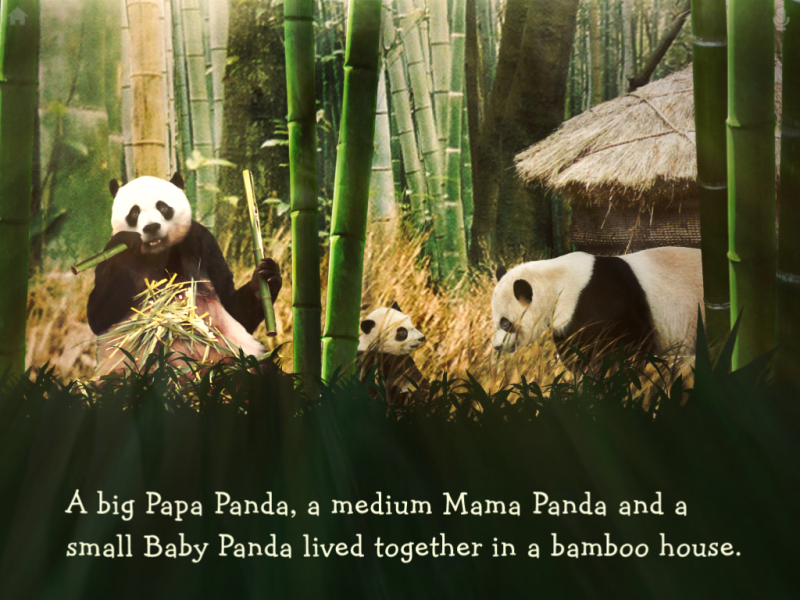
I have reviewed another 'See Here' app in a previous post, 'The Wrong Side of the Bed' a 3D app, and I have just discovered 'Twinkle, Twinkle'. What I like about the work of this developer is the desire to put as much effort into the story and illustrations as the interactive elements. 'The Three Pandas' is based on the traditional story of 'The Three Bears' with an Asian twist. It will appeal to younger readers aged 3-7 years.
Reading 'The Wrong Side of the Bed' with 3D glasses
The story is set in a bamboo forest, where a little girl (Mei Mei) enters the house of three pandas. As you would predict, she eats their porridge, sits on their chairs, and sleeps in their beds. But unlike the traditional tale there is a slight twist at the end. The story has been developed in association with 'Pandas International' and so the app provides additional facts about pandas and an external link that enables you to learn more about the Giant Panda. A portion of all proceeds goes toward Panda conservation efforts. The animation is delightful. You can tickle the pandas on each screen shot and be surprised by their responses. As with most apps you have a choice of languages (English or Chinese).
The story is simple and delightfully understated. The illustrations would be a hit in any form of picture book. The animation of Mei Mei and the pandas is photographic in nature while the backgrounds are a mix of drawn and real objects. All in all, the images are wonderful.
a) Fun & Interactivity (4) -There is enough interest in the interactive elements with the 'tickle' function.
b) Useability (3) - This is a simple app but an easier way to be able to navigate back and forward would be helpful.
c) Benefits for Literacy & Learning (4) - While the story is a simple tale based on a well-known fairy tale, the Chinese setting, changes to the plot and additional background information means that there are additional learning experiences for the reader.
d) Story quality (4) - A well-written simple story that younger readers enjoy.
e) Image quality (5) -Beautifully illustrated.
f) Value (5) - Excellent value for money at $US 2.99
Total Score = 25/30 (The higher the better)
5. 'The Wonkey Donkey' by Craig Smith and illustrated by Katz Cowley (Scholastic)
This app is based on Craig Smith's wonderful book by the same name. The original picture book came with an audio recording of the song. This app can be read or followed as it is sung. It is a funny, predictable and cumulative song, that uses rhyme to great effect. Each page tells something new about the three-legged, one-eyed donkey, who walks down the road. He ends up being a lanky, honkey tonkey, winky, wonky, cranky, stinky dinky, spunky, hanky panky donkey. No child or adult can use this app without smiling! There is much fun to be had by listening to the song and trying to predict the new word for each clue given!
a) Fun & Interactivity (4) - There are a small number of interactive elements that children can activate by touching the illustrations. But the song itself is wonderful, who needs extra effects?
b) Useability (3) - Quite easy to use. The reader can also check their reading by touching the text but unfortunately is word-by-word only. There is a record function that is a lot of fun.
c) Benefits for Literacy & Learning (4) - The book is a great way to introduce young readers to rhyme, rhythm and word play. These are all very important with readers under six years.
d) Story quality (4) - This is a wonderful predictable book.
e) Image quality (4) - Simple, but excellent images.
f) Value (2) -At $8.49 this app is a bit expensive.
"What Was That Noise?" is a simple, original, illustrated, interactive children's storybook. It's a rhyming, noisy book (each page has a sound effect!) that kids will love to read and play with. You can read to your child, or use the "read-aloud" feature to let them read on their own. It has to be the simplest app on the market and is perfect for pre-school children. You can touch the text and it reads the complete phrase or touch the picture to hear the noise that the text describes. The illustrations are beautiful and yet very simple pen and wash. Young children will love this app; it is a good first app for 2-4 year olds.
a) Fun & Interactivity (4) - Perfect for the age group.
b) Useability (4) - Couldn't be easier.
c) Benefits for Literacy & Learning (3) - Uses rhythm, some rhyme and excellent illustrations to introduce children to concepts of print and story. It offers an enjoyable experience of books and language.
d) Story quality (4) - Excellent for its type
e) Image quality (5) - Beautiful.
f) Value (5) -At $0.99 it is incredible value
Total Score = 25/30 (The higher the better)
My previous posts on story apps
'Alice', the iPad and new ways to read picture books (HERE)
'Literacy and the iPad: A review of some popular apps' (HERE)
'Literacy and the iPad: A second review of children's apps' (HERE)
'eBooks, not what they're cracked up to be?' (HERE)
I wrote on Digital Storytelling a year ago, but thought I'd do a similar post as I see great opportunities with this approach. Digital Storytelling is a relatively new term that has varied meanings. It began as a way for people to tell their personal stories and family histories. They combine relatively simple texts with images and sometimes videos that the author has often created along with the texts. Their purpose was initially to inform, as therapy, as creative expression, as part of local histories, and so on.
They are usually short, taking just 2-5 minutes to view, read and listen to. They are real stories told in your words and usually using your own voice. Here is just one example (there are others at the end of the post).
Above: The story of 'Intelligence and Luck' is an excellent example of how well written text supported by the most simple of sketches can be very meaningful.
But as the idea has been embraced it has been adapted to suit varied purposes and creators. The common elements are:
It is a form of storytelling
They are authentic creations
They use images in association with print and sound
They are published digitally
Just like the illustrations in a good picture book or graphic novel, the digital resources used in association with words are very important in a digital story and include:
Still photos
Scanned images and documents
Short videos
Music
Sound effects
How are they made?
Essentially, digital stories are short movies produced on inexpensive and readily available equipment:
Home computer
Computer video programs like iMovie (Macintosh) or MovieMaker (Windows)
Digital recorder
Hand held video camera or phone with built-in video
Digital camera
Digital scanner
Of course, you don't need all of the above, you could get started with a digital camera or video and a computer.
Once completed the digital stories can be uploaded to websites, blogs, burned onto DVDs and shared with others, projected onto a television screen, or viewed on your computer, viewed in a school hall by large audiences, presented on a Smart Board for the class to share, or given to parents and other interested audiences.
What are the advantages of Digital Storytelling?
There are many good things about digital storytelling that relate to the creators and the community of interest in which they are shared. Creators are able to:
Use word, image and sound to communicate powerful and effective stories.
Publish their digital stories to wider audiences that can have access anywhere around the world.
Extend their network of relationships as they share their work with others and cooperate with others on joint projects.
Learn to comprehend and use images as well as words to communicate.
Learns new things whether the creators, collaborators or the audiences for the digital stories.
Nine Simple Ideas for Digital Storytelling
You might try one of the following ideas for digital storytelling:
a) Have students choose a person and simply tell their story in 10 pictures and with 10 associate text segments. This can be a famous person, or someone known to them.
b) Interview someone about something and take photos to support the story.
c) Have the students choose three people to talk about the same incident or experience, for example, a recent climatic event like a storm or fire, a sporting event, or the childhood memories of play for a sibling or fellow student, their mother or father and a grandparent.
d) Create a series of drawings, pictures or collages and use these as the visuals for a story that they tell in spoken and/or written word.
e) Do a web search and capture images that relate to a significant event (e.g. an environmental disaster or an historical event) then retell the event in words and images.
f) Have children collect a sample of photographs that sample their life span and tell their own story.
g) Retell a well-known picture book with a twist in the plot, a change in characters, a shift in time or setting and their own illustrations to support their text.
Above:These storyboards were created by individual students then put together by the teacher into a digital story
h) Use modelling clay, play dough or even Lego or other construction toys to create a series of characters to support a story - use and manipulate the 3D models and photograph them or video them to help tell the story.
i) Create a group or class digital story that is based on a common narrative storyline that is then told using story boards that different children make. These are photographed or used with video technology to present the story in image, word & sound.
j) As well the above story-based ideas some teachers have been using the same concept of the storyboard for science, social science, history, in fact any school subject, as a tool for learning and communication.
Further Examples of Digital Storytelling
Because Digital Storytelling is a relatively new activity, there are few good examples available with younger children because the earliest work in this genre has been with adults and high school children. However, the following additional examples should give some sense of the possibilities.
Above: 'Mongolia for Mongolians' is an excellent example from senior High School students of an account of their experience of Mongolia
Above: This is an excellent video that tells how one 3rd Grade teacher taught her children to make digital stories
Hopefully, some of these examples will get you started if you haven't already attempted digital storytelling. Have a look at the resources below. There are a couple of good kids examples on the site promoting Lisa Miller's new book (link below).
Useful Resources
The 'Center for Digital Storytelling' has been a key resource for ideas on digital storytelling (HERE)
Lisa Miller has written a very practical book that has just been released 'Make Me a Story' (HERE)
Edutopia has a helpful online piece- 'How to use Digital Storytelling in the Classroom' (HERE)
The 'Digitales' site offers a lot of good technical advice (HERE)


 Another of my favourite works by Roughsey is 'The Rainbow Serpent' first published in 1975 and still available. It won the Children's Book Council of Australia award for best picture book in 1976. Goorialla (the Rainbow Serpent) travelled across Australia to find his tribe. As he travelled his tracks formed the mountains, the creeks, lagoons and rivers. The Bil-bil brothers plot to kill him. When Goorialla's anger is spent and he disappears into the sea the world is changed.
 Dick Roughsey and Percy Trezise (1923-2005) formed a strong partnership to produce many wonderful books together. While Trezise was not Indigenous he became Roughsey's brother in a traditional Aboriginal ceremony and was given the name 'Warrenby'. Roughsey lived with his wife and their six children on Mornington Island, but often spent half the year on the North Queensland mainland. He and Percy Trezise discovered and studied the art of Aboriginal cave galleries in the Laura region of Cape York. The Quinkin gallery inspired the award-winning books 'The Quinkins' and 'Turramulli' the 'Giant Quinkin'.