Readers of this blog know how much I like libraries, so when I saw this library I had to share it with you.
I'm staying near Little Shelford outside Cambridge in the United Kingdom at the moment and have been impressed by what must be one of the world's smallest libraries. When the local council in this small town found that the famous British red telephone box was no longer needed, they asked local residents for suggestions concerning its use. A retired school teacher, Mary Palazzo, decided that it would be the perfect way to start a community library. She's the closest thing to the librarian which of course we know all libraries need!
“The parish council asked for suggestions for what to do with the
phone box and I had seen that a mini-lending library was working in
Somerset and thought it would be great to try here.”
Mrs
Palazzo sought the help of members of the Little Shelford book
club to set it up. One resident added shelves to the phone box and many began to gather books. The books are organized in a number of broad categories to make it easier to find what you want.
Library Rules
The library has a set of simple rules posted inside the box and requests for particular books are left on post-it notes. Town members are encouraged to take a book to read and to leave one in its place. The telephone box contains adult and children's books, including some wonderful picture books.
The library is aimed at Little Shelford’s 700 residents. Mrs Palazzo has found some books are more popular, with mystery and detective stories being the most popular. After two years it is still going strong.
The project is one of a number of similar projects that have been started by local citizens in small villages across the United Kingdom that have red telephone boxes that are no longer viable as a public phone service in the age of the cell phone.
HT: Thanks to my daughter who spotted the Phone Booth library while she was staying in Cambridge and mentioned it on her blog.
Learning
to spell like learning to write has often been surrounded by many
misconceptions. It has been misunderstood by children, parents and even
some teachers. The standard way to teach spelling in schools has
generally been through the memorisation of lists of words and learning
rules.
But as I pointed out in a previous post on spelling (here),
it is impossible to learn the number of words that we use as adults by
memorising lists. So, while spelling lists might help children to
memorise some words, proficient spelling requires the development of a
range of generic skills that are necessary for effective spelling.
The stages of spelling growth
Children
begin to learn about spelling in the preschool years in rich language environments that support them as readers,
offer them many varied opportunities to write, and encourage them to explore and play with words.
There are many skills that children need to learn as part of writing for varied purposes. Most children move
through a series of stages in spelling development. While these are
never 'neat' and discrete, they are recognisable with most
children. Understanding the stages will help us to choose the right
strategies to help them become better at spelling. Gentry and Gillet (1993) suggest that most children move through the following stages:
Pre-phonetic
- this occurs very early on (from age 2-3 years) and involves the
child trying to form letters or simply drawing symbols that are an
attempt to represent letters.
Semi-phonetic -
at this stage (age 4 and up) the child is able to write most letters
and even some approximations to words, and they know some of the sounds
they make (as well as letter names).
Phonetic -
eventually the child is able to represent sounds with the appropriate
letters (single letters at first). They also begin to represent words
in more conventional ways, but often they will use invented spelling
patterns where the word has some (but not all) of the letters correct.
This begins for most children from 5 years of age.
Transitional
- at this stage children (aged 6-7 years) are able to think about the
word, develop visual memory and begin to internalise the spelling
pattern and know when words 'look right'.
Conventional
- at this more mature stage the child can use both visual and auditory
skills and memory as well as meaning based strategies (like seeing how
the word fits in context). Now they can write multisyllabic words from
memory and find the learning of new words much easier as they apply
their skills and strategies from one situation to another. This occurs
for most children from about 8 years of age but continues to develop
throughout the primary years of schooling.
How can I help children to be better spellers?
Most
children learn quite naturally to experiment with writing and
spelling. This occurs in varied ways. For example, as we read
to toddlers we point to words and language devices; this in a sense is
the beginning of spelling awareness (not just reading). Early
memorising of rhymes and songs, playing with sounds and word play of
all kinds is also the beginning of spelling. The 10 necessary skills
outlined in a previous post (here)
are acquired both incidentally ('caught') and by explicit help
('taught') and instruction. There are a variety of more explicit
strategies that teachers and parents can use to support spelling
development in the primary school years. I will share 8 key strategies
that are helpful.
1. 'Have a go' strategy
This
is a strategy for trying to spell unknown words as part of the writing
process (ideal for children aged 6 years and older). Teach your child
(or children) to apply the following strategy when they need to spell
an unknown word.
Ask yourself, have I seen it before?
Say the word out loud and try to predict how many syllables you can hear.
Ask do I know any other words that sound almost the same?
How are those words spelt?
'Have a go' at spelling it (Aussie vernacular for trying to do something).
Ask yourself, does the word look right?
Have additional attempts at getting the word right.
2. Look-cover-write
This
is a strategy that you can teach children new words at any age, once they have started
to write. It has three simple steps.
Step 1
- When you need to remember how to spell a new word look at it carefully, say it
out loud, examine the number of syllables, any unusual
grapheme/phoneme relationships etc. Step 2 - Cover the word
Step 3 - Try to write it from memory
3. Here is a collection of self-help strategies - children as young as 6 can be taught to try to learn new words.
After covering the word try to picture it in your mind.
Uncover the word and trace the letters, cover and try again
Look at the new word, break it into syllables. After studying the syllables cover the word and try to write it.
Look at the new word and try to memorise the most difficult part of the word (e.g. the 'ght' in sight).
Check your writing environment for the word, or one like it (wordlists, other writing, dictionaries etc).
4. Using sound to visualise words
An
alternative to some of the more visual strategies above is a simple
auditory strategy that can be used as follows. The key to the strategy
is to keep encouraging the child; avoid making the child feel like
spelling is one big test session.
Ask the child to write the word after saying it slowly at least twice.
Encourage them to listen to the word as they say it and to try to write the sounds in order.
Now repeat the word breaking it into its parts or syllables; for
multisyllabic words some teachers have the children clap as they say the
syllables out loud.
Encourage the child to try to think of other words that sound the same, and to think about how the other words are written.
Finally, have the child write the word (bit by bit) as they say the syllables.
5. Word family approaches
Many
young children will benefit from an approach that presents words in
sets that have similar phonological elements. For example, you might
present your children with a group of words ending in 'ight', others that begin
with 'thr' etc. You can have fun forming the lists with your child (or
children), writing them down, then trying to remember them. There are
many good spelling games that support this type of approach.
6. Using a word connection strategy
This
is a strategy that supports the development of the 'connection' skill
mentioned in my previous post on spelling. It is a meaning-based
strategy.
Ask the child whether the word to be spelled reminds them of another word they know.
Encourage them to explain how it is similar and then use the information to help spell the word.
Then encourage them to think of other words like these words and to use parts of the new associated words to write the new word.
Encourage them to think of places or contexts where they might have seen this word used.
Then try to write the new word.
7. Morphemic (meaning-based) strategies
Photo courtesy Wiki Commons
For
some words a meaning-based approach will help older writers. This
starts with the parent or teacher pointing out a morpheme within a new
word, explaining the meaning, then analysing a set of words. For
example, a word like 'unexpected' can be broken into two elements, 'un'
and 'expected'. Discuss with the child or children what 'expected'
means and then explain the meaning of the prefix 'un'. Have the child
think of other words that fit this pattern and then write them down.
Depending on the age of the children you might even go further with an
example like this and break it into 'un', 'expect' and 'ed'. In this
instance you would also consider how the suffix 'ed' changes the
meaning of the word.
For older children (aged 11 and up) you might also consider exploring Latin roots to aid spelling. For example:
'mare' meaning 'sea' as used in marine
'pedis' meaning 'foot' as used in pedestrian
'gress' meaning to walk as used in 'progress' and 'transgress'
'tract' meaning to 'draw', 'drag' or 'pull' as used in 'attract' and 'contract'
'hyper' meaning 'excessive' or 'excessively' as in 'hyperactivity'
You can find a good resource for basic Latin word elements here.
8. Mnemonics
Mnemonics
are devices that help us to remember things. I'm not a big fan of this
approach but sometimes it helps when a child (or adult) just can't
manage to avoid confusing two spellings. So it's usually a strategy that
people use to remember how to spell words that they get wrong
habitually. A mnemonic simply helps to remove confusion or narrow the
options for spelling. There is a down side to mnemonics though. If you
use them too much you tend to reduce the use of other key spelling
strategies, reducing your confidence and risk-taking as a writer. A
simple example of a mnemonic applied to spelling is one used to help us
know the difference between 'affect' and 'effect'. It is based on the
word 'raven' used as an acronym: R - remember A - 'affect' V- verb E - 'effect' N - noun
Online resources
There a variety of online resources that
aim to help children learn more about spelling. Most are simply ways to
memorise lists of words but even this basic strategy has a place,
particularly for irregular words that are exceptions to our languages
rules. An advantage of online resources is their appeal for young
children and the instant feedback that children receive. One useful site
is Kidsspell.com (here) that
offers varied wordlists, a free spellchecker and thesaurus, games to
play etc. You can also find sites that allow children to apply
strategies like the ones I have described online (see for example
application of 'look, cover, write' on this site). You can find other games and activities at 'Games aquarium' (here) and others on the Kent Junior High School site (here). But remember, spelling is much more than learning lists and playing online games.
Summing up
Language is always undergoing change (see my post on 'English, the Inventive Language')
and with increased use of mobile phones, Facebook, Twitter and so on,
it is bound to change more than at any other time in history. But
accurate spelling is still important. With spellcheckers everywhere and
the preparedness of the young to invent their own language online, some
suggest that the teaching of spelling isn't as important, but this of
course is nonsense. Conventional spelling is still important - let
anyone come up with an invented version of your name and see how you
react. Accurate and consistent spelling is not just about conventions
and good taste; it is important for the communication of meaning.
Spelling is an integral part of reading, writing, speaking and
listening. It is learned as we use language for real purposes. But it
isn't simply 'caught'; there is an important need for teaching. Most of
this 'teaching' does not occur through memorising lists of words, but
rather as we draw children's attention to variations in the English
language. We need to show them simple rules for spelling, offer
strategies for getting words right, provide tools for seeking correct
spellings (including dictionaries and spell checkers), give them new
knowledge about how our complex language works and as we simply
encourage them to use and 'play' with words. Other links and resources
'Guide to English Spelling', David Appleyard (here)
My previous post on 'Twenty Fun Language & Thinking Games for Travellers' has some relevant activities that could be adapted (here).
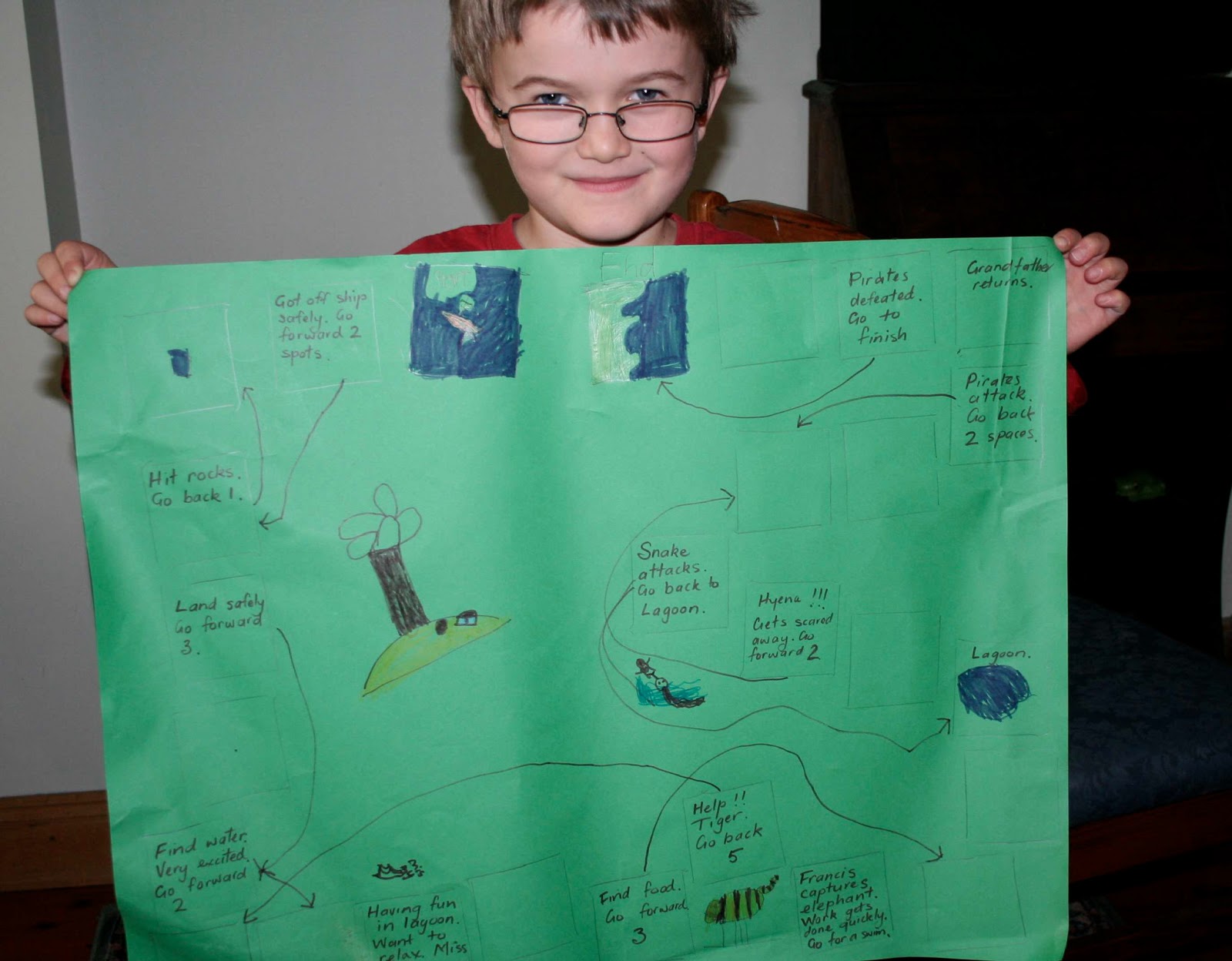
Sam (age 7) holding his 'Swiss Family Robinson' game
Imaginative recreation is an essential part of learning. By re-creation I mean the reconstruction, presentation or retelling of a story in new ways. The story might have been experienced firsthand (e.g. an event, eye witness account, careful observation), seen as a film, video or TV program, heard or read.
Story in its own right is critical to
learning, communication and well-being. This is something that I've written about many times (for example HERE & HERE). For children, the re-creation or reliving of a story
is a critical part of their growing knowledge of narrative as well as a way to gain knowledge.
Lydia reading with her Dad
From
a very early age, children begin in various play situations to
experiment with story in the form of literature, song, film or even
real-life accounts. My youngest granddaughter Lydia has been fascinated by story since her first year of life. Now as she reaches the age of two, re-creation is a big part of her everyday play. She uses Little People characters, toys and objects of all kinds (even her knife & fork!) to tell stories. Not all of her stories are re-creations, many are highly original and involve the use of varied objects to apply names and roles in situations that she creates. But story for her is stimulated by television (e.g. 'Everything's Rosie', 'Charlie and Lola', 'In the Night Garden') as well as books.
Young children often quite naturally use re-creation to support and play
with story. Other children need help and encouragement to do this. Re-creation can be seen in children's experience of story in varied
ways, for example:
Changing rhymes and songs, e.g. 'Baa Baa Black Sheep' to 'Baa Baa White Sheep' as Lydia does often. Acting out 'Little Red Riding Hood' with the resources of the dress-up box and some friends.
Dramatizing a well-known children's song from television or CD or a children's picture book.
Using art or drawing to imagine a story character, mythical creature or story setting.
Using Lego (or other toys, props and objects) to re-imagine story alone or with others.
Creating something new that grows out of an experience of story.
Recently, another of my grandchildren, Samuel (aged 7 and pictured at the beginning of the post) watched the movie 'Swiss Family Robinson' (1960) with me. The story is based on a novel written by Johann David Wyss in 1813 (in reality he rewrote the original version of the story of his father Johann David Wyss). It tells of a family that is shipwrecked in the East Indies on route to Australia. They face many challenges but manage to create a tree house, gather and grow food and survive.
Sam was captivated by the video and watched it at least 6 times while staying with us. He began drawing some things based on the story and wanted to talk about it often: "I wish we could build a tree house". His grandmother suggested that he make up a game about the story. He eagerly took up the suggested idea and with some simple advice from his about the form the game might take, he began creating his board game version of the film. The game was based on the shipwreck and the family fleeing the ship for the island. He suggested that he'd do a second game for the defense of the island and the attack of the pirates. The game was played with dice and buttons for markers. Players moved forward and often landed on squares that either offered chances for progression or regression. For example, 'Hit rocks, go back 1', 'Pirates defeated, go to finish', 'Help, tiger! Go back 5'. It was a wonderful re-creation of the opening scenes of the movie.
Close-up of Sam's Game
But why is re-creation so important? Is it more than 'just' play? As an aside, I've written much about the special value of play HERE. If
it were 'just play' it would still have an important role to play in
any child's intellectual development. But, imaginative recreation does
many things to support language and literacy. It helps children to:
Play with and understand the complexities of plot development.
Comprehend any story at much greater depth.
Understand character development in new ways.
Enter 'into' a setting as they create an imagined version of the setting and events of a story.
Understand story in three dimensions.
Appreciate the way the language of story is shaped by, and in turn shapes, characters, settings and plots.
In short, imaginative re-creation is a powerful learning
strategy for children that stretches them as language users and
learners.
Examples of Imaginative Re-creation by Age Group
a) Toddlers (1-3 years)
Being encouraged to be a wild thing as the story 'Where the Wild Things Are' reaches the critical moment when Max declares 'Let the wild rumpus start'.
Finger Plays and rhymes ('This Little Piggy', 'Incy Wincy', 'Round and Round the Garden')
Retelling Thomas the Tank Engine stories using the various engines that feature in the story.
Using dolls or soft toys to act out domestic scenarios. Using dress-up clothes in association with well-known stories.
Creating a story using toy soldiers, Polly Pocket toys, magnetic boards with characters, fuzzy felt and so on.
Joining in the television dramatization of a well-known story on a program like 'Playschool'.
b) Early years (4-6 years)
Many of the better story apps for iPad or android devices are an
innovative way for multiple re-created experiences of stories (see my
recent post on this HERE).
Drawing maps, key characters (dragons, people) or scenes.
Acting out stories with a group of children or with adult family members.
Creating an adapted text to re-create part of a story (e.g. poetry, a
character interview, telling the story from a different point of view).
Using puppets to re-create a story.
Using modelling clay or craft materials to create characters to re-create and retell a story.
Creating knights for storytelling
c) Later childhood (7-12 years)
More elaborate dramatization, with involvement in making props and costumes.
Simple animations using one of the programs readily available (see my previous post on animation HERE).
Using materials like Lego to re-imagine a well-known story.
Creating a board game that recreates the plot or a specific part of a story (as Sam did).
Creating a complex map or plot summary as a device for others to use.
Create a script to be acted for a specific part of a story.
Write a newspaper report based on an event within a story.
Indigenous
Australians were the original inhabitants of the continent we know
today as Australia. They include Aboriginal Australians and Torres
Strait Islanders. Together they make up 2.5% of Australia's population
today. It is believed that they are amongst the oldest races on earth
with estimates suggesting that they first arrived on this continent
between 40,000 and 125,000 years ago. They are an ancient people with a
rich and unique culture. There is enormous diversity across the many
nations and clans, with an estimated 250-300 spoken languages with 600
dialects. Sadly fewer than 200 of these languages remain and most are in
danger of being lost. Like many non-Indigenous Australians I see the
preservation of Indigenous languages and their stories as of critical
importance. While travelling in Central Australia last year this was
brought into sharp focus for me.
An encounter with the 'The Three Caterpillars'
Mparntwe or Alice Springs is home to the Arrernte
people, Indigenous Australians who have called this beautiful place
home for at least 45,000 years. It is at the geographical centre of
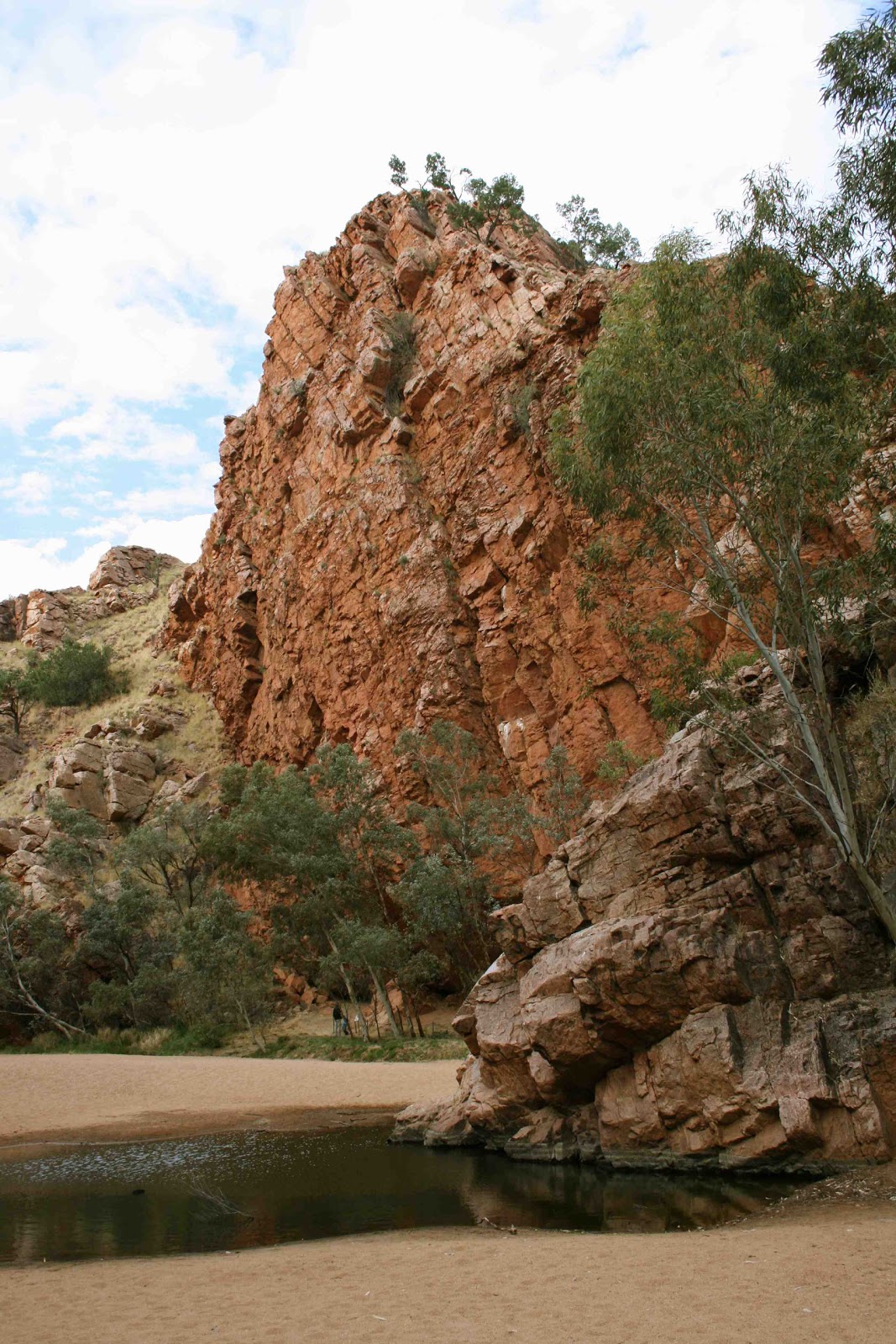
Australia. The photo opposite is of a place called 'Emily Gap'. At this place I was able to view Indigenous rock art that tells the story of how three
caterpillars named Yeperenye, Ntyarlke and Utnerrengatye created the MacDonnell Ranges.
The
Arrernte people, believe the ranges were formed by giant caterpillars
that entered this world through one of the gaps in the escarpment of the
area. In traditional stories the caterpillar ancestors, Yeperenye,
Utnerrengatye and Ntyarlke are the major creation forces of the Alice
Springs area. These stories tell how they arrived from all directions,
first stopping at Mparntwe, a particularly sacred site in Alice Springs,
where they battled with the Irlperenye (green stink bug).
'Three Caterpillars' - Emily Gap
The Caterpillars fled when the Irlperenye (stink bug)
started to kill them. The ranges around Alice Springs are the seen as
the remains of the many caterpillars. The gaps in the ranges like Emily
Gap indicate where the stink bugs tore the heads from the bodies of the
caterpillars. The rock formations around the area are and the few
surviving Yeperenye went on to sculpt the rivers and trees along the
tops of the ranges.
'The Three Caterpillars' were
painted on the cliff face at some point in time. The dark red and light
orange stripes were created by red ochre and white lime blended with
animals fats and applied to the rock surface.
Indigenous Dreamtime
stories are associated with specific Indigenous clans and nations and
their lands and these stories are passed on to younger generations by
elders and storytellers. They have survived for thousands of years but
the loss of traditional languages and the separation of many Indigenous
people from their traditional land is a threat to their survival. While
some of these stories are secret, or are seen as of such a sacred
nature that they are only told by specific people
(e.g. told by men to men, or by women to women), in the last 40 years
many Indigenous Dreamtime stories have been shared through children's
books.
As a non-Indigenous Australian I love these
stories and read them to my children and grandchildren from a very young age. I would like to see more of them written down by the people
who own these stories so that others can enjoy them. Thankfully, many
are being recorded but just as many aren't. For example, to date I
haven't come across a written version of 'The Three Caterpillars' that I
learned of when exploring Alice Springs.
Some of my favourite Indigenous Stories
Some
of my favourite Indigenous Dreamtime stories have been passed down to
all Australian children through the storytelling and wonderful art of
Dick Roughsey
(1924-1985) or Goobalathaldin to use his tribal name. He was from the
island of Langu-narnji in the Gulf of Carpentaria in northern
Australia. His first picture book 'The Giant Devil Dingo'
received wide acclaim for the richness of the storytelling, the
distinctiveness of his painted illustrations, with their vibrant
colours, fascinating detail, and the integration of art and word. It
tells of Old Eelgin, the grasshopper woman who was evil and had taught
her giant dingo Gaiya to kill men for food. But one day Gaiya meets his
match in the Chooku-Chooku (butcher-bird) brothers.
Another of my favourite works by Roughsey is 'The Rainbow Serpent' first published in 1975 and still available. It won the Children's Book Council of Australia
award for best picture book in 1976. Goorialla (the Rainbow Serpent)
travelled across Australia to find his tribe. As he travelled his tracks
formed the mountains, the creeks, lagoons and rivers. The Bil-bil
brothers plot to kill him. When Goorialla's anger is spent and he
disappears into the sea the world is changed.
Dick Roughsey and Percy Trezise
(1923-2005) formed a strong partnership to produce many wonderful books
together. While Trezise was not Indigenous he became Roughsey's brother
in a traditional Aboriginal ceremony and was given the name 'Warrenby'.
Roughsey lived with his wife and their six children on Mornington
Island, but often spent half the year on the North Queensland mainland.
He and Percy Trezise discovered and studied the art of Aboriginal cave
galleries in the Laura region of Cape York. The Quinkin gallery
inspired the award-winning books 'The Quinkins' and 'Turramulli' the
'Giant Quinkin'.
'The Quinkins' is a wonderful story that tells of the Yalanji tribe of Cape York
and their encounters with the Quinkins, spirit people of the land with
two tribes: Imjim and the Timara. Imjim were small fat-bellied fellows
who stole children while Timara were funny and whimsical spirits who
like to play tricks. They were tall and very thin and lived in the
cracks of the rocks, and they didn't like the Imjim. This is the story
of two children, Boonbalbee and Leealin. This book was an IBBY Honour
book in 1980, and was the Children's Book Council Book of Australia
Picture Book of the Year in 1979. As I travelled through northern
Australia and looked at the crevices in the rocks the echoes of this
story made me think, "could these be Quinkin rocks?"
There are so many of their titles that I love and have enjoyed sharing with children. These include 'The Cave Painters'
by Percy Trezise (1988) which tells of the experiences of two Bullanji
children Nonda and Mayli as they travel to visit their mother's people,
the Yalanji who live in 'Quinkin Country'. 'The Magic Firesticks'
(Trezise & Roughsey) is another story of the Yalanji people in
Cape York and tells how the people discovered the way to light fires,
not simply sustain fires once they were alight. After monsoonal fires
quenched all their fires two young men (Bandicoot and Curlew) travel to a
far off Fire Mountain where it was said Didmunja (a wise man) had magic
sticks which could produce fire when you wanted it.
'Banana Bird and the Snake Man'
(Trezise & Roughsey) tells of a time when people who were later
to become birds, animals, plants and reptiles were still in human form.
The snake men of Cape York were cannibals who would kill people and
hang them in trees to be collected later when they were hungry. This
story tells of the triumph of Coucal the brother of Banana Bird man who
avenges his brother's death and destroys the Snake men.
Another wonderfully simple book is 'When the snake bites the sun' told by David (Bungal) Mowaljarlai,
which was retold and illustrated by Pamela Lofts. This delightful story
of the Ngarinyin tribe of Western Australia, tells the story of the sun
and why it is as it is today. This was one of a series of simple
picture books for preschool children produced in the 1980s some of which
are still available. Other books in the series included 'Dunbi the owl', 'Echidna and the shade tree' and 'How the birds got their colours'. We owe Pamela Lofts (who lives in Alice Springs) a great debt for recording and illustrating many Indigenous stories. You can find a full list here.
Tiddalik Rock (Wollombi NSW)
'What made Tiddalik Laugh' has been produced in various versions of varied authenticity. It is based on the 'Cylorana platycephala'
(or Water-holding Frog) that swells as it swallows water. It is
sometimes referred to as 'Molok' as well as 'Tiddalik'. The version I
first read was Joanna Troughton's
beautifully (and amusingly) illustrated version, although this might
not be the most authentic traditional version of the story. Tiddalik
woke up one morning with an unquenchable thirst. He began to drink all
the fresh water he could find till he was satisfied and every creek and
billabong was dry. All the creatures and plant life began to die, so the
other animals decided to do something about it. But how could they get
the water back? Wombat had the answer, make him laugh? But how? The
amusing solution involved Platypus in Troughton's version of the story.
The story is said to have originated in South Gippsland Victoria but is
common along the Eastern seaboard of Australia, so this is unclear. The
photo of this rock (opposite) known as Tiddalik rock is located near Wollombi in NSW.
'Enora and the Black Crane', by Arone Raymond Meeks
is another fine example of a traditional story being turned into a
picture book. Arone Meeks is a member of the Kokoimudji tribe from the
Laura area of far North Queensland. This story tells of Enora and how
his killing of a crane led to birds acquiring their colours and him
becoming the black crane. Winner of Australian IBBY Award for Children's Literature (1994), CBCA picture book of the year (1992) and UNICEF Ezra Jack Keats
International Award Silver medal (1992). Arone Meeks also illustrated
Catherine Berndt's wonderful book 'Pheasant and Kingfisher' (1987) that
was shortlisted by the CBCA in 1988 and won the Crichton Award for Meeks
in the same year.
A more recent book which I love is the 'Papunya School Book of Country and History'
(2001). This isn't really a Dreamtime story, it is the story of the
Anagu people of Central Australia. It offers a balanced telling of the
people, their place, their culture and history. It does a good job in
speaking of some of the difficult issues arising from the impact of
white settlers. It is a wonderful collaboration between well-known
non-Indigenous advocate Nadia Wheatley and Indigenous writers,
storytellers and artists from the staff and students of Papunya School.
Another more recent community collaboration is 'Our World: Bardi Jaawi: Life At Ardiyooloon'
(2011) by One Arm Point Remote Community School. Ardiyooloon is home
to the Bardi-Jaawi people and sits at the end of a red dirt road at
the top of the Dampier Peninsula, 200km north of Broome in the
north-west of Western Australia. 'Our World: Bardi-Jaawi Life at
Ardiyooloon' takes readers inside the lives of the children of a remote
Indigenous community; lives that are very different to those
experienced by most Australians. Worthy Honour book in the CBCA awards
for 2011 in the 'Eve Pownall Award' for Information Books.
Yet another wonderful collaborative book is 'Playground' (2011) compiled by Nadia Wheatley
with illustrations and design by Ken Searle, has been short-listed for
the 2011 Children's Book Council of Australia (CBCA) Awards. This is an
unusual book isn't quite a graphic novel, but then again, it isn't
simply a reference book. Drawing on the stories of 80 Indigenous
Australian Elders, 20 Indigenous secondary students and with Indigenous
Historian Dr Jackie Huggins as adviser and critical friend, Nadia
Wheatley has created a unique collaborative work. The book offers a
wonderful insight into experiences of childhood for Aboriginal and
Torres Strait Islander people from 1900 to the present.
With
stunning photographs and illustrations, it takes us into the daily
life of Indigenous children (past and present) who are connected with
their land from birth. The stories and drawings help the reader to
understand Indigenous life in all its facets - learning, playing,
understanding and respecting the earth, the first days of life,
relationships in families, what 'home' was, languages, daily food
gathering and hunting, the place of song, dance, art and ceremony.
With the arrival of European people there have been adaptations, but
Indigenous children remain embedded in their culture. Daily life is
different, but Indigenous children are still learning from country and
community. This book would be a good introduction for readers who want
to know more about Indigenous people not simply read their stories.
Some other great resources
Based on an Aboriginal Dreamtime story of Waatji Pulyeri (the Blue Wren)
Lovely example of Indigenous Storytelling, 'How the Kangaroo Got its Pouch' A Wirrajuri tale
Some brief further notes on Indigenous Australians
In
Central Australia the Indigenous people are called the Anangu. Within
this group there are many different language groups including the
Pintupi, Warlpiri, Anmatyerre, Pitjantjatjara and Arrente. All
Indigenous Australians come from different 'Ngurra' (homelands or
traditional countries) and within their rich cultural traditions have
stories, drawings, dances other cultural practices that have been passed
down through the generations for millennia. There has been a wonderful
balance and 'bond' between people and their land. They see their
ancestors as their teachers and for thousands of years they have taught
their children the knowledge of ancestors and a history seen within the
very rocks, water courses, hills, fauna and flora of their place. This
has been passed down often (but not exclusively) through story. Often
these stories are told in the context of place and have been oral, but
in the last century some of these stories have been written down so that
they can enrich all people, even if perhaps not understanding their
full significance.
There is a deep sadness that many
non-Indigenous Australians feel that there has been some loss of
language and stories of these unique people. It was with a mixture of
joy and sadness that I caught glimpses of the rich connection between
Indigenous people and their land while I travelled across Central
Australia. The joy comes from the richness I could see in this
connection, but the sadness is that for many Indigenous Australians this
connection is made more difficult by their dislocation from traditional
lands. My hope is that more Indigenous stories will be captured in
written and spoken forms.
Note: * This is a revised version of a post I wrote in 2011
Charlotte Lance is the author and illustrator of a delightful new picture book call 'A Really Super Hero' published by Allen & Unwin (2013).
Charlotte is from Melbourne. She freelanced as an illustrator and graphic designer after she graduated from Melbourne's NMIT in 2004. She has been working as an illustrator for the last five years. This has been mainly in book publishing, but she also has an illustrated children's
T-shirt label 'BOY GIRL'. She sells selected work as prints, and
occasionally exhibits her work.
'A Really Super Hero' is her first author/illustrated work and is a wonderful first book in that sense. This is a book that connects with the experiences of virtually every child and of course their parents. In the words of Charlotte in my interview with her below, this story is "purely and simply about the way children can make the everyday and
the ordinary feel extraordinary." With the inevitable response of their parents being
"...to stare, one eyebrow up, with their ‘get-real’ eyes". It might just be that I love this book because as a grandparent I get to put the capes on as well! No eyebrow raising in my house when super heroes appear.
The language of Charlotte's text has a narrative verse form that catches your attention from the first stanza:
'I want to be a hero
and a REALLY SUPER one,
so my mum sewed my undies
with an S upon the bum'
The illustrations are detailed line drawings with wash used sparingly so that as 'reader' you are drawn to the characters, and in particular, their actions, manner and personality. The characters are so believable and so appealing. Children who read this book will be able to see themselves and the adults who love them. This is a wonderful book from a talented illustrator and writer.
On the strength of this wonderful first book I was quick to seek an opportunity to do a blog interview with Charlotte. The quality of this her first authored (as well as illustrated) book, and the answers to my questions, suggest that we can expect many more fine books from this author/illustrator that children will love.
1. TC: "What contributed most to your love of story in your childhood years?"
It’s probably a boring answer but stories and more specifically storytelling can take you to places that are not your here and now. As little ones we dream of all sorts of things that can’t come to life in our real worlds, from very simple things to big crazy dreams. For me it was simple things and the details. The colour of the walls in my imaginary house, the blankets on my imaginary bed. It’s a way of making what is in your head come true. And so now I still write stories for myself.
2. TC: "Could you tell me a little about the inspiration for ‘A Really Super Hero’?"
A Really Super Hero is purely and simply about the way children can make the everyday and the ordinary feel extraordinary. And then, the dreary old parents have to stare, one eyebrow up, with their ‘get-real’ eyes. Luckily this means absolutely nothing to the beautiful mind! ‘A Really Super Hero’ is just a bit of fun and silliness.
3. TC: "As a relatively new illustrator of children’s books and an even more recent author, could I ask do you see yourself primarily as an illustrator or do you want to do more writing?"
I see myself continuing to do both. Illustration, which is what I trained to do, has always been about storytelling. It makes sense to me that I do both. Whether or not that is just my view we’ll have to see!
4. TC: "Your ‘super hero’ in your new book ‘A Really Super Hero’ is a quirky and feisty young woman. Is there an inspiration for this wonderful character?"
Well yes, I’d like to say that it’s me, ‘quirky and feisty’, but in fact it’s me, clumsy and slightly ridiculous. As well as lots of our little ones who blindly storm through the obvious (to others) chaos created by their robust imaginations. To be the person who just continues on regardless of suspected hopelessness is something to be proud of yes?
5. TC: " Poetry seems to have become more popular of late to offer a narrative account in picture books. Is there a particular reason why you have used it?"
There’s no particular reason. I did grow up loving the rhythm of Roald Dahl’s books. Actually whether they were in rhyme or not they were almost musical. Maybe that has something to do with it. ‘A Really Super Hero’ just seemed to come out that way. My next book is not in rhyme though. 6. TC: "What is the best response you've ever had to your illustrative and creative work?"
It was just recently, somebody said that one of my illustrations made her feel as though she had seen it in her childhood, that it felt familiar. Unless I unknowingly ripped somebody off, this is about as good a compliment as I could receive because it’s how I feel when I draw them.
7. TC: "Do you have other book projects on the drawing board?"
I am working on my next book with Allen and Unwin, ‘An Inconvenient Dog.' I also have a few projects that I want to do just for fun, I’m animating my own stories and illustrations. Why not?
8. TC: "Do you enjoy reading and poetry? On a long haul flight to London, which two books would you take?"
I love it, but haven’t done enough of it lately. I have two little kids so my long haul to London may well be a rotation of Batman and Spiderman…. and once they were asleep I think I’d go for Jane Austen. Beautiful, so easy to read and a little bit magical.
9. TC: "Who or what has been the most significant influence on your creative work?"
That’s a hard one, I definitely have my favourite illustrators, Quentin Blake, Janet Ahlberg, John Birmingham (these have not changed from childhood) and Roald Dahl I think for the magic of storytelling. And my mum for having a sort of creativeness that comes from heaven. She’s a genius. If she makes ‘that face’ when she looks at my work, then it must be crap. Truly, not joking, it goes in the bin. I try to avoid showing her anything, ever. Ever.
Charlotte's responses above should be enough to make you hunt for her book but when you see the book you'll be glad that you did. Watch out for this young illustrator and author her next work, 'An Inconvenient Dog' to be published by Allen & Unwin.
Other relevant posts
Have a look at my other 'Author and Illustrator Focus' posts HERE
There are many good reasons to implement daily writing workshops classrooms. Probably most important amongst these is that they offer
the opportunity for children to experience writing as process not just as product. That is,
to understand that writing is something that has to be worked on if it
is to communicate with and engage readers. Young writers need to
experience writing as craft, something that requires hard work,
revision, research, planning, careful use of language and a sense of
purpose and audience. But Katie Wood Ray
reminds us in this short video that there is something even more basic
that writing workshops offer - the chance to develop stamina.
I
had the chance to see such 'stamina' demonstrated as part of a research project when team
teaching on a Grade 1 class with an outstanding teacher, Inta Gollasch. I spent most
of the year in Inta's class observing the literacy behaviour of her
children (I have written about this in detail on my book 'Pathways to Literacy'). The language story that follows illustrates a number of other
good reasons for having daily writing workshops in classrooms. Inta's approach to writing workshop was simple, she provided:
Time each day when children were encouraged to write about topics of their choosing.
Folders in which they kept their draft materials and lots of writing materials.
Opportunities for the children to share their writing with others when the need arose.
Individual teacher conferences for children when needed (but at least weekly).
Varied opportunities for the children to publish and share their writing with larger audiences.
Help with publishing when the young writers wanted to pit their work into some more permanent form.
On the first day in the classroom I observed a boy named Brock eagerly writing in a "magic cave" constructed as a retreat area.I stopped to ask how he came up with this idea for his story.He replied:
"Well, it was like Chlorissa. (She wrote about) that book (The Enchanted Wood) that had children who moved to the country.I changed it around."
Brock's piece based on the The Enchanted Wood (Blyton, 1939) was primed (at least in part) by the fact that Chlorissa had done this earlier.
The teacher's reading of these books had a strong influence upon the writing of children in the classroom.This showed itself in the students' narrative writing, in playground games, in letter writing and even at home.In all, ten 'Blyton type' stories were written in this classroom during the year.
Chlorissa's
writing that had inspired Brock and others to write their own Faraway
Tree stories was begun in June (mid school year in Australia). She was
still writing it at the end of the school year (December).By
this time the story was 20 pages long and Chlorissa had stuck each of
the pages together to form a scroll, that could stretch almost across
the width of the classroom (something she liked to demonstrate at the end of
every writing session).
Chlorissa's
writing demonstrates what Katie Wood Ray was talking about; daily
writing workshops can help children to develop stamina. This is stamina
of two kinds, first, the ability just to stick at a task for a long
period of time (30 minutes each day). Second, the ability to keep coming
back to the same task day after day. This is one of the key skills of
the writer, sticking with the writing task - stamina!
But I think the language story also demonstrates a few other things as well:
1. Writing workshop can encourage children to learn about the craft of writing.
2. It offers opportunities for young writers to write for 'real' audiences.
3. The sharing of writing can inspire other young writers.
4. Books are an important source of inspiration for young writers.
The Children's Book Council of Australia (CBCA) shortlist has been announced, as has the list of 'Notable' books. The awards will be announced in Children's Book Week on the 17th August. The theme this year is 'Read across the universe'. As usual, there are many wonderful books. I will review the winners and honour books in Book Week, but below you will find all the books shortlisted and links to help you find them. Please don't be put off by the fact that some sites list the books as unavailable. This is common just after the shortlist is announced as major books shops quickly buy up the first print run. New stock typically comes in quite soon.
The shortlist is a valuable guide to book purchases but there many other wonderful books published each year. As a result the CBCA also publishes a Notable Book List
that has over 100 titles listed. Standards are high so these are always wonderful books as well.
Shortlist for 'Older Readers' category (Young Adult Readers)
Shortlist for 'Picture Books' category (Varied ages, Birth to 18 years)
'The Coat' illustrated by Ron Brooks and written by Julie Hunt (Allen & Unwin)
'Tanglewood' illustrated by Vivienne Goodman and written by Margaret Wild (Omnibus)
'Herman and Rosie' by Gus Gordon (Viking)
'Sophie Scott Goes South' by Alison Lester (Viking)
'Lightning Jack' illustrated by Patricia Mullins and written by Glenda Millard (Scholastic)
'A Day to Remember' illustrated by Mark Wilson and written by Jackie French (Angus & Robertson).
Short list for 'Eve Pownall Award for Information Books' category (Varied ages, Birth to 18 years)