Friday, July 4, 2014

Experiencing Poetry Rather Than 'Torturing' It!

I've written before about the power of poetry (HERE) and regularly review good poetry books on this blog. Poetry is to be read, listened to, experienced and enjoyed. It can amuse, entertain, challenge, teach and change us. Our aim as teachers and parents should be to seek to share good poetry often, and help children to 'experience' poems as significant literary and life events. Ariel Sacks recently wrote a great post in which she reminded us of this simple truth. In response to the post one of her readers in turn reminded us of Billy Collins great poem on poetry (William Collins was Poet Laureate of the United States from 2001 to 2003). In it he challenges us to avoid the temptation to beat a poem to death rather than experiencing and enjoying it.

I ask them to take a poem
and hold it up to the light
like a colour slide
or press an ear against its hive.
I say drop a mouse into a poem
and watch him probe his way out,
or walk inside the poem's room
and feel the walls for a light switch.
I want them to waterski
across the surface of a poem
waving at the author's name on the shore.
But all they want to do
is tie the poem to a chair with rope
and torture a confession out of it.
They begin beating it with a hose
to find out what it really means.

Billy Collins, 1988

If you are looking for some good poetry for children aged 5-12 years here is an excellent recent list Some would suit older readers, and 'Wayling' is certainly for older readers. The Centre for Excellence in Primary Education (CLPE) has an annual award for poetry written for children.  This UK charity promotes the effective teaching of children’s literacy and emphasises the importance of children’s literature. The award is presented annually, usually in July, for a book of poetry published in the preceding year. Here is the excellent shortlist.

Poems to Perform, Julia Donaldson (editor), illustrated by Clare Melinsky (Macmillan)

This is a careful selection of poems, both familiar and new, that lend themselves to being performed in a range of collaborative ways. Progress through the book is subtly themed: gliding through poems about school, football, food and many other matters. It offers succinct suggestions for how they could be presented both verbally and dramatically at the back, leaving plenty of scope for teachers and pupils to make their interpretations. The judges felt that the poems in the anthology had been really carefully chosen and selected to reflect the best of poems to perform across a broad range of time, poets and styles. The poems range from classics by Edward Lear, W H Auden, and Eleanor Farjeon, to contemporary work by Michael Rosen, John Agard, and Clare Bevan. It is illustrated throughout with exquisite, expressive lino-cuts, this is a book for teachers, parents and children; in fact anyone who loves great poetry. I bought this to use with children myself! The descriptions are edited versions of the judge's comments on each book.

The Dragon with a Big Nose, by Kathy Henderson (Frances Lincoln)

This collection was chosen because the judges particularly liked the city poems and how these really captured the feel and vibrancy of urban life. These are odes to the urban environment - its buildings, its transport, the people and creatures that inhabit it and the effects of weather on it. The dragon on the cover disguises the contents although fantasy and reality converge in poems like ‘Under the Stairs’ and many of them describe wonder in the apparently ordinary. The child’s eye viewpoint is foremost and this contributes to this being that rare commodity – a single poet collection for younger children. The poet’s own illustrations work wonderfully with the text.

Bookside Down, by Joanne Limburg (Salt Publishing)

This is Joanne Limburg’s first collection for children. It has a unique and contemporary feel, catching the voice and ear of the intended audience providing thoughtful observations of modern childhood. What happens if you read a book while standing on your head? Dare to discover the answer within these poems that provide a fresh take on school and family life, complete with computapets and a Wii with a Mii channel. Take a prefix lesson that doesn’t deal with grammar too seriously while requiring some understanding to get the joke. Sample the mouth-watering potatoes Dad cooks, tantalising all your senses ‘for truly they are epic’. Don’t lose your temper or you may find important things are lost too.


Wayland. The Tale of the Smith from the Far North, by Tony Mitton, illustrated by John Lawrence (David Fickling Books)

'Wayland' was chosen by the judges for the mastery of the form, its epic nature and the beauty of it as a complete piece of art, poetry and legend. This verse retells the legend of a master blacksmith who fashions such ‘wonderful ware’ that he is captured by a king. It is a tour de force. Readers are quickly drawn into this 'story' set in a landscape of forests and mountains depicted in John Lawrence’s extraordinary engravings. The whole work is stunningly sustained in rhyming four line stanzas. There is lust and violence at the centre of this saga and neither poet nor illustrator shirk from portraying these – so this is definitely a publication for older children. There is the love of Wayland for his Swan-Maiden and beauty in the way words and pictures reunite them.

Cosmic Disco, by Grace Nichols, illustrated by Alice Wright (Frances Lincoln)

This is a collection of poetry with beautiful rhythms, language and imagery that Grace Nichols always captures with such mastery. This collection whirls us out into the cosmos to dance ‘in the endless El Dorado of stars stars stars’ and back again to ‘that little old blue ball spinning in the corner over yonder’. Nature is personified in many guises. Lady Winter raps out a warning and chastises a cheeky robin. Autumn is a knight with ‘cape of rustling ochre, gold and brown’ and ‘spurs made of sprigs’ and ‘medals made of conkers’. Colours speak, giving persuasive arguments why the artist should choose each one of them. Venus is addressed majestically and a ‘star that time forgot’ given a new name.


Thursday, June 26, 2014

Why dialogue is important to comprehension development

This is a reprise of a post I wrote in 2011, which was based on an idea I first devised in the 1980s. Back then I was challenging teachers to consider the importance of what I called 'Text Talk'. I wrote about it at the time in a number of publications, including my book 'Teaching Reading Comprehension: Meaning Makers at Work' (Continuum). I was trying to challenge teachers to consider using more than just the classic IRE form of questioning. The Initiate-Response-Evaluate (IRE) approach is probably the most common approach to comprehension. Typically, the teacher leads a discussions and asks questions to which a response is elicited and then evaluated by the teacher (and sometimes students). It is useful to test factual knowledge, or recall. It can also be used to attempt higher order questioning, but it rarely seems to in classrooms. I've written other posts on questioning (see HERE) that you might consider. But in this post I simply want to remind teachers and parents that testing comprehension doesn't do much to enhance or improve comprehension.

What do I mean by 'Text Talk'?

Above: Reading to my grandchildren. Lot's of Text Talk here
'Text Talk' means more than the teacher or parent talking to children about books, or asking them questions designed to elicit information. Rather, Text Talk requires the teacher or parent and children to have dialogue or conversation about reader understanding or meanings as they share a book, watch a film, observe some event and so on. It is used to tease out the knowledge and meaning that a text, image, movie or event offers. It's about tussling with, interpreting and even critiquing what the creator of the book or film has sought to communicate. 

Text Talk as an alternative to IRE questioning offers more space for children to share ideas and meanings, and offers them opportunities to grow understanding beyond a single idea or focus. The role is varied, but in essence, still simple and if led by the teacher involves:

a) Providing background information if necessary and appropriate.
b) Eliciting responses from readers to the text.
c) Suggesting alternative strategies for making meaning.
d) Sharing insights about reading and language.
e) Supporting and assessing student efforts to construct meaning.
g) Asking questions that expand knowledge and insight, rather than simply testing it. 
g) Introducing new forms of language and alternative purposes for reading.

Of course, while such discussions often need a facilitator, there is a place for students to fill this role. In this way different voices and ideas are sometimes heard and more students tend to engage rather than the most vocal few.

When teachers try to support comprehension, they can assume varying roles, ranging from some which are heavily teacher-centred and text dependent, to those that are child-centred and reader dependent. At times teachers will adopt a questioning role, but at other times they will provide support in the form of knowledge, alternative strategies etc. These roles are not mutually exclusive, nor is one approach right and the other wrong (although implementation of both can be good and poor). What is needed is balance and, above all, true conversation about books.

How should teachers talk to students about text?

One illustration of 'text talk' in action that I've used a lot is actually to be found in a children's novel 'The Great Gilly Hopkins' (Paterson, 1978). This story revolves around Gilly's struggles to adjust to life in yet another foster home, come to greater understanding of herself, and experience love for the first time. Within the story there is a delightful exchange between Gilly, Mrs Trotter (foster mother), Mr Randolph (a blind man who lives next door) and William Ernest, a younger mildly disabled foster child who lives also with Mrs Trotter.

After dinner one evening Mr Randolph asks Gilly to read some of Wordsworth's poetry to him. She reluctantly agrees, and finishes William Wordsworth's 'Ode on Intimations of Immortality from the Recollections of Childhood'. She sits down lost in her own inner anger and frustration. But Mr Randolph interrupts her thought:
'Well, what do you think of Mr Wordsworth, Miss Gilly?' asked Mr Randolph interrupting her angry thoughts.
'Stupid,' she said.....................A look of pain crossed his face. 'I suppose,' he said in his pinched, polite voice, 'in just one reading, one might....'
'Like here' - Gilly now felt forced to justify an opinion which she didn't in the least hold - 'like here at the end, "the meanest flower that blows". What in hell - what's that supposed to mean? Whoever heard of a "mean flower"?
Mr Randolph relaxed. 'The word mean has more than one definition, Miss Gilly. Here the poet is talking about humility, lowliness, not' - he laughed softly - 'not bad nature.'
Gilly flushed. 'I never saw a flower blow, either.'
'Dandelions.' They all turned to look at William Ernest, not only startled by the seldom-heard sound of his voice, but by the fact that all three had forgotten that he was even in the room. There he sat, cross-legged on the floor at the end of the couch, a near-sighted guru, blinking behind glasses.
'You hear that?' Trotter's voice boomed with triumph.
'Dandelions? Ain't that the smartest thing you ever heard? Ain't it?' W.E. ducked his head behind the cover of the couch arm.
'That is probably exactly the flower that Mr Wordsworth meant,' Mr Randolph said. 'Surely it is the lowliest flower of all.'
'Meanest flower there is,' agreed Trotter happily. 'And they sure do blow, just like William Ernest says. They blow all over the place.'

This extract provides a perfect example of people talking about text and in the process increasing shared knowledge of the world, and their grasp of language.  As well, it creates interest and appreciation of an unfamiliar and more complex work than they could encounter and understand alone. Within it we see:
  • Mr Randolph providing access to a text beyond Gilly's experience.
  • How interaction and dialogue between individual people can facilitate learning.
  • How a 'teacher' can exercise quiet control through questioning and comment without stifling other voices and views (or just testing knowledge).
  • That the 'teacher' is not the only person with knowledge, and that insight can come from unlikely places (William Ernest).
  • Mr Randolph providing new knowledge in response to the Gilly's questions.
  • The excitement of Trotter as she witnesses the insight of William Ernest, and her affirmation of support for him as a person and a learner.
Text Talk and a more dialogic approach to reading comprehension, results when a teacher or parent has the sensitivity and insight to spot the teachable moment, to grapple for the right question, to know just when to provide new knowledge, or when to probe and prompt children to grasp new things.It can be used incidentally, or as the focus for whole lessons or group activities.

Related Posts

'Guiding Children's Learning' HERE
 Other posts on comprehension HERE

Monday, June 16, 2014

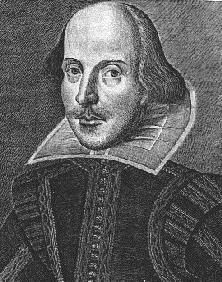
Getting Children of All Ages Excited About Shakespeare

I've written previously on this blog about the value of Shakespeare for children of all ages, even primary school children (HERE). I grew up in a home where books weren't read to or with me, so reading was not a pleasurable pursuit at home. So there was little chance that I was ever going to meet Shakespeare until forced to read it at High School. What a terrible way to be introduced to some of the world's greatest literature.  I found English classes boring and seemingly unrelated to my life.  Not surprisingly, I found Shakespeare's plays remote and of little interest. And yet later in life I began to appreciate and love Shakespeare's work.

But is it possible to make Shakespeare accessible for children as young as seven or eight years? Yes, I think it is! A good place to start is either with an abridged version of the great plays or using some of the wonderful prose versions of his work. A company in Sydney has even begun to present live Shakespeare to primary schools.

Bell Shakespeare has set itself the task of introducing primary aged children to Shakespeare's plays, with a plan to teach Shakespeare's work to children as young as six. The company wants to inspire a new generation to love the work. The company sees the program as a form or 'early intervention' where children will be helped to appreciate the complex and rich language of the great epic stories that are the foundation of Shakespeare's work.

Sixty- Minute Shakespeare

I have no doubt that in classrooms where children learn to love words, language and narrative, that they will find Shakespeare exciting, challenging and enriching. There are many resources that will help you. Recently, I had a look at Cass Foster's abridged versions of Shakespeare's plays. The 'Sixty-Minute Shakespeare' series is an ideal alternative for those who lack the time to tackle the unabridged versions. Professor Foster has carefully condensed (without modernizing) the rich poetic language of each play so that it can be completed in about 60 minutes. The abridged versions offer the excitement of Shakespeare's tales, as well as the wonderful imagery in the prose and verse.

Each edition also comes with detailed footnotes on nearly every page explaining the more arcane words and phrases to help the reader better understand and appreciate each play. You will also find practical suggestions for staging, pacing, and thematic exploration very useful. Each script is approximately 70 pages.

'Shakespeare's Hamlet' staged on the page by Nicki Greenberg

This is a remarkable and ambitious work from Nicki Greenberg for high school children. This imaginative and epic 415-page graphic novel will excite many teenage readers. Hamlet has become an expressive black inkblot whose form changes shape according to his circumstances and mood. This is not a kid's picture book! Rather, it is one more attempt to present Shakespeare in new forms. Not just to make it more accessible (for some might find some other word-only attempts less challenging) but to tell it afresh.

There is no doubt that Greenberg’s Hamlet is unique. At 400+ pages it is hardly an easy 'read'. But might it not help the young uninitiated reader of Shakespeare to see new things? Only readers 13+ will be able to help us to answer this question.

The language of Shakespeare is given new emphasis as the play is performed on paper. This is a play 'staged' in a book as the title suggests.  It is a very interesting book but I can't help but feel that a retelling like Leon Garfield’s Shakespeare Stories (see below) is not a better way in. It is hardly stuff for the poor reader, but more likely the gifted who wants to experience Shakespeare with new depth and relevance. It might just do this for some.

Joint winner of the Children's Book Council of Australia (CBCA) Picture Book of the Year 2011

Photo courtesy of the Guardian

Prose Forms for Young Children

You don't need a theatre company to help you to introduce Shakespeare to young children. One of the easiest ways to get young children interested in Shakespeare's work is to read some of his plays in adapted prose form. While there are some pretty awful attempts to do this, the collections written by Leon Garfield are superb. His first collection 'Shakespeare Stories' was illustrated by Michael Foreman and published by Gollancz in 1984. It features 12 of Shakespeare's best-known works, including 'Twelfth Night', 'The Taming of the Shrew', 'A Midsummer Night's Dream' and 'Macbeth'. Garfield is a brilliant writer of children's fiction and so if anyone was to tackle this project, he would surely be the most likely to succeed in presenting the plays with as much complete dialogue as possible but with adaptations that make the works more accessible without detracting from the language, plots and characterisation of each play. This is how Garfield begins 'A Midsummer Night's Dream':
Hermia, who was small, dark and perfect, loved Lysander; and Lysander loved Hermia. What could have been better than that? At the same time, Helena, who was tall, fair and tearful, loved Demetrius.
But Demetrius did not love Helena. Instead he, too, loved Hermia...who did not love him. What could have been worse than that? 
Garfield's adaptations are engaging and faithful to the plays and if read well to children as young as 7 or 8 will capture their attention. I have used them with children or varied ages and they love to hear Garfield's versions of Shakespeare's work and they want to pick them up and read them. My daughter has also found the Garfield collections wonderful to use with her children aged 6-10.  She has written about this on her own blog (HERE).

A shorter collection, 'Six Shakespeare Stories' was published by Heinemann in 1994 and 'Six More Shakespeare Stories' in 1996.

Other resources

There are a number of other helpful resources and sites for teachers who want to try Shakespeare with children aged 6-12 years.

'Beautiful Stories from Shakespeare' was written by Edith Nesbit in 1907 and is still available in more recent editions (HERE)

A good BBC resource that offers children a simple introduction to Shakespeare and his work (HERE)

The 'Shakespeare 4 Kidz' site is worth a look. Their tag is "Bringing the world of Shakespeare to the young people of the world" (HERE)

'Shakespeare is Elementary' is a great little site developed by an elementary school (Crighton Park) in Novia Scotia Canada. It has some great ideas for getting started (HERE)

You can buy some scripts adapted for young children but I haven't personally tested them (HERE)

The 'Shakespeare for Kids' site also has some helpful advice for teachers using Shakespeare with primary/elementary school children (HERE)

Read more about the Bell Shakespeare work in Sydney HERE

Thursday, June 5, 2014

Britain's Top 10 Children's Books

While lists of great books, let alone 'best-loved' books, are fraught with problems, they do serve to remind us of books we might just have forgotten.  Yes, what we love will vary from adult to adult, and also from child to child, but this recently promoted list of 'Britain's best-loved children's books' is interesting as much for what isn't in it, as what did actually make the top 10. Interestingly, only one book in the top 10 was published in the last 25 years. I'd want to add a number of more recent books to my top 10. I suspect that 'Winnie The Pooh' wouldn't be number 1 in the US, but it might be in the top three in Australia. I have included a link to Lorna Bradbury's list of 100 top books below, which makes for interesting reading. I've also added some links at the end of the post to a number of sites that feature the choices made by children which tend to have a much more recent bias. I'd love to hear about books you'd like to see in the top 10.

1. Winnie The Pooh - AA Milne (1926)
2. Alice's Adventures In Wonderland - Lewis Carroll (1865)
3. The Very Hungry Caterpillar - Eric Carle (1969)
4. The Hobbit - JRR Tolkien (1937)
5. The Gruffalo - Julia Donaldson (1999)
6. Charlie And The Chocolate Factory - Roald Dahl (1964)
7. Black Beauty - Anna Sewell (1877)
8. Treasure Island - Robert Louis Stevenson (1883)
9. The BFG - Roald Dahl (1982)
10. The Lion, The Witch And The Wardrobe - CS Lewis (1950)

Lorna Bradbury's Top 100 Books for Children and Young Adults 
US Children's Book Council 'Children's Choices 2014' 
Young Australians Best Book Awards (YABBA)

Thursday, May 29, 2014

10 Great New Books for Children Aged 7-14 Years

1. 'Crooked Leg Road' by Jennifer Walsh (Allen & Unwin)


Whispered secrets, a missing boy, a hidden shack and a mysterious family ... the stage is set for another exciting, real-life adventure from the author of 'The Tunnels of Tarcoola'. 

It's the end of a long, hot summer, and mystery is the last thing on the minds of friends Kitty, David, Andrea and Martin. Then Andrea spots a strange van parked behind David's house, and a few days later, he disappears. Kitty is convinced he's been kidnapped - and that the secretive new boy has something to do with it - but David's family say he's safe. Only why won't they say where he's gone?

The friends don't know it, but they've stumbled on a sinister plot involving a criminal gang, a planned kidnap, and a school event that could go very, very wrong. This is an excellent and gripping tale that children aged 10-13 will enjoy.


2. 'Alexander Altman A10567' by Suzy Zail (Black Dog Books)

Alexander is a fourteen-year-old Jewish boy who has been sent to Auschwitz concentration camp during WWII. Here like others he must learn to trust others in order to survive. Like many Holocaust novels it is based on a true story. Like other Jewish people captured and imprisoned by the Nazis, Alexander's identity is taken from him and a number tattooed on his arm that he knows by heart - A10567. He knows that to survive Auschwitz, he has to be tough and at first trust no-one. But when he is given the job of breaking in the commander's new horse, he sees that their survival is linked to the survival of the soldiers' horses. Alexander sees the fear in the animals and seeks their trust. If he wins their trust he might just survive. 

This is a beautifully written and challenging story from an emerging writer that children aged 11 to 14 years will enjoy. Suzy Zail was previously a litigation lawyer, but now she writes full time. Her first novel for young adults, 'The Wrong Boy', was short-listed for the 2013 Children's Book Council of Australia Book of the Year Award in the Older Readers category.

3. 'No Stars to Wish On' by Zana Fraillon (Allen & Unwin)

A little boy's spirit shines amid some dark truths in this tender and memorable novel about being taken from home and put in an orphanage.

This is a fictional story that draws on knowledge of the experiences of institutionalized children; often called 'Australia’s Forgotten Generations'. Jack is a positive boy who is deaf and reads lips. In spite of his disability he remains optimistic about his possible return to his family. Like the other children in orphanages of the time, he has been taken due to the lack of care he had received at home. The Nuns who run the institution where Jack lives offer them a tough life where punishment is common.

There are many interesting characters in the novel, no doubt based on the experience of children in care. We meet Samson who was sent there by his mother, and Charlie who works in the laundry where he is regularly burnt by the copper used to heat water and clothes. Some children are even used for medical experiments. The work in the kitchen is hard and injury is common.  Jack's job is to clean the 'holes' where children were detained for additional punishment. This is a well-written book that tells an important story. It will be difficult to read for many but it is an important book that will help many to understand what once happened to orphaned and neglected children and the need to guard against such abuses in the future. The book will challenge children aged 10 to 13 years.

 Zana Fraillon was born in Melbourne, but spent her early childhood in San Francisco. She now lives once more in Melbourne with her family.

4. 'The Billy That Died With Its Boots On: And Other Australian Verse' by Stephen Whiteside (Walker Books)

I tend to be hard to please when it comes to collections of short verse for children. There are so many already that it is hard to find something new. Stephen Whiteside has managed to put together a collection of very funny and original work. I've tested the work with some of my grandchildren and they agree, there is some funny stuff here. Like 'I'd Like a Pet Brontosaurus', 'The Dragon at the Chookhouse' and the poem that gave us the book title 'The Billy That Died With Its Boots On'. As you can see, there is a decidedly Aussie slant to this collection, but children from other countries will enjoy finding out what a 'billy' and a 'chook' are, the story of Simpson and his donkey, and much more. There is some wonderful read aloud material here that any teacher of children aged 7-12 would love to have and share.

Stephen Whiteside's collection is aided by the delightful black and white paper cut illustrations by Lauren Merrick (a new illustrator). He is an acclaimed Aussie poet who has been writing rhyming verse for over thirty years. His work has been highly acclaimed, including being awarded the Children's Poem of the Year in the 2013 Australian Bush Laureate Awards.

5. 'A Very Unusual Pursuit' by Catherine Jinks (Allen & Unwin)

'A Very Unusual Pursuit' is the first instalment in what should be a wonderful new fantasy series (the 'City of Orphans' trilogy).  It is set in Victorian London, where squalour sat alongside splendour. Where the houses of the rich were not always that far from the houses of the poor, open sewers, a seedy underworld and of course, the gruesome and frightening 'bogles'.

Monsters have been infesting London's dark places for centuries, eating every child who gets too close. That's why ten-year-old Birdie McAdam works for Alfred Bunce, the bogler. With her beautiful voice and dainty looks, Birdie is the bait that draws bogles from their lairs so that Alfred can kill them. 

One life-changing day, Alfred and Birdie are approached by two very different women. Sarah Pickles runs a local gang of pickpockets, three of whom have disappeared. Edith Eames is an educated lady who's studying the mythical beasts of English folklore. Both of them threaten the only life Birdie's ever known. But Birdie soon realises she needs Miss Eames's help, to save her master, defeat Sarah Pickles, and vanquish an altogether nastier villain. Catherine Jinks, one of Australia's most inventive writers, has created a fast-paced and enthralling adventure story with edge-of-your-seat excitement and chills.

The book is also available in the USA with the title 'How to Catch a Bogle'. Readers aged 11-14 will enjoy this engaging fantasy. It has been shortlisted in the Children's Book Council Australia Awards for 2014.

6. 'Song For A Scarlet Runner' by Julie Hunt (Allen & Unwin)

This fantasy adventure is the story of a young girl who is on the run for her life after bringing bad luck to her village. It is a tale of loyalty, survival and the search for freedom and will be enjoyed by readers aged 10-12 years.

Peat is on the run - forced to flee for her life when she's blamed for bringing bad luck to her village. She heads for the endless marshes, where she's caught by an old healer-woman who makes Peat her apprentice and teaches her the skill of storytelling.

But a story can be a dangerous thing. It can take you out of one world and leave you stranded in another - and Peat finds herself trapped in an eerie place beyond the Silver River where time stands still. Her only friends are a 900-year-old boy and his ghost hound, plus a small and slippery sleek - a cunning creature that might sink his teeth into your leg one minute, and save your life the next.


The book has been shortlisted in the Children's Book Council Australia Awards for 2014, as well in the inaugural 'Readings Children's Book Prize, 2014' and the 'Aurealis Awards, 2013'.

7. 'Maxx Rumble Soccer: Knockout' by Michael Wagner and illustrated by Terry Denton (Walker Books)

'Knockout' is the latest of Michael Wagner's funny books written for sports crazy boys aged 8-10 years. The soccer series sits alongside a set of nine Australian Rules books and eight cricket books. In this soccer series there are three books to date. In them you can follow Maxx, Rexx and the Stone Valley Saints through a tough season of soccer mayhem. The series is illustrated by brilliant and popular Australian illustrator Terry Denton.

"Don't worry, Rexxy," I said. "The Giants just THINK they're smart. I bet they're even dumber than us!" "IMPOSSIBLE!" said Rexxy. Eight teams. Three weeks. One winner! That's the Soccer Knockout competition. And the Saints want to be that winner. But before they even reach the second round, they must beat a team of total geniuses!

8. 'The Simple Things' by Bill Condon (Allen & Unwin)

I love Bill Condon's work; it always has an authenticity that is lacking in the work of many writers. But Bill seems to get inside the everyday experiences and minds of children. This delightful novel for younger independent readers is no exception. Stephen has to stay with his elderly Aunt Lola, who he has never met. The only thing he knows about her is that she sends him ten dollars twice a year, for which he always writes a thank you. But what does an eight year old say to a grumpy and scary old lady when he meets her. He wants to turn around and go home, but his mum says he'll need to stay.

But left to his own devices, and with the help of Lola's neighbour Norm, and his granddaughter Allie, he learns about some simple things in life like fishing, cricket, and climbing trees, not to mention family. And when Lola entrusts Stephen with a special secret, he realises that she has become more than an old aunt, she's now a friend. Readers aged 7-11 years will enjoy this book.

9. 'Flora & Ulysses: The Illuminated Adventures' by Kate DiCamillo and illustrated by K.G. Campbell (Candlewick Press)

This brilliant novel is the second book which has won Kate DiCamillo the Newbery Medal, having also won in 2004 for 'The Tale of Despereaux'.

It is an hilarious and unlikely story. It begins with an overactive super vacuum cleaner and a tragic accident that involves Mrs Tickman and a squirrel that never saw the vacuum cleaner coming.  Flora tried to warn her but ... too late! However, Ulysses (the flying 'super hero' squirrel) has not been killed '...but rather is been born anew, with powers of strength, flight, and misspelled poetry..'. Flora too is changed and is about to discover many things about herself. Ulysses joins forces with Flora to deal with her mother.

The 233-page book is a mix of text, full-page fine illustrations and graphic (comic-like) pages, all in black and white. The illustrations of K.G. Campbell are delightful and are a great complement to the story. The book will enchant and engage the most reluctant of 7-12 year old readers.


10. 'My Life as an Alphabet' by Barry Jonsberg

Barry Jonsberg has written a number of very successful books for adolescents and in this case tween readers. This very funny book is no exception. This first person narrative is in a journal/diary form with a twist (the alphabet) and will engage readers 10-13 years. Twelve-year-old Candice Phee manages to amuse those around her despite the bizarre mix-ups and the confusion she creates. In the words of Candice:

This isn't just about me. It's also about the other people in my life - my mother, my father, my dead sister Sky, my penpal Denille, Rich Uncle Brian, Earth-Pig Fish and Douglas Benson From Another Dimension. These are people [with the exception of Earth-Pig Fish, who is a fish] who have shaped me, made me what I am. I cannot recount my life without recounting elements of theirs. This is a big task, but I am confident I am up to it.

Candice takes her through the alphabetical A-Z experiences of her life:
A is for assignment - A recount on her life, how could that go wrong?
B is for birth - "I wasn't there at my birth", well not "as a reliable witness", so what was it like?
C is for chaos - "Classrooms are battlegrounds."
And so on. Each chapter is a recount by Candice of some part of her life, and each is very funny. Barry Jonsberg does a wonderful job communicating an authentic voice for this slightly crazy (well at least quirky) twelve-year-old girl. Ten to twelve year old Girls (and boys) will love this book. It has been shortlisted for the Australian Children's Book Council Awards 2014.

Wednesday, May 21, 2014

When Imagination, Story & Creativity Work As One

Lydia reading with her Dad
I've written before on this blog about the importance of children's imaginations being fed and stimulated, and the relationship that this has to story, rhyme, drawing, play, craft, dramatisation and language. One key easy way to bring together many of these things is through imaginative recreation, that is, encouraging children to evoke or imagine past events, stories, memories and so on. This often involves the creation, reconstruction, presentation or retelling of a story in new and varied ways.

Story in its own right is critical to learning, communication and well-being. This is something that I've written about many times (for example HERE & HERE).

From a very early age, children begin in various play situations to experiment with story in the form of literature, song, film or even real-life accounts. My youngest granddaughter Lydia has been fascinated by story since her first year of life. As her Dad said one day, she can create a story out of any inanimate object - clothing pegs, pencils, shoes, cups, buckets, toys, objects, cutlery, food and so on. Not all of her stories are re-creations, many are highly original recounts, songs and rhymes, and involve the use of objects to apply names and roles in situations that she creates. Story for Lydia is stimulated by television (e.g. 'Everything's Rosie', 'Charlie and Lola', 'Playschool') as well as books, experience, play situations with adults, playground adventures, nature walks etc.
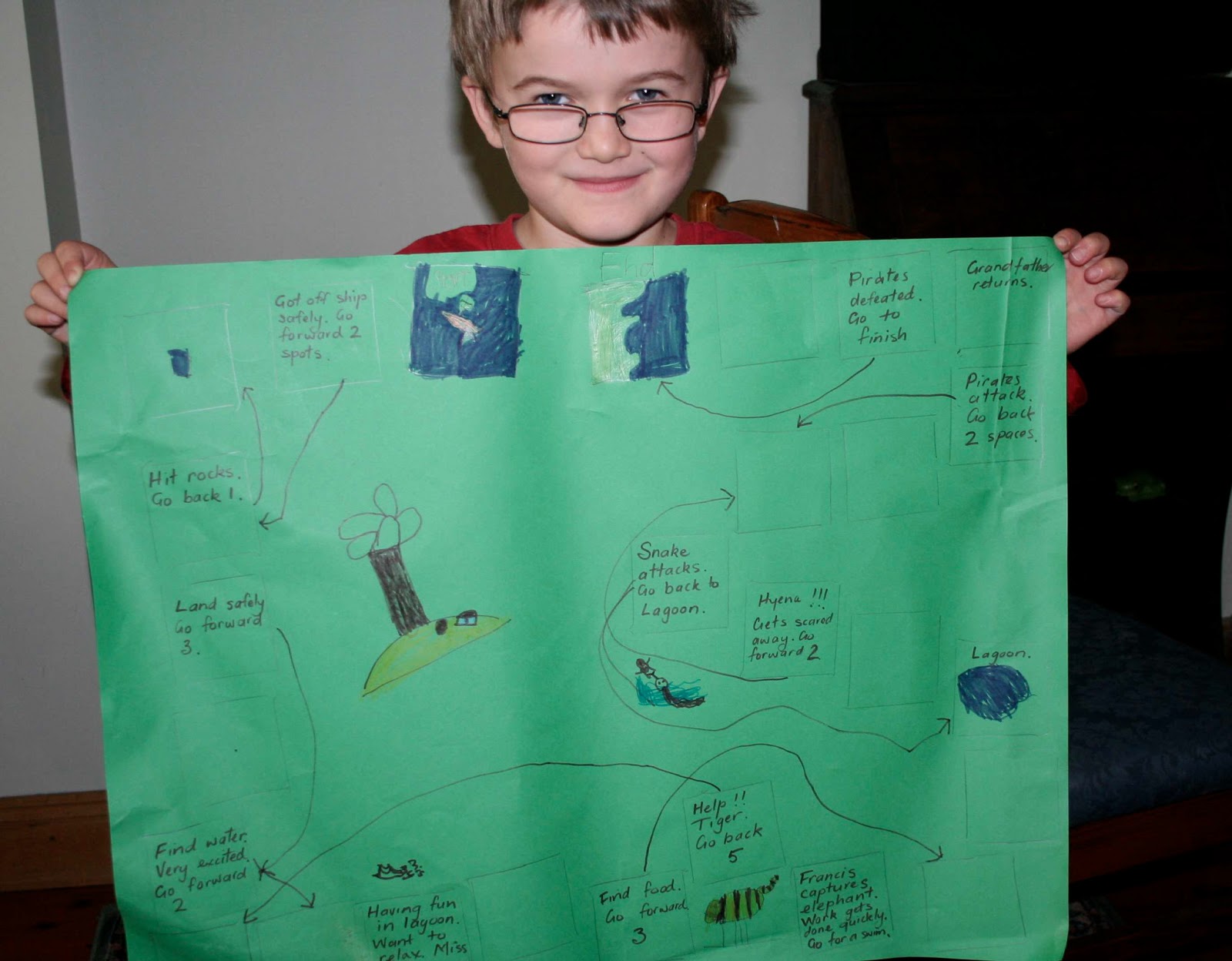
'Swiss Family Robinson' game, made by Sam after watching the film

Young children often quite naturally use re-creation as part of their play. Other children need help and encouragement to do this. Re-creation can be seen in children's experience of story in varied ways, for example:
  • Changing rhymes and songs, e.g. 'Baa Baa Black Sheep' to 'Baa Baa White Sheep' as Lydia does often.
  • Acting out 'Little Red Riding Hood' with the resources of the dress-up box and some friends.
  • Dramatizing a well-known children's song from television or CD or a children's picture book.
  • Using art or drawing to imagine a story character, mythical creature or story setting. 
  • Using Lego (or other toys, props and objects) to re-imagine story alone or with others.
  • Creating something new that grows out of an experience of story.

But why is re-creation so important? While play has a special value (see HERE) and has an important role in any child's intellectual development, imaginative recreation provides direct support to language and literacy development. It helps children to:
  • Play with and understand the complexities of plot development.
  • Comprehend any story at much greater depth.
  • Understand character development in new ways.
  • Enter 'into' a setting as they create an imagined version of the setting and events of a story.
  • Understand story in three dimensions.
  • Appreciate the way the language of story is shaped by, and in turn shapes, characters, settings and plots.

In short, imaginative re-creation is a powerful learning strategy for children that stretches them as language users and learners. As well, it stimulates their creativity and imagination.

Examples of Imaginative Re-creation by Age Group

a) Toddlers (1-3 years)


  • Being encouraged to be a wild thing as the story 'Where the Wild Things Are' reaches the critical moment when Max declares 'Let the wild rumpus start'.
  • Finger Plays and rhymes ('This Little Piggy', 'Incy Wincy', 'Round and Round the Garden')
  • Retelling Thomas the Tank Engine stories using the various engines that feature in the story.
  • Using dolls or soft toys to act out domestic scenarios.
    Using dress-up clothes in association with well-known stories.
  • Creating a story using toy soldiers, Polly Pocket toys, magnetic boards with characters, fuzzy felt and so on.
  • Joining in the television dramatization of a well-known story on a program like 'Playschool'.

b) Early years (4-6 years)

  • Many of the better story apps for iPad or android devices are an innovative way for multiple re-created experiences of stories (see my recent post on this HERE).
  • Drawing maps, key characters (dragons, people) or scenes.
  • Acting out stories with a group of children or with adult family members.
  • Creating an adapted text to re-create part of a story (e.g. poetry, a character interview, telling the story from a different point of view).
  • Using puppets to re-create a story.
  • Using modelling clay or craft materials to create characters to re-create and retell a story.
Creating knights for storytelling

c) Later childhood (7-12 years)

  • More elaborate dramatization, with involvement in making props and costumes.
  • Simple animations using one of the programs readily available (see my previous post on animation HERE).
  • Using materials like Lego to re-imagine a well-known story. The development of Lego with themes that relate to movies and stories has led to an even closer link between this toy and story making
  • Creating a board game that recreates the plot or a specific part of a story (as Sam did).
  • Creating a complex map or plot summary as a device for others to use.
  • Create a script to be acted for a specific part of a story.
  • Write a newspaper report based on an event within a story.
  • Use a variety of written genres to create a new text ('The Jolly Postman' and 'The Jolly Pocket Postman' are published examples of this).
These are just some of the ways that imaginative re-creation can be stimulated.

Summing Up

Children are capable of incredible imagination and creativity. Story is both an outcome of both of these human capacities, as well as means to stimulate their learning and growth in many areas. When imagination, creativity and story come together, we have a very powerful combination to 'stretch' our children.

Other posts

Posts on creativity
The Power of Story
Posts on Play


Monday, May 12, 2014

2014 Australian Children's Book Council Award Nominations

The Children's Book Council of Australia (CBCA) shortlist has been decided. The awards will be announced in Children's Book Week on the 16-22 August. The theme this year is 'Connect to Reading - Reading to Connect'. As usual, there are many wonderful books. I will review the winners and honour books in Book Week, but below you will find all the books shortlisted and links to help you find them. Some of the books have already been reviewed in my other posts.

The shortlist is a valuable guide to book purchases but there many other wonderful books published each year. As a result the CBCA also publishes Notable Book Lists that have over 100 titles listed. Standards are high so these are always wonderful books as well. Please don't be put off by the fact that some sites list the books as unavailable.

Shortlist for 'Older Readers' category (Young Adult Readers)

The Incredible Here and Now (Felicity Castagna, Giramondo)

Life in Outer Space (Melissa Keil, HGE)

The First Third (Will Kostakis, Penguin)

Fairytales for Wilde Girls (Allyse Near, Random House)

Wildlife (Fiona Wood, Pan)

The Sky so Heavy (Claire Zorn, UQP)

Shortlist for 'Younger Readers' category (Independent Younger Readers)

Violet Mackerel’s Possible Friend (Anna Branford, illustrated by Sarah Davis, Walker Books)

Song for a Scarlet Runner (Julie Hunt, A&U)

A Very Unusual Pursuit (Catherine Jinks, A&U)

My Life as an Alphabet (Barry Jonsberg, A&U)

Light Horse Boy (Dianne Wolfer, illustrated  by Brian Simmonds, Fremantle Press)


Shortlist for 'Early Childhood' category (Preschool and beginning readers)

I’m a Dirty Dinosaur (Janeen Brian, illustrated by Ann James, Viking)

Baby Bedtime (Mem Fox, illustrated by Emma Quay, Viking)

Banjo and Ruby Red (Libby Gleeson, illustrated by Freya Blackwood, Little Hare)

Kissed by the Moon (Alison Lester, Viking)

The Swap (Jan Ormerod, illustrated by Andrew Joyner, Little Hare)

Granny Grommet and Me (Dianne Wolfer, illustrated by Karen Blair, Walker Books)

Shortlist for 'Picture Books' category (Varied ages, Birth to 18 years)

The Treasure Box (Margaret Wild, illustrated by Freya Blackwood, Viking)

King Pig (Nick Bland, Scholastic Press)

Silver Buttons (Bob Graham, Walker Books)

Parachute (Danny Parker, illustrated by Matt Ottley, Little Hare)

The Windy Farm (Doug MacLeod, illustrated by Craig Smith, Working Title Press)

Rules of Summer (Shaun Tan, Lothian)

Short list for 'Eve Pownall Award for Information Books' category (Varied ages, Birth to 18 years)

Big Red Kangaroo (Graham Byrne, text by Claire Saxby, Walker Books)

The Bloodhound Boys Book 1: The Great Blood Bank Robbery (Andrew Cranna, Walker Books)

I’ve An Uncle Ivan (Ben Sanders, Thames & Hudson)

The Nerdy Birdy (David Snowdon, text by Danielle Wheeldon, self-published).

Related links

Previous posts on children's book awards (HERE)