Showing posts with label Illustrator Focus. Show all posts

Friday, August 15, 2014

Author & Illustrator Focus: Chris McKimmie

Chris McKimmie is a writer, illustrator and artist. His career has had several phases. In the 1970s he worked as a graphic designer and publications designer for the ABC, the National Parks and Wildlife Services and the University of WA Press. As well, he wrote, illustrated and designed a series of 8 children's books as well as designing many book covers. Later he moved to Queensland and established the illustration program at the Queensland College of Art, Griffith University.

He has also applied his skills, knowledge and experience to film. In the 1980s he was production designer for the award-winning short film 'Stations' (1983) and the feature-length film 'Australian Dream' (1986). He also wrote the lyrics for the songs in both films, as well as 'Madness for Two' (1982), 'Top Enders' (1987) and 'Waiting' (1990). These films were written and directed by his wife, Jackie McKimmie.

Throughout his career he has also exhibited paintings and drawings at many Australian galleries. The last ten years have been a particularly fruitful time for him with children's literature and he has written and illustrated a number of wonderful children's picture books (see the full list at the end). The picture books he has written and illustrated can be recognised immediately by their deceptively simple style. This is a style that reflects careful attention to varied techniques honed over many years working as an illustrator in varied genres. He makes his images using acrylic on MDF, ink, watercolour, gouache, pastels and any other materials that seem like a good idea. I always feel as I read his books that here is an author and illustrator who seems to have a special way of getting inside the heads of his readers to set off sparks of imaginative energy.

Chris has received a number of awards for children's books including being shortlisted by the Children's Book Council of Australia for 'Two Peas in a Pod' (2011), 'Special Kev' (2009), and 'Brian Banana Sunshine Duck Yellow' (2007).

For more on Chris McKimmie's background read the interview I conducted with him at the end of this post.

Brief reviews of some of his recent picture books

'Crikey and Cat', Christopher McKimmie (written & illustrated), Crows Nest: Allen and Unwin, 2014


Like all of Chris McKimmie's picture books 'Crikey and Cat' is aimed at inquisitive, creative and imaginative readers. It challenges them to think outside the square. Like all of his books he leaves 'space' for young readers to do their own thinking. If the stars suddenly disappeared, what would you do? With a ladder, a tape, and some late night cutting, the problem is solved! "Nice". But then, along comes the storm.... (you should read on). It is a wonderful blend of McKimmies delightful simple images, and just enough words to stimulate young and old brains. Wonderful!  Suitable for readers aged 3-6 years.

Scarlett and the Scratchy Moon', Christopher McKimmie (written & illustrated), Crows Nest: Allen and Unwin, 2013

Scarlett can’t sleep again. The moon is scratching the sky, and she’s counting sheep. Scarlett is also sad because her pet dogs, Holly and Sparky, have died. But then a surprise comes to the door and the world seems new again.

'Alex and the Watermelon Boat', Christopher McKimmie (written & illustrated), Crows Nest: Allen and Unwin, 2012

This book was inspired by his experience living through the Brisbane floods of 2011.  The flood provides the setting for a small boy's search in a 'watermelon' boat for his special stuffed rabbit. The river had burst its banks. The dam was overflowing. 'Don't go outside, Alex!' Mum shouted. But just then Rabbit hopped out the open window ...

Good Morning Mr Pancakes', Christopher McKimmie (written & illustrated), Crows Nest: Allen and Unwin, 2011

It's holiday time for Bee. But first the chooks need their toenails painted, the dogs and cats need their bags packed and Gregor needs enough greens for a week. Then Bee is off to the island.

Two Peas in a Pod', Christopher McKimmie (written & illustrated), Crows Nest: Allen and Unwin, 2010

From the inside front cover Chris McKimmie had me in. What might the four dwarves mean? I didn't think this was a book about dwarves?! No, it's about a boy and girl, like 'two peas in a pod', whatever that means. Violet calls her friend Marvin 'Marvellous' and they do everything together. Like watching the clouds to discover cotton wool castles and marshmallow kingdoms. Or catching the train in their lounge room to Toowoomba, Dimboola, Woop Woop and beyond. They live in Raven Street and you never know what they might encounter - ghosts, dwarves, woolly elephants? When Marvin leaves Violet for the plane trip home, it's always lonely. But luckily, Mum and T Rex are there waiting. I just love this book!


Special Kev Christopher', McKimmie (written & illustrated), East Melbourne: Allen and Unwin, 2008

If only my Mum had called me 'Special Kev' (funny thing is that strangers often call me 'Kevin', but that's my story). Trevor ('Special Kev') was always going to be different. He was born on April Fools Day and had different qualities to all of his "eleventy million cousins". With curly red hair and freckles he'd be noticed all right. Kevin seems to have a life with plenty of problems (like 'the thing with Nicky Bathgate) and it's never his fault. No, it was Fatty Boombah's, Nicky's, or Megan the Meanie's. Only Aunty Pav - who like Kevin is unique - seems to offer him a lifeline. This special book about a special child, has lots to say about difference, friendship and family. As with all McKimmie's books, it offers an opportunity for joyous fun with young children, but there is always a deeper point that awaits the reflective reader.

Maisie Moo and Invisible Lucy'. Christopher McKimmie (written & illustrated), Crows Nest: Allen and Unwin, 2007

The funny and tender story of Maisie who lives with her parents in the Gone Bonkers Discount Palace. She shares her troubles and joys with her invisible friend, Lucy, and misses her father who is often away driving his truck.

Brian Banana Duck Sunshine Yellow', Christopher McKimmie (written & illustrated), East Melbourne: Allen and Unwin, 2006

A wonderful, innovative, quirky picture book about a child's search for identity and the need to belong - and a glorious celebration of the colour yellow.
An Interview with Chris McKimmie

1. Most of your published profiles don’t say a lot about you. Where did you grow up? What were your early influences? Are there people who helped to shape the Chris McKimmie who writes and illustrates such interesting picture books?

I was born in Perth, Western Australia and I am the youngest in a family of five. I grew up surrounded by aunties and cousins. Every Christmas we would gather around two trestle tables at my Italian grandmothers place two doors up. She had twelve kids, including my mother. The aunties, uncles and cousins would drink, play the piano accordion and sing and watch my grandmother have her one cigarette a year on her birthday which was also Christmas day.

At school we didn't have art. We had tech drawing which I would always get smudged and crooked. I didn't like school much and was glad to get out. My last year at school was spent listening to the top 40 hit parade and plotting the course of various songs and playing along on my homemade drum kit. When I left school after just scraping through I bought a sparkling red Premier drum kit and played in bands at weddings, twenty firsts, nightclubs and the one jazz club in Perth. Then I went to Sydney where I met Jackie.

We both returned to Perth and studied there and had our first son while we were students. I studied Graphic Design with electives in painting and drawing and I finished my studies a year before Jackie and worked at the West Australian University Press as a book designer. Every pay day I would buy a children’s book for our son. This was my introduction to picture books. I realised that as long as a book had a certain honesty to it that it served a purpose one way or another and at some time or other.

When Jackie finished her studies we moved to Sydney and had our second son. I worked various jobs cleaning and then as a designer at National Parks and Wildlife and the Australian Broadcasting Commission. Then I took a year off to help raise the boys and write and illustrate some children’s books while we both worked part-time. The 8 books I wrote, designed and illustrated were published by Hicks Smith and Methuen and sold internationally. In 1976 we moved to Queensland so I could take up a job offer from the Queensland College of Art. We planned on staying a few years but have been here a bit longer than that. Up until 2001 I was the convenor of the illustration programme at the college. Since I left I have been working on stories and books and paintings for exhibitions.

2. Do you love story as much as illustrating? Do you see the words in your books as just as important as the images?


Yes. I work on both together and change them as the story develops. Sometimes getting rid of some pretty good pictures. Sometimes getting rid of some pretty good writing. I also design all my books and I see that as a valuable part of the story as well.

3. Could you tell me a little about the inspiration for ‘Crikey and Cat’?


Crikey started out as the blue book. Pretty much the first half of the book. The publishers asked me to combine it with two other books I had sent them in rough form. These books were about a red cat. I found it impossible because the story lines wouldn’t connect. I asked Jackie, my wife, who is a writer of films, plays and poetry if she could come up with anything and she solved the story line in about five minutes.

4. A number of reviewers speak of your work as ‘quirky’, and this word came to my mind as well. But it seems to me that it’s much more than this. Do you see a book like ‘Crikey and Cat’ as quirky or would you describe the book another way?

No I don’t see it as quirky. Nor do I see my other books as quirky. I just work around my limitations.

5. What is the best response you've ever had to your illustrative & creative work?
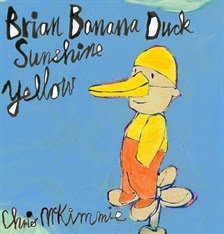
I once got an e mail from a woman who told me she was taking my book Brian Banana Duck Sunshine Yellow on holidays with her and she reads it four or five times a day and that the line ‘It’s just beautiful, Wayne’ was the best line ever written in the English language. I was pretty glad I lived in a different state.

6. Do you have other book projects on the drawing board?

I have just signed a contract for a book called Lara of Newtown about a cat that is abandoned at Christmas time then is given as a Christmas present and abandoned again.

7. Who or what has been the most significant influence on your creative work?

Pretty much everything. I read a lot of poetry. Novels, short stories and picture books. If you have read some of my books e.g. Good Morning Mr Pancakes all the grandkids have been a help as well.

Full List of Chris McKimmie's Children's Books 

'Crikey and Cat', Christopher McKimmie (written & illustrated), Crows Nest: Allen and Unwin, 2014
'Scarlett and the Scratchy Moon', Christopher McKimmie (written & illustrated), Crows Nest: Allen and Unwin, 2013
'Alex and the Watermelon Boat', Christopher McKimmie (written & illustrated), Crows Nest: Allen and Unwin, 2012
'Good Morning Mr Pancakes', Christopher McKimmie (written & illustrated), Crows Nest: Allen and Unwin, 2011
'Two Peas in a Pod', Christopher McKimmie (written & illustrated), Crows Nest: Allen and Unwin, 2010
'Special Kev Christopher', McKimmie (written & illustrated), East Melbourne: Allen and Unwin, 2008
'Maisie Moo and Invisible Lucy'. Christopher McKimmie (written & illustrated), Crows Nest: Allen and Unwin, 2007
'Brian Banana Duck Sunshine Yellow', Christopher McKimmie (written & illustrated), East Melbourne: Allen and Unwin, 2006

Earlier Works

'The Caught Bird', Christopher McKimmie (written & illustrated), Sydney: Methuen Australia, 1977
'The Shape I'm In', Christopher McKimmie (written & illustrated), Sydney: Methuen Australia, 1977
'One Rainy Day', Christopher McKimmie (written & illustrated), Sydney: Methuen Australia, 1977
 'The Magic Day', Christopher McKimmie (written & illustrated), Sydney: Methuen Australia, 1977
'Apple to Zoo', Christopher McKimmie (written & illustrated), Sydney: Hicks Smith, 1975
'The Painted Bird', Christopher McKimmie (written & illustrated), Sydney: Hicks Smith 1975 'Two Friends', Christopher McKimmie (written & illustrated), Sydney: Hicks Smith, 1975
'One Day', Christopher McKimmie (written & illustrated), Sydney: Hicks Smith, 1975

Thursday, March 13, 2014

'The Adventures of Pinocchio': Ingpen illustrates Collodi's original text

Robert Ingpen

Robert Ingpen is one of Australia’s most successful illustrators and has written and/or illustrated more than 100 books. He was born in 1936 and did most of his growing up as a boy in Geelong. From an early age he was obsessed by stories and says that at times he had trouble distinguishing fantasy from reality. Now as a man in his 70s he sets a pace that few could match. He is arguably Australia's greatest children's book illustrator and is one of the best illustrators of our time anywhere in the world. You can read more about the illustrator and his work in my previous 'Author and Illustrator Focus'.

'The Adventures of Pinocchio' by Carlo Collodi, illustrated by Robert Ingpen (Walker Books)

This latest book in the Walker Illustrated Classics series is stunning! Ingpen is at the top of his craft in this work. As usual, his illustrations offer extraordinary detail. He uses a variety of media, including watercolour, pencil, and pastel. But whatever the media, the detail is always amazing and at times almost breathtaking. He brings characters to life. Each of the 36 chapters have a double page spread that offers an engaging start to each new chapter in the life of this mischievous puppet. The first double page for chapter 1 shows the carpenter Mastro Cherry in his workshop. You can 'drink' this in for ages before wanting to read on. Fantastic!

What is also wonderful about this volume is the fact that it is based on the original text of Pinocchio published first in 1883 from a collection of separate chapters that appeared previously in an Italian newspaper for children. This is not the Disney form of the story. This is a more 'gritty' tale that will surprise you in places. The original Collodi version portrays a strange topsy-turvy world that hints at Tuscany and where sinister things happen. The young Pinocchio lurches from one problem to another, just surviving on many occasions. In fact, Collodi meant for him to die after chapter 15, but his readers were so outraged that he was forced to continue the story for another 21 chapters and give it a more satisfactory ending for the wooden puppet that becomes a boy.


As with all of the books in this series, the book design is stunning. All have hard covers, think paper and coloured pages throughout in varied soft tones. These are handsome, 'rich' collectors' editions that make you want to read the stories.

Illustrated Classics Series

Walker Books engaged Robert Ingpen to illustrate a series of unabridged classic children's books about 6 years ago. Since then they have produced a series of stunning collectors' books. Every book in the series excels in design and needless to say Ingpen's illustrations add a great deal to each of the classic stories. This is all the more remarkable because there have been many illustrated versions of most classic books; so gaining the attention of new generations of readers isn't easy. However, each of these books make me want to re-read every book, because Ingpen's illustrations help you to discover new things in each of them. It's obvious how much Ingpen loves the books himself given the brilliant way each illustration supports and extends the text without dominating it. The books include:

'Peter Pan and Wendy' (2004) written by J.M. Barrie
'Treasure Island' (2005) written by Robert Louis Stevenson
'The Jungle Book' (2006) written by Rudyard Kipling
'The Wind in the Willows' (2007) written by Kenneth Grahame
'A Christmas carol and A Christmas tree' (2008) written by Charles Dickens
'Alice's Adventures in Wonderland' (2009) written by Lewis Carroll
'The Adventures of Tom Sawyer' (2010) written by Mark Twain
'The Secret Garden' (2010) written by Frances Hodgson Burnett
'The Night Before Christmas' (2010) written by Clement Moore
'The Owl and the Pussycat: And other Nonsense Rhymes' (2012) written by Edward Lear
'The Adventures of Pinocchio' (2014) written by Carlo Collodi.

All of the books in the series are stunningly designed and illustrated. They stand out on any book stand with quality hardback covers (with individually appropriate embossing), quality stitching, dust jackets that are consistent in design, featuring gold lettering for titles and fonts and design features throughout that are suggestive of classic books that are in some cases over 100 years old. The books ooze quality - you can't help but pick them up.

The illustrations utilise all of Ingpen's strengths, with hardly a double page spread in any of the books without illustrations, and many with more than one. The double page spreads, chapter divisions and inside cover images are of superb quality, and show Ingpen's attention to detail.  All the illustrations have the typical Ingpen fine line detail and wash colours that always give softness to the image. The cover of 'The Adventures of Tom Sawyer' is typical of the design of the books.

His Awards

Robert Ingpen has received many awards.  He was probably first noticed as a great talent when he did the illustrations for Colin Thiele's classic book 'Storm Boy'. This led to a long collaboration with Thiele. His work on 'Storm Boy' won him his first award, 'The Visual Arts Board Prize' presented by The Australia Council for the Arts. The list of awards that followed is significant and recognise his extraordinary skill. As well as the Hans Christian Andersen Medal already mentioned that was awarded in 1986, he was awarded the prestigious Dromkeen Medal for significant contribution to the appreciation and development of children's literature in 1989. He was also awarded an honorary Doctor of Arts from RMIT in 2005 for contribution to children’s literature and in 2007 he was made a member of the Order of Australia for service to literature.
  • Another indicator of his standing as an illustrator is the significant international exhibitions of his work. These include:
  • A major retrospective exhibition in Taipei, which travelled to other regions of Taiwan for a two-month period (2009). 
  • An exhibition of the original artworks for 'Around the World in 80 Days' was held in London (2009). In 2002 Ingpen had a solo exhibition in Bologna, Italy.
  • In 2002 Ingpen's work also featured in the inaugural exhibition at 'The Eric Carle Museum of Picture Book Art' (Massachusetts).
Reference

Complete List of Robert Ingpen's writing and book illustrating can be found in my previous post on the illustrator HERE.

Wednesday, June 19, 2013

Craig Smith the Illustrator: An interview and review of his work

Craig Smith's Background
 
Craig Smith is a prolific illustrator who has been amusing and entertaining children for many years. He has illustrated 380 books. This includes trade and illustrated books, series, and book covers. He has a quirky, mischievous and humorous style that always seems to have surprises in each work. His artwork combines a wonderful sense of the absurd with attention to detail. As you read his complete bibliography you are quickly struck by just how many wonderful writers he has illustrated for and how many varied publishers. Craig Smith has been in high demand as an illustrator for almost 40 years. He estimates that this has required approximately 9,000 illustrations! 

He has won a number of awards; including The NSW Premiers Literary Award 1982 for Nan Hunt's authored book 'Whistle Up a Chimney', and a number of awards from the Children's Book Council of Australia (CBCA). The latter included an Honour Book for 'Where's Mum?' (1993), another for 'Cat' (2008), and a shortlisting for 'Billy the Punk' (1996).   

Craig grew up in the Adelaide Hills. He has been a freelance illustrator since 1976. Like many artists and authors, for some of his early years he had part-time jobs to make a living - washing dishes in a restaurant, scraping rust off the Sydney Harbour Bridge, and doing drawings for advertising. One of the more interesting jobs he had as a young man was working as a nurse's aide in a hospital for the elderly. In that role he was able to observe the human body. This experience he suggests stayed with him and affected the way he has been able to develop characters in his work. He lives with Erica, in Melbourne and has four grown-up children, and four grandchildren. 

Some of my favourite Craig Smith books

His most recent book has just been published by Allen & Unwin. It is called 'Where Are You, Banana?' (2013) and was written by Sofie Laguna. Roddy's dog, Banana, has disappeared! But when Roddy hears a wail from the drain, he finds an ingenious way to rescue his beloved pet. There is a free audio reading available for a smartphone or tablet via QR code printed inside the book. As usual, Craig's illustrations are vibrant and make the story come to life.

With so many books to choose from, it's risky trying to select just a handful of Craig's many wonderful works. But here are some of my favourites.


1. 'Black Dog', author Christobel Mattingly, William Collins, 1979 (Out of print)

This was Craig's first book and was done completely in very fine line work and black and white.  Crosshatched in a long, careful and laborious way, using an ultra fine technical pen. Sadly, it's out of print, but I'm glad to have it in my collection.


2. 'Whistle Up the Chimney', author Nan Hunt, William Collins, 1981

Mrs Millie Mack lived alone in her little cottage, and as she sat down to knit at night she liked to listen to her fire going crickle crackle.  But one winter, when she threw several pieces of wood from a 'bogey louvre' from an old railway carriage, there were very surprising results. I've always loved this book and have been reading it to children for over 30 years. The wonderful line and wash drawings of Craig Smith give Mrs Mack a personality that many will recognize. Curiously, when I discussed the book once with Nan's daughter she commented that Mrs Mack looked just like her mum.  This is all the more surprising given Craig's comments in his interview about little contact with authors. This wonderful book won The NSW Premiers Literary Award in 1982.


3. 'Sister Madge's Book of Nuns', author Doug MacLeod, Omnibus, 1986 (new edition 2012)

This book is just as funny today as it was almost 30 years ago when first released. Doug MacLeod's text and Craig's illustrations almost compete for the right to be more outrageous. I think it's a draw! It is written in hilarious verse and introduces Sister Madge Mappin and other equally unusual inhabitants of the Convent of Our Lady of Immense Proportions. Craig's illustrations (the old and new version) make a significant contribution to this book of irreverent fun.

4. 'Pigtales', author Ron Elisha, Random House, 1994 (Out of print)

This book about a pig was written by Ron Elisha a medical practitioner and playwright from Melbourne. While the book is out of print, if you can find a copy somewhere you'll enjoy it. Once again, Craig's illustrations help to make the book. Craig suggests that this 'under recognised' book contains one of his favourite drawings ‘In the back of a smallgoods van, hung a dejected Prince Porgy, awaiting his final deliverance....I’ve always loved the poignant characterisation of poor Porgy. I've wondered if my feeling for Porgy is because my childhood was close to a small abattoir. These things do leave lasting impressions.'

5. 'Billy the Punk', author Jessica Carroll, Random House, 1995

Billy decides that he needs to look different. And he doesn't care that no one much likes his hair or his new clothes. While Craig makes great use of fine line in his books, in this one he uses colour to bring out the 'emotion' or mood of the story. In Craig's words, 'Billy walking to school is in a cool blue, to show his aloneness, or self-centredness. (Of course, other elements that emphasise this are the ‘from behind’ point of view, and the empty landscape). When he’s being yelled at by his teacher, the colour surrounding her is hot, angry, orange.' The book was shortlisted in the CBCA awards 1996.

6. 'Cat', author Mike Dumbleton, Working Title Press, 2007 (Out of Print)

'Cat' is about a day in the life of a cat of course. It is a very simple but animated story with few words. Craig's images are essential to the strength of the work. The life of a cat can be dangerous. It is a great read aloud book for younger readers. It was a CBCA Book of the Year Early Childhood Honour Book in 2008.


My Interview with Craig Smith

The following interview is one of the most interesting that I've done. As well as helping to offer an insight into Craig Smith the illustrator and person, it provides a huge amount of good practical advice for young illustrators.

1. Was your gift for drawing obvious early? Who encouraged its development?

As a child and adolescent I had very average skills. However my older sister, Maire, has superb drawing skills, and these were apparent as far back as young childhood.

My developmental pathway came about through visiting my sister at art school (SA School of Art in Adelaide), and becoming enthralled by the place in all its facets: painting, sculpture, film (rudimentary animation) and graphic design (especially typography). My portfolio was sufficient to become enrolled - I suspect it was partly because my sister was brilliant.

However, like a lot of art students, I had a good work ethic, and the lecturers were good, occasionally inspiring, as were many of my classmates. Plus, the campus library with its contemporary art journals and illustration compendiums made clear the international standard we wanted to attain in the energized environment of Gough Whitlam and Don Dunstan’s (South) Australia in the 1970’s.

Two last points; Life-drawing is the foundation skill for an illustrator. My lecturer George Tetlow was a terrific guide to how to do it. Lastly, I was lucky to strike a friendship with John Nowland, an inspired and very professional graphic designer. This friendship had – as well - all the aspects of a genuine mentor/mentee relationship.

2. What books and illustrators were influential for you when you were growing up, and as an adult? Who inspired you, and perhaps what illustrators and authors still do?

I’ve always enjoyed browsing and reading books. An example of a pivotal book was Lord of the Flies by William Golding – read at 13. I imagine this was a pivotal text for many. For the purpose here, I’ll concentrate on illustrators that inspired me, and especially around the period of art school, and the ten years thereafter – when most receptive to influence.

First influence, being taught the principles of Swiss graphic design, exemplified in the book: Graphic Design Manual: Principles and Practice by Armin Hofmann. My first bible at art school.

Secondly, New York graphic designer Milton Glaser. His book Milton Glaser Graphic Design was my second bible at art school.

Next, by now I was drifting towards illustrative solutions for all my art school work. A number of Swiss/German artists became especially influential, Etienne Delessert, Heinz Edelmann, Roland Topor, Tomi Ungerer and most of all, the great Karl Friedrich Waechtar.

They were especially influential by their exotic & peculiar Europeanness. Others included Ralph Steadman, John Burningham, Michael Foreman and Tony Ross in the UK. A very, very useful photographic resource was The Human Figure In Motion by Eadweard Muybridge. Nowadays, there is less that is influential but a lot that is charming and provoking; Leigh Hobbs and Shaun Tan come immediately to mind.

3. Do you have any preferred methods or medium?

The medium is the simple part – arrived at by years of experience, and still steadily changing. Basically the medium is, a blending of gouache paint (useful for watercolour like effects – but less troublesomely soluble than watercolour), acrylic paint and acrylic ink. My illustration has always relied on an outline. This part of the illustration has changed most over years, from a precise opaque line drawn with a nib, and embellished with crosshatching - to nowadays an imprecise line still drawn with a nib, but the ink often much watered down and with little or no crosshatching.

I rely on observing what happens as paint and ink dries, and trying to manipulate that. With regard to computer skills; you must have them. At the minimum to work professionally, you should have the ability to make basic alterations in Photoshop, as necessary, (to the scan files). Actually ‘painting’ for long hours on computer is physically stressful and eventually torturous, in a way that real painting never is.

4. How important is a sense of ‘partnership’ between author and illustrator? What is the key to the collaboration between author and illustrator working as it has for so many of your books?

A publishing strategy is to partner people with the hope it works commercially. Occasionally it does, mostly it fizzles. In my experience, it does not involve directly working together at all – you just share a rapport, and attitude, with regard to the story. A different way of looking at it is, the rapport is actually with the editor. A good, supportive, thoughtful relationship with an editor is very motivating. I think it is the principal relationship. My working practice requires mostly being left alone.

5. What is the best response you've ever had to a book?

The first book… Then being offered another one after that! I’m always cheered by a response that I periodically get from the few readers of a series known generically as 'I Hate Fridays' by Rachel Flynn' (Penguin 1990 –1997). The readers are always girls who’s eyes shine with fun and brightness – they are clued in to Rachel’s acute, dry humour and familiar school characters. (These five black and white books may be my best work).

Update: As I write this, I just received a notification that a recent book has a nice review in the NY Times (Heather Fell In the Water by Doug MacLeod, Allen & Unwin). That ranks!

6. Does the work of illustration get easier, or harder as your reputation grows and your list of great works lengthens?

I think it gets easier to make judgements and decisions. I've had enough success to gain self-confidence. Not enough to think I've got it all worked out.

7. What's the most unusual request that you ever had for an illustrating assignment?

The first that comes to mind would be What a Week! (by Robyn Ryan, Playworks). Requiring the child hero to be using a specific walking aid, and with some specific body movements characteristic of his condition. Another would be the requirement to picture the direct language describing child sexual abuse in Some Secrets Should Never Be Kept (by Jay Sanders, Upload Publishing).

Perhaps the first drafts for the 'Toocool' series (by Phil Kettle, Black Dog Books), in which Toocool's sporting rivals were all in his imagination - drawn by anthropomorphizing the brick wall etc. Sad to say, this approach was abandoned.

Another would be the video clip for 'The Lonely Goth' by Mick Thomas. The task involving planning, and timing, a series of images to accompany the song. I loved this task.

However, the task of animating the song 'Insy Winsy Spider' for the TV show Here's Humphrey - all in one day. This task broke me mentally and also broke my enjoyment of animation.

8. Can you tell us a little bit about your new picture book, Where Are You, Banana?

'The dog, Banana' has that familiar doggy curiosity that has him lost, then found by Roddy - but hopelessly at the bottom of a road works (footpath) hole. Some quick thinking, and savvy use of toys, makes the rescue possible. It is a child size drama- no less moving for that. Using this book, the relationship between Roddy and Banana is bought even further to life - if you choose - by utilising a QR code to go to web narrations (audio) to listen while reading along with the story. This is an interesting use of groovy new technology, highlighting the warmth and liveliness of the narrators. Very exciting.

9. Do you have many new projects on the drawing board?

No, not many in number. The years of abundant production in educational publishing are finished.

However, there are some nice projects happening. Some favourites are:

• A picture book based on the Vietnam War.
• A self-authored picture-book about a cat, on the theme of vanity.
• Another is a venture into self-publishing – 'Doctor Frankenstein's Other Monster' (by Nigel Gray, CSI-Books) - because I use the book in school visits, plus it is a vehicle to develop an enhanced fixed layout EPUB ebook. The iBook version of this is just about ready to go.

Wednesday, September 21, 2011

Improving on 'The Iron Man'?

"The Iron Man came to the top of the cliff.
How far had he walked? Nobody knows. Where had he come from? Nobody knows. How was he made? Nobody knows.
Taller than a house, the Iron Man stood at the top of the cliff, on the very brink, in the darkness.
"

So begins one of the great modern fairy stories; or is it science fiction? No matter, 'The Iron Man: A Story in Five Nights' is a wonderful work of fiction for readers aged 6-10 years and has thrilled readers since it was published by Faber in 1968. It is a modern classic which in its 1st edition used the wonderfully simply line drawings of George Adamson. Illustrations stripped bare, as 'miserly' as the text, giving just enough to inflame the curiosity and imagination of readers. Illustrations as intriguing as the words and complementing the masterful text. 

Surely, such a work cannot be improved on? Surely, it would be foolish even to try? Warner Brothers tried with an animated film titled 'The Iron Giant' (1999) and it was (in my view) an abomination, in light of the quality of the book. But.... it seems there was a way to improve on the classic work. Laura Carlin is the secret weapon, surprising this reader, with the same killer blows as the Iron Man dealt to the Space-bat-angel-dragon. In her own way, Carlin improves on Adamson's contribution as illustrator in the original edition.

Here is an illustrated junior novel turned into a graphic novel with wonderful success. I have seen the odd review (odd in number, and odd in nature), that have spoken of the 'simplicity of the drawings', 'the child-like figures', the 'imprecise details' etc. Theses comments show neither understanding nor appreciation of the genius of the text. Hughes offers a text with simplicity of vocabulary and sentence structure that helps to create the mood, the intrigue and 'space' for young minds to imagine. This is precise descriptive language that allows the reader to see with equal preciseness, the path of the characters, the events and even the plot. Carlin wonderfully partners Ted Hughes in this new edition from Walker Books (even though he's been dead since 1998).


I applaud Walker Books for its work in recent years producing new editions of classic works. Many publishers attempt to do the same thing. Old books can be reprinted and good profit made for low cost. But Walker has been trying to offer something new and significant in each of its attempts.  I have reviewed the Classic Series that Robert Ingpen has illustrated (here) which in their own way add value for new readers to well-known works. The purpose of course, in new editions, is to introduce such works to a new generation. This new edition of 'The Iron Man' will do just that. Can you improve on 'The Iron Man'? I think Walker have succeeded in this new format. The production and the illustrations are superb.


Laura Carlin's illustrations are in rich watercolours that offer a somewhat impressionistic interpretation of Ted Hughes's text, mostly in full-colour, with occasional two-colour stylised images across part and whole pages for dramatic effect. A simple example is an image of the two red eyes of the Iron Man shining in the deep black pit where he is trapped. The images are well integrated with the text, sometimes appearing as almost marginal sketches and, at other times, detailed double-page spreads. The publishers also make good use of other devices such as varied text fonts and styles, paper sculpture holes to slowly reveal the space-bat-angel-dragon, and they use multiple page fold-outs in places, including a dramatic 6 page spread that folds out to the reveal story's conclusion. The sensitivity with which Carlin interprets the text and the clever book design, offers a wonderful example of a graphic novel that improves the reader's experience of the original work. It is brilliant stuff!

Plot summary

The Iron Man describes the unexpected arrival in England of a mysterious giant "metal man" who wreaks havoc on the countryside by attacking the neighbouring farms and eating all their machinery. A young boy called Hogarth befriends him and he and the extraordinary being end up defending and saving the earth when it is attacked by a fearsome "space-bat-angel-dragon" from outer space.

The book was written at a high point of the Cold War and it would seem that the intent of the author was to place a spotlight on the futility of war, violence, and the arms race.  Many see the space-bat-angel-dragon as an idealized version of the Soviet Union offering a threat because of the hostility of nations toward one another. It offers a message of hope and peace. A solution to the problems of the world devised by a child who showed compassion and empathy, and was prepared to talk to the 'enemy'.

About the Author

Ted Hughes was born in Yorkshire in 1930. His first book, 'The Hawk in the Rain', was published by Faber in 1957, and was followed by many volumes of poetry and prose for both children and adults, including 'How The Whale Became', 'Under the North Star', 'Tales from Ovid' and 'Birthday Letters'. He was Poet Laureate from 1984 and was appointed to the Order of Merit in 1998, the year in which he died. There has been much written about him and his ill-fated marriage to American Poet Sylvia Plath who died by suicide aged 30 in 1963. But he should be remembered first as a great poet and writer for adults and children.

About the illustrator

Laura Carlin is a graduate of the Royal College of Art and the winner of several awards including the Shelia Robinson Drawing Prize, the Quentin Blake Award and the 2004 National Magazine Award. Laura's work as a ceramic artist and illustrator has featured in publications such as Vogue, the Guardian, and the Independent. Books she has illustrated include 'The Silver Donkey' by Sonya Hartnett and Michael Morpurgo's 'The Kites are Flying!'.

Book details

Title: 'The Iron Man' Ted Hughes, illustrated by Laura Carlin
ISBN: 9781406324679
Imprint: Walker Books
Binding: HARDBACK
Release Date: November 1, 2010
Dimensions: 200 x 270mm, 96pp
Australian RRP: $34.95

Related posts

Author Focus: Robert Ingpen (HERE)
Aussie Book Reviews: Graphic Novels (HERE)

Books for children by Ted Hughes

'The Earth Owl and Other Moon People' (1960)
'Meet my Folks!' (1961)
'How the Whale Became' (1963)
'Nessie the Mannerless Monster' (1964)
'The Iron Man' (1968) Illustrated by George Adamson
'Coming of the Kings and Other Plays' (1970)
'Season Songs' (1976) Illustrated by Leonard Baskin
'Moon-Whales and Other Moon Poems' (1976) Illustrated by Leonard
Baskin
'Moon-Bells and Other Poems' (1978) Illustrated by Felicity Roma
Bowers
'Under the North Star' Illustrated by Leonard Baskin (1981)
'Ffangs the Vampire Bat and the Kiss of Truth' (1986) Illustrated by Chris
Riddell
'The Cat and the Cuckoo' (1987) Illustrated by R. J. Lloyd
'Tales of the Early World' (1988) Illustrated by Andrew Davidson
'The Iron Woman' Illustrated Douglas Carrell (1993)
'The Mermaid's Purse' (1993) Illustrated by R.J. Lloyd
'Collected Animal Poems: Vols. 1–4' (1995)

Thursday, April 28, 2011

When Words and Art Meet

I've just been to see the finalists in the 2011 Archibald Prize. This is Australia's most distinguished prize for portraits. There were many wonderful works but something struck me while viewing the Archibald winners as well as the finalists for the 'Wynne Prize' (for an Australian landscape painting or figure sculpture art prize) and the 'Sulman prize' (for the best subject/genre painting and/or murals/mural).  In a number of cases artists used words as part of their art. While we often consider how images support and add to the written word in books, comics and graphic novels, it seems that increasingly modern artists use words in metaphorical ways to support and add to the meaning of their art.

A wonderful example is finalist Sonia Krestchmar’s acrylic on wood portrait of Sydney-born author Cassandra Golds. Cassandra writes books for children and young adults. Some critics have described Gold's writing as part parable, part surrealist fable and part love story.

Artist Sonia Kretschmar
Kretschmar became familiar with Golds’ work when she was commissioned to illustrate the cover of her novel 'Clair-de-Lune' for Penguin Books in 2004. Since then she has illustrated two other novels by Golds, 'The museum of Mary Child' (2009) and 'The three loves of Persimmon' (2010).

The inspiration for the portrait of Cassandra Golds were some lines from 'The three loves of Persimmon':

“Persimmon gazed at him. For a moment she had the strangest feeling that there was a bird trapped inside her ribcage, as if her bones were its prison and it was flapping frantically against them, trying to get out. She opened her mouth, but could find no words.”

Author Cassandra Golds
In discussing her portrait Kretschmar commented "As birds, and cages, and cats all seem to be recurring themes in her work, those lines were the perfect catalyst for my concept...Dressing her in a voluminous lace skirt seemed an apt reflection of her 'other time, other worlds' sensibility." The background of the painting is also formed completely from words. All are lines of text taken from 'The three loves of Persimmon', which describe the meeting of the main character with a young male artist who offers to paint her portrait “for an Art Prize”.

I hope to interview Sonia soon in relation to Errol Broome's recently released book 'Dove'.

Monday, February 7, 2011

Author & Illustrator Focus: Robert Ingpen

Robert Ingpen is one of Australia’s most successful illustrators and has written and/or illustrated more than 100 books. He was born in 1936 and did most of his growing up as a boy in Geelong. From an early age he was obsessed by stories and says that at times he had trouble distinguishing fantasy from reality. Now as a man in his 70s he sets a pace that few could match. He is arguably Australia's greatest children's book illustrator and is one of the best illustrators of our time anywhere in the world.  Such is his energy, that he still accepts commissions as an artist for major works such as the tapestry he designed to celebrate the 150th anniversary of the Melbourne Cricket Ground

In 1986, his extraordinary gift was acknowledged internationally when he was awarded the Hans Christian Andersen Medal for Children's Literature (illustration). He is the only Australian illustrator to have been awarded this medal that is the pinnacle for illustrators of children's books. Only 23 people have won the award since its inception in 1956. Remarkably, Australian writer Patricia Wrightson won the Hans Christian Andersen Medal for writers also in 1986 (the only Australian author to win the award for writers).

Ingpen says he had a wonderful childhood, filled with books, storytelling and drawing. His mother was very creative and was trained as a milliner.  His father ran a business that sold goods to local supermarkets.  At school, Ingpen was known for his drawing and storytelling, and was also keen on sport. Academically, he struggled and shared once that the "1950s education didn't agree with me. I was totally lost". Thankfully, an art teacher spotted his talent and encouraged him to do more study. The encouragement and friendship of this teacher continued long after he left school.


At the age of 17 after leaving Geelong College he began to study art and design, graduating with a Diploma of Graphic Art from RMIT (1955-57). In his first year he studied a subject called the Art of the Book that was taught by Harold Freedman. It was Freedman who Ingpen acknowledges taught him about book construction. Ingpen says that at this time, with Freedman's help, he learned how to study properly, as well as to appreciate visual storytelling and how to do it well.

Early in his career Ingpen specialised in relating design to scientific research. In 1958, he was appointed as the artist at CSIRO (Commonwealth Scientific and Industrial Research Organization). In the late 1960s he set out on a new path as a freelance designer, illustrator and author. His work in science still continued when he served as part of a United Nations team in Mexico and Peru, designing pamphlets on fisheries (until 1975).

The breadth of his artistic talents and interests is shown by his involvement in a number of conservation and environmental projects. These include helping to design the Swan Hill Pioneer Settlement and serving as one of the founders of the Australian Conservation Foundation. He still lives in the Victorian coastal town of Anglesea in a home that he designed and largely built himself. In Geelong, where he grew up, he has inspired thousands of children to use their imaginations. The town has an annual Poppykettle Festival, named in honour of his story, 'The Voyage of the Poppykettle'. The festival has been providing entertainment and arts activities for primary students for 30 years. Each year, the festival attracts 4000-5000 school children to present a parade in costume, performances and artwork for the local community.

His Work

With approximately 100 works (see the list at the end of the post) it is difficult to cover this extensive and varied work in one post, so I will comment on just some of his works and the latest stunning series of classic novels that he has been illustrating for Walker Books.

Ingpen's illustrations always stand out because of the extraordinary detail. He uses a variety of media, including watercolour, pencil, and pastel. But whatever the media, the detail is always amazing and at times almost breathtaking.  I recently reviewed a new electronic version of 'Alice in Wonderland' (here). One of the most dramatic pages on the iPad version that combines movement and the possibility of interaction with the images is at the point where the Queen has ordered Alice's head to be lopped. Alice declares "Who cares for you...You're nothing but a pack of cards!" In the e-book version the cards begin flying around (kids love rattling the iPad to see them fly). But when I opened the corresponding double-page (pp 180-81) in Ingpen's illustrated version, I was moved to say "Now, who needs an e-book with illustrations like this." The image is stunning as is the production and design. On p.178 as Alice's trial ends and the whole pack of cards rises into the air, the line drawing on a taupe coloured washed background seems to bleed across p.179 and into the next double-page that shows Alice's face in stunned surprise as the cards fly about.

Copyright - Do not use without permission

Ingpen is known primarily as an illustrator but he is also a fine writer with 13 works of fiction and over 20 non-fiction. His most recent book as writer and illustrator is 'The Boy from Bowral' which tells the biographical story of Australian cricketer Sir Donald Bradman who is the greatest cricketer of all time. Bradman is seen as a legend in any cricket playing nation and Ingpen provides a lucidly written and historically accurate picture of Bradman's early life in Bowral, his rise to prominence as a cricketer, and his sporting career. The images are drawings based primarily on existing photographs, so the keen cricket fan (like me) will feel that they recognise some of the images. The cover (which wraps around to the back) is a wonderful sequence of images that appear like a series of video frames that capture the classic Bradman drive. I loved this book and any cricket following child or adult will also enjoy it.

But while I love Ingpen's latest book, my favourite is 'The Idle Bear'.  The best compliment I can pay to Ingpen is that in my opinion the text that he wrote is as good as the wonderful illustrations. I have read this book to children as young as two years and to groups of teachers, and the responses while different, are always strong and positive. This is a book that has so much depth. Like many great books, its readers can explore meanings and themes that even the author didn't necessarily anticipate as they connect the book with their own experiences and reading history. I have heard the book described as humorous, warm, moving and poignant, and all seem appropriate.  A reviewer in 'Publishers Weekly' concluded, "such wide-eyed bears, in dire need of family, should find a home in any reader's heart." Some have questioned its appropriateness for children, seeing its language as too difficult, and the narrative as too elusive. But such comments show no true awareness of the picture book. Ingpen knows how picture books work. In an interview with Frances Atkinson, Ingpen suggested that he always makes sure the artwork supports the text, rather than dominating it, "a good story is elegantly wrapped and the child discovers things bit by bit." The 'Idle Bear' is just such a book.

Two well-worn bears hanging out together with virtually no distracting background to the images, but for the occasional inclusion of several objects that are cleverly introduced as the story unfolds (or winds, dawdles?).  Ted 'turns' to Teddy and says:
"What kind of a bear are you?" asked Ted
"I'm an idle Bear."
"But don't you have a name like me?"
"Yes, but my name is Teddy. All bears like us are called Teddy."
Ted thought for a while, then said,
"Well, Teddy, I have been Ted forever - at least fifty years, I think."
"Me too," said Teddy,
"at least that long."
And so they continue to talk. They discuss what 'ideas' are as they look at a copy of 'Winnie the Pooh', then Ted catches a memory of where he comes from ('up the street'). The key protagonist Ted then contemplates being taken out and put away as he sits in a 'bear box' (a very bare box!). He discusses his worn out growl and tries to ignore the uncomfortable observation from Teddy that he's full of straw, for he must be too ("but then scarecrows and cushions are full of straw"). He remembers dogs and Michael who he hasn't seen "...for how long?"  "It must be forty years," thought Ted aloud.  And then Ted and Teddy philosophise about their status in life, while sitting on a copy of Webster's dictionary. Ted thinks he's a "worldly bear" while Teddy concludes that he's "an idle bear", but he wishes he knew "...what an idle is.  And he is still thinking about it." If I could own just 10 picture books this would be one of them.

Copyright - Do not use without permission

Illustrated Classics Series

Walker Books engaged Robert Ingpen to illustrate a series of unabridged classic children's books about 6 years ago. Since then they have produced a series of stunning collectors' books. Every book in the series excels in design and needless to say Ingpen's illustrations add a great deal to each of the classic stories. This is all the more remarkable because there have been many illustrated versions of most classic books; so gaining the attention of new generations of readers isn't easy. However, each of these books make me want to re-read every book, because Ingpen's illustrations help you to discover new things in each of them. It's obvious how much Ingpen loves the books himself given the brilliant way each illustration supports and extends the text without dominating it. The books include:
'Peter Pan and Wendy' (2004) written by J.M. Barrie
'Treasure Island' (2005) written by Robert Louis Stevenson
'The Jungle Book' (2006) written by Rudyard Kipling
'The Wind in the Willows' (2007) written by Kenneth Grahame
'A Christmas carol and A Christmas tree' (2008) written by Charles Dickens
'Alice's Adventures in Wonderland' (2009) written by Lewis Carroll
'The Adventures of Tom Sawyer' (2010) written by Mark Twain
'The Secret Garden' (2010) written by Frances Hodgson Burnett
'The Night Before Christmas' (2010) written by Clement Moore

All of the books in the series are stunningly designed and illustrated. They stand out on any book stand with quality hardback covers (with individually appropriate embossing), quality stitching, dust jackets that are consistent in design, featuring gold lettering for titles and fonts and design features throughout that are suggestive of classic books that are in some cases over 100 years old. The books ooze quality - you can't help but pick them up.

The illustrations utilise all of Ingpen's strengths, with hardly a double page spread in any of the books without illustrations, and many with more than one. The double page spreads, chapter divisions and inside cover images are of superb quality, and show Ingpen's attention to detail.  All the illustrations have the typical Ingpen fine line detail and wash colours that always give a softness to the image. The cover of 'The Adventures of Tom Sawyer' is typical of the design of the latest books.

Above is the UK/US cover
One minor quibble is that in some of the books that have more text (e.g. 'The Adventures of Tom Sawyer') the images are occasionally reduced in size to fit. Having said this, there is always a compromise to be made between text, image and book size in any illustrated novel. On the flipside, there are many large images in this wonderful series and a number of double page spreads that have little or no text. Overall, I felt that this balancing act was perfect in 'Alice in Wonderland' but not quite perfect in 'Tom Sawyer'. I also wondered about a few of the images in 'The Night Before Christmas' (which I love!) that depict Saint Nicholas as an almost a gnome-like character, but then again, I'm sure Robert Ingpen had his good reasons for this, and as my wife said "have you ever seen St Nicholas?" This title is a picture book rather than an illustrated novel and features the famous poem written by Clement Moore. This was written for his children and once published (anonymously) in a New York newspaper in 1823 quickly became a classic poem.

His Awards

Robert Ingpen has received many awards.  He was probably first noticed as a great talent when he did the illustrations for Colin Thiele's classic book 'Storm Boy'. This led to a long collaboration with Thiele. His work on 'Storm Boy' won him his first award, 'The Visual Arts Board Prize' presented by The Australia Council for the Arts. The list of awards that followed is significant and recognise his extraordinary skill. As well as the Hans Christian Andersen Medal already mentioned that was awarded in 1986, he was awarded the prestigious Dromkeen Medal for significant contribution to the appreciation and development of children's literature in 1989. He was also awarded an honorary Doctor of Arts from RMIT in 2005 for contribution to children’s literature and in 2007 he was made a member of the Order of Australia for service to literature.
  • Another indicator of his standing as an illustrator is the significant international exhibitions of his work. These include:
  • A major retrospective exhibition in Taipei, which travelled to other regions of Taiwan for a two-month period (2009). 
  • An exhibition of the original artworks for 'Around the World in 80 Days' was held in London (2009). In 2002 Ingpen had a solo exhibition in Bologna, Italy.
  • In 2002 Ingpen's work also featured in the inaugural exhibition at 'The Eric Carle Museum of Picture Book Art' (Massachusetts).
A Complete List of Robert Ingpen's writing and book illustrating

a) Illustrated Works

'Storm Boy' (1974) written by Colin Thiele
'The Runaway Punt' (1976) written by Michael Page
'The Australian countrywoman's cookbook' (1977), Country Women's Association
'Running the Brumbies: True Adventures of a Modern Bushman' (1979) written by Colin Stone
'Lincoln’s Place' (1978) written by Colin Thiele

'Chadwick’s Chimney' (1979) written by Colin Thiele
'River Murray Mary' (1979) written by Colin Thiele
'I Rhyme My Time: A Selection of Poems for Young People' (1980) written by David Martin
'Turning Points in the Making of Australia' (1980) text by Michael Page
'Night of the Muttonbirds' (1981) written by Mary Small
'This Peculiar Colony' (1981) written by Ronald Rose
'Clancy of the Overflow' (1982) written by Banjo Paterson
'Churchill Island' (1982) text by Graham Pizzey
'Click Go the Shears' (1986) (A traditional Australian song)
'The Stolen White Elephant' (1987) written by Mark Twain
'A Strange Expedition' (1988) written by Mark Twain
'Child's Story' (1988) written by Charles Dickens
'A Christmas Tree' (1988) written by Charles Dickens
'The Nargun and the Stars' (1988) written by Patricia Wrightson
'Peacetimes' (1989) written by Katherine Scholes
'The Great Deeds of Superheroes' (1989) written by Maurice Saxby
'The Great Deeds of Heroic Women' (1990) written by Maurice Saxby
'The Lands of the Bible' (1992) written by Philip Wilkinson and Jacqueline Dineen
'The Magical East' (1992) written by Philip Wilkinson and Michael Pollard
'The Master Builders' (1992) written by Philip Wilkinson and Michael Pollard
'The Mediterranean' (1992) written by Philip Wilkinson and Jacqueline Dineen
'Brahminy : the Story of a Boy and a Sea Eagle' (c1995) written by Colin Thiele
'The Drover’s Boy' (1997) written by Ted Egan
'Jacob, the Boy from Nuremberg' (1998) written by Enjar Agertoft
'The Poppykettle Papers' (1999) written by Michael Lawrence
'Who is the World For?' (2000) written by Tom Pow
'The Tapestry Story : Celebrating 150 Years of the Melbourne Cricket Ground' (2003) written by Keith Dunstan
'The Wizard’s Book of Spells' (2003) written by Beatrice Phillpotts
'The Magic Crystal' (2003) written by Brigitte Weninger
'Peter Pan and Wendy' (2004) written by J.M. Barrie
'Treasure Island' (2005) written by Robert Louis Stevenson
'The Jungle Book' (2006) written by Rudyard Kipling
'Mustara' (2007) written by Rosanne Hawke
'The Wind in the Willows' (2007) written by Kenneth Grahame
'Ziba came on a boat' (2008) written by Liz Lofthouse
'A Christmas carol and A Christmas tree' (2008) written by Charles Dickens
'Alice's Adventures in Wonderland' (2009) written by Lewis Carroll
'The Adventures of Tom Sawyer' (2010) written by Mark Twain
'The Secret Garden' (2010) written by Frances Hodgson Burnett
'The Night Before Christmas' (2010) written by Clement Moore

b) Fiction writing

'The Voyage of the Poppykettle' (1980)
'The Unchosen Land' (1981)
'Beginnings and Endings with Lifetimes in Between' (1983) written with Bryan Mellonie
'The Great Bullocky Race' (1984) written with Michael Page
'The Idle Bear' (1986)
'Out of This World : the Complete Book of Fantasy' (1986) written with Michael Page
'The Age of Acorns' (1988)
'The Dreamkeeper : A Letter from Robert Ingpen to his Granddaughter Alice Elizabeth' (1995)
'The Afternoon Treehouse' (1996)
'Folk Tales & Fables of Asia & Australia' (1992) co-written with Barbara Hayes
'Once Upon a Place' (1999)
'A Bear Tale' (2000)
'The Rare Bear' (2004)

c) Non-fiction writing

'In Pastures Green : the Story of the Presbyterian Church' (1954)
'Pioneers of wool' (1972)
'Pioneer Settlement in Australia' (1973)
'Robe : a Portrait of the Past' (1975)
'Don Dunstan’s Cookbook' (1976)
'Paradise and beyond : Tasmania' (1978) co-written with N.C.K. Evers
'Australian Gnomes' (1979)
'Marking time : Australia’s Abandoned Buildings' (1979)
'Australia’s Heritage Watch : an Overview of Australian Conservation' (1981)
'Aussie battlers' (1982) written with Michael Page
'Australian Inventions and Innovations' (1982) co-authored with Sally Carruthers ... [et al.]
'Colonial South Australia : its people and buildings' (1985) text by Michael Page
'Worldly dogs' (1986), written with Michael Page
'The making of Australians' (1987), co-authored with Michael Page
'Conservation' (1987) co-authored with Margaret Dunkle
'Encyclopedia of Things That Never Were: Creatures, Places, and People' (1987 ), co-authored with Michael Page
'A Celebration of Customs & Rituals of the World' (1994) co-written with Philip Wilkinson
'Encyclopedia of Mysterious Places : the Life and Legends of Ancient Sites Around the World' (1990), co-written with Philip Wilkinson
'In the Wake of the Mary Celeste' (2004), co-authored with Gary Crew
'Imprints of Generations' (2006)
'The Boy from Bowral : the Story of Sir Donald Bradman' (2007)

Other Posts

All posts in the 'Author & Illustrator Focus' series (HERE)