Showing posts with label play. Show all posts

Wednesday, May 3, 2023

The Importance of Play Revisited

One of the most popular posts I've ever written on this blog (in fact the 2nd most popular at 35,000 reads) was one that considered how soon children can and should start writing (in the sense of writing 'real' words)? This might seem a silly question today, but for those of us over the age of 50, we all recall that researchers, educators, teachers and parents assumed that children should only learn to express themselves in handwriting once they had the foundations in listening, speaking, reading, writing letters and pretty much in this order. Of course, now we know this was incorrect.
 

Above: Two children reading together

While there were some reasonable grounds for supporting the traditional order, including the young child's difficulty physically handling pencils to create letters and words, more limited hand eye coordination etc, we accept now that it was simplistic to assume that there needed to be a lock step developmental sequence for spoken and written language. 


We also know, there are good reasons (and evidence) to support the early introduction of writing early (and some of us spent many years making this point). For example, while educators, psychologists and paediatricians once assumed there is little communicative intent with a newborn baby, it's clear that almost from the first day of life, babies begin to respond to their world. And many of their very early vocalisations, eye movements, gazes, facial movements and body movements are attempts to communicate. I'm a bit of a baby whisperer myself, and can get smiles from babies very early (and NO older readers, it isn't 'wind'!!).

Well known paediatrician Dr Kim Oates gave a wonderful lecture on this topic at New College in 2006 as part of the New College Lecture series (that at the time I hosted here). While speaking follows well after the ability to hear and respond to sound, attempts to communicate commence almost immediately. Babies will begin to focus their eyes on objects, and particularly faces talking to them VERY early.

Lydia writing at Palace of Versailles

Any as for writing, parents will attest to the marks small children will make on floors, walls and paper if they get hold of a crayon of pencil! Children begin attempting to place their mark on the world as soon as they can grab anything that will make a mark. It's as if they want to be able to say:

"Look, I did this. This is MY mark." 

And of course, if you ask older toddlers what it says, they will often say things like, "me and mummy", "It's just a word", "it's a drawing", "dog" etc.

What do we know about early scribble and drawing?

We now know that even children's earliest scribbles very quickly have meaning associated with them. While at first children are as much interested in the gross motor movement (the rhythmic drawing of circular patterns, fast scribble to fill a page etc), they soon begin to attempt much more, as they seek to communicate or create meaning through their scribbles, patterns and drawing.


Above: Sample from the "Young in Art" site showing intent in the drawing of a young child

There have been numerous studies of children's early art, and many examined early literacy prior to the 1970s, but few looked closely at the relationship between the two. A colleague and dear friend of mine (still!) from Indiana University, Professor Jerome C. Harste conducted significant research in the late 1970s and early 1980s that taught us much about children's early writing. With his colleagues Professors Virginia Woodward and Carolyn Burke and many graduate students, they studied the early writing of children aged 3, 4, 5 & 6 years. They concluded that the process of scribbling "bears sociolinguistic and psycholinguistic similarity" to the processes we observe in reading and writing [See Harste, Woodward & Burke (1983), Language Stories and Literacy Lessons.

Harste, Woodward and Burke concluded that most children know the difference between reading and writing by age 3, and by this time they are developing an understanding of written language, demonstrated in their scribbles and attempts to write and draw. They argued against traditional developmental notions and suggested from at least the age of 3, children begin to demonstrate elements of authoring. They named this the "authoring cycle". As they examined the early 'scribble' and 'writing' of very young children they identified:

  • Organization (evidence of conventions and the genesis of cognitive processes similar to adults)
  • Intentionality (evidence children knew their marks signify something)
  • Generativeness (an attempt to generate or make meaning)
  • Risk-taking (trying things they hadn't before)
  • Awareness that writing & language have social functions
  • Understanding that context matters in language (i.e. the situation is related to what you write and how you use it)
  • Meaning making in children's 'scribbles', and later words using invented spelling, that formed a text or unit of meaning. They also realized that the sum of the elements collectively meant something.

For example, picking up on just one of the above elements of authoring, Harste, Woodward and Burke observed in the scribbles of children from families who had a first language other than English, some interesting differences. 

The writing below shows just how different scribble can be for four-year-old children living in homes that speak different languages; in this case, English, Arabic and Hebrew. 

They concluded that evidence like this demonstrates that at age four, and even before, these children were trying to write words, and their 'scribble' demonstrated organization similar to the processes used by proficient writers.

So, what does this mean for early writing?

Even though we've moved a great deal in family and school practices in the last 30 years, the following brief comments are still relevant and important for parents and Preschool teachers to understand. 

I believe we need to:

  • Take children's early drawing and scribble seriously - look at it, enjoy it, discuss it with your children (e.g. "What's this?" "What does this mean?" etc).
  • Encourage children to write - give them blank paper and simply suggest they "write"!
  • Let children see you writing and talk about your writing.
  • Look for patterns in children's early drawing and scribble and expect to learn things about your child from it.
  • In short, encourage writing just as much as you encourage reading and celebrate their drawing and 'writing'. How? Put it on the wall, fridge, notice board. Date it and keep it, or make up a writers' folder etc.

I have also written about this topic at length in other publications such as my book "Pathways to Literacy", Cassell: London, 1995.

What's different since I first wrote about this topic over 25 years ago? And why does it matter?

a) The Differences

There are a number of key differences in 2023. 

First, children are more likely to use devices for writing and drawing today. Early scribbles might be made on an iPad or similar device as well as on paper, walls, footpaths etc. And of course, most of these are rarely retained.

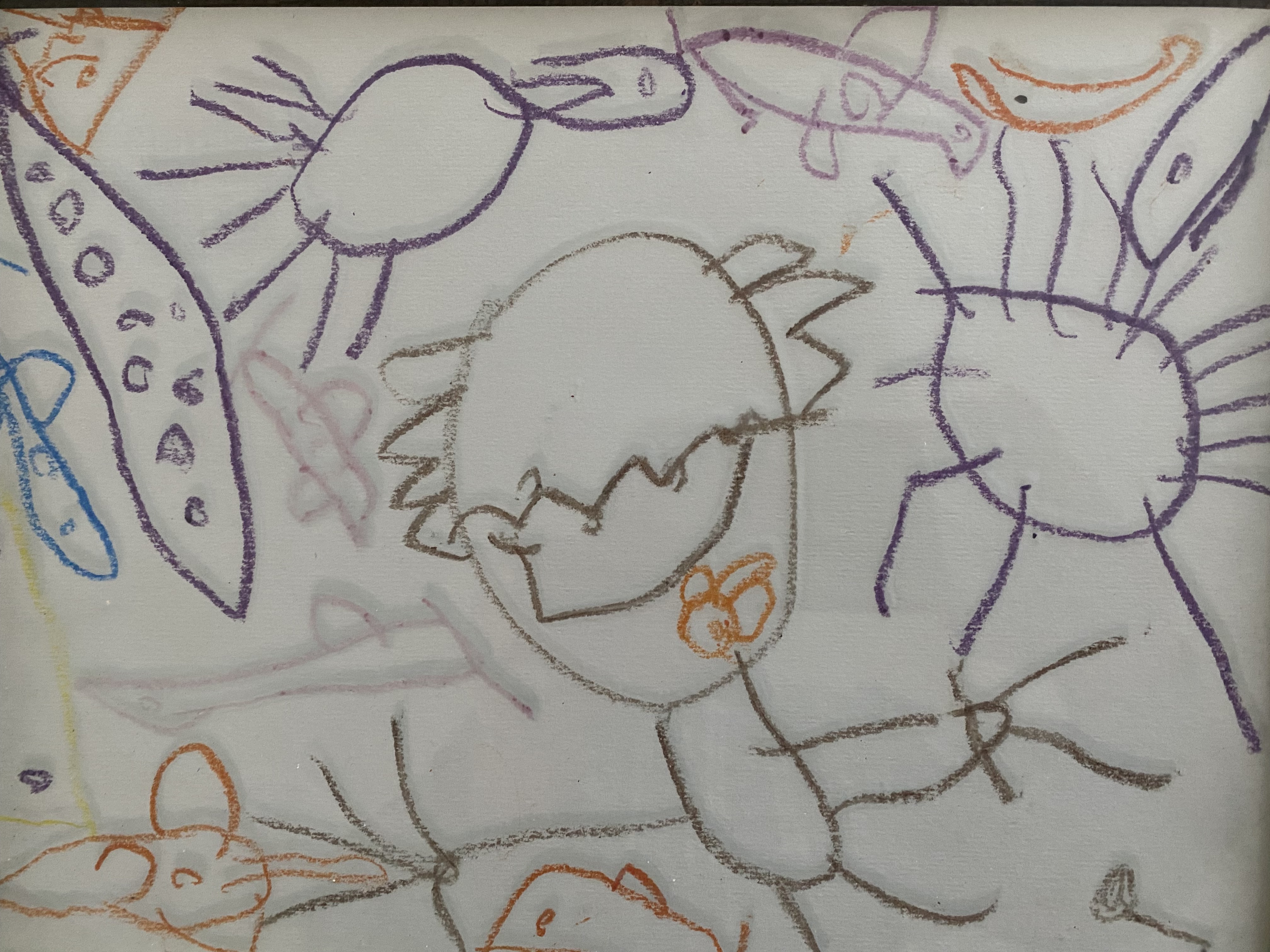
Second, adults should take early writing and drawing in any form more seriously. Look intently, ask your children to explain what they've written, drawn and so on. For example, the image below was drawn in 2007 and is one of my favourites from a grandchild who at the time was 4 years old. We'd been to the aquarium and he drew this back home and explained that he'd drawn it from the perspective of the fish. After he drew the image below he said, "that's how the fish looked at us while we were looking at them." 
Third, children probably spend less time with parents in the earliest development phases (0-4 years) than they did 30-50 years ago; attending playgroups and childcare centres. 

b) The adjustments we need to make

Today, parents and teachers are far less likely to observe their children or students as they compose, whether in text or drawings. 

As parents, we need to see iPads and other devices not just as a way to keep our children quiet, while we do other things. To be sure, there are times when we do NEED to do this. In days gone by the TV and toys played their part in achieving this, as did sand pits, parks etc (but let's not lose these either).

Above: A teacher using an iPad to demonstrate

My recommendation to parents (& teachers) is that when children are using devices, we need to ask them regularly what they're doing, and comment on drawings etc. You might even capture screen shots of special things to share with others (like parents, family etc). Create an electronic portfolio for toddlers.

Teachers of course can make much greater use of iPads and other devices in the classroom to encourage writing, drawing and far more. They are now tools that can be used individually or in groups. I have a graduate student Norah Aldossary who has just completed an interesting PhD on this titled 'The Potential of iPad Apps to support Vocabulary Development in Children Learning English as an Additional Language'.

Other literacy educators have been doing great work in considering how to use devices for learning in classrooms. For example, Michelle Neumann has written about this in 'Teacher Scaffolding of Preschoolers' Shared Story App and a Printed Book' (2019). The many studies by Michelle and others have shown varied benefits from using iPads in this more educational way. Some have found varied benefits, for example:

  • Vocabulary benefits (e.g. Shang & Gray, 2014)
  • Comprehension benefits (e.g. O'Toole & Kannsass, 2018)
  • Word learning in 5 year olds (e.g. Korat et al., 2010)

However conversely, others have found that if used badly, devices might lead to poorer vocabulary and story comprehension (e.g. de Jong and Bus (2003). This seems linked to the children ignoring the text and 'reading' the pictures alone. I'd also suspect, this is linked as well to less child and adult interaction, which we know 'stretches' children's language and learning.

Another interesting study by Roskos, Carroll and Burnstein (2012) looked closely at how teachers used the iPads. They found benefits when teachers used the iPad to extend shared reading by asking questions, explaining word meanings and engaging the students in conversation as they read the iPad stories. This of course leads to development.

In short, as we live in times where the parent and child, or the teacher and her/his students no longer sit reading book stories like they once did with their children, the iPad has potential to facilitate play and experimentation with language and with it growth in language, reading and writing.

Summing up

Children's play always has been, and still is, very important for learning. While the world has changed as technology has developed, the importance of stories and the interaction of children with adults as well as other children, is a key factor in early learning. There is a freedom in play that encourages:

  • Risk taking
  • Experimentation
  • Boldness

We must never allow our busyness, or the convenience of devices to reduce the place of play in children's early years, both prior to school, but also at school. This is a challenge that teachers and parents alike need to take on.


Saturday, October 26, 2019

Supporting Preschool Children (0-4) at Home in Literacy, Maths & Technology Education

Readers of this blog might know that I co-wrote an online preschool support program for parents of children 0-4 years that was released in 2018. The Australian Literacy Educators Association has just uploaded the latest modules in this free online program. No catch, just free support and practical ideas for new parents not sure how to help their children to learn. This support program started out with my co-author Anita Ayre (my co-author) preparing activities for her daughter to support her first child (Anita's grandchild). I was asked to partner with her to develop this online program for parents and grandparents. 


The online resource program is available FREE via the 'Australian Literacy Educators Association' website. The resource is called 'Little People's Literacy Learning: A guide for engaging parents and carers'. It offers practical help for parents and carers of children aged 0-5. And again, it's FREE! You don't need to be a member of ALEA to access to the resource is open to all.

This FREE online guide was launched in 2017 for parents and carers comes with hundreds of activities that you can enjoy with your child. Initially, there were 17 units. Now it has grown to 27 with new modules on 'Maths', 'Maths Language', 'Technology Use', 'Measurement', 'Space' and 'Pattern' just released. The modules will help parents to use simple activities as part of life. Some are incidental and others have some limited planning required. But all you need to know is explained in the modules. All activities are designed with an emphasis on learning through collaborative play and shared discovery. Why are so many of the recent modules related to maths? Because language and literacy have many important relationships to these topics.

Anita and I are experienced teachers, parents, and also (these days) active grandparents who love spending quality time with our grandchildren. In this resource, we offer a wealth of suggestions and hints for parents and carers who want to engage with their children in language, literacy learning and mathematics activities. Technology is also linked to many of these topics as well as now having a separate module. All activities are designed with an emphasis on learning through collaborative play and shared discovery. They can all be incorporated into daily life with very little (or often no) preparation! We offer hundreds of integrated examples throughout, including how new technology and multimedia can also enrich the learning experiences of your child with the same richness as other non-technology applications. You'll also find some advice on how to monitor and control screen time.

The resource contains practical and VERY doable common sense activities. You will find it HERE.


Wednesday, January 17, 2018

Why We Need to Bore Our Kids

My title is meant to be outrageous, but I've also used it because I think it's also true!

We live in an age where children and adults alike never seem to stop! Rarely do we daydream, sit quietly on a park bench and stare into space, lie around at home resting on a wet day and so on. Lazing around does not seem easy in our driven lives. What's more, if there ever is a moment where we aren't confronting a task, conversation or activity, we reach for a device to help us fill this time with more activity. When there is a free moment, we often look to others or devices, to help us know how to use our time.

In one sense, dealing with bored children should be less of a problem than at any time in history, because it seems that there are endless things to do and many ways to use our time. But maybe, our children need to experience boredom? Might a lack of boredom be bad for our children?

What is boredom?

In essence, it is 'unmet arousal'. You are looking for something to do, or an activity to fill a space in your life, but you just can't motivate yourself to do something. Neil Burton suggests that there are many reasons for this:

"These reasons can be internal—often a lack of imagination, motivation, or concentration - or external, such as an absence of environmental stimuli or opportunities. So while you want to do something stimulating, you find yourself unable to do so;  moreover, you are frustrated by the rising awareness of your inability."1

What is significant about boredom is that it's a state that can be acted upon by the bored person. The typical bored child - who we have all experienced - will say, "I'm bored! What can I do?" Or, "Mum can you ... ". Note the onus is being placed on you as the parent to deal with their 'bored state'!

My simple answer to such situations is NOT to try to solve the problem, or simply give in and allow them to retreat to devices and more screen time. During times of boredom your children might just:
  • Find some new activities and interests
  • Lead them to use their imagination 
  • Offer opportunities to be creative
  • Assist them to develop mindfulness
  • Begin to enjoy the moment and their surroundings
However, you might just need to give them some prompts and help to get them started. Here are a few ideas.

How to respond to "Mum, I'm bored"?

At times, you should simply say, "what are you going to do then"? Don't feel that you need to solve the problem. Rather than always trying to solve the problem, it is often best simply to offer some prompts that will direct them towards possibilities. Here are some examples:

1. If it's a fine day, tell them to go outside, lie on their back and look at the sky, and think about 3 things that they might do. If it's bad weather suggest that they look out the window, what do you see? List ten things you can see. Draw one thing. Use one thing as a stimulus for a riddle or poem, "There was a ___  ___ in my yard, I didn't need to look too hard, but try as I might ...".

2. Suggest that they get a box (a shoe box works well) and go and find 5 things they would like to place in it that they could use, or do. This might lead children to put in a favourite toy, a game, crayons, craft materials, a book and so on. Ask them to consider one the thing they could do first. If you have more than one bored child, ask them to compare boxes and come up with a shared activity.

3. Give them a large cardboard box and ask them to consider what they might turn it into. Having a large cardboard box or two in your garage (perhaps in flat pack form) is a great resource. Perhaps a cubby, robot, space vehicle, animal and so on.

4. Suggest that they create a play to prepare and present to the family or some friends. You might help them to come up with some characters and a simple plot. For example, you might have a policeman, a dog, two children, and a school teacher. How can you create a story around these characters that you could present to others?

5. If the weather is fine, suggest that they devise a scavenger hunt, where 'treasure' is collected from the home (with your assistance) and which can then be hidden. The treasure could be edible, or treats of some kind. When the hunt is completed everyone shares the booty.

6. Why not create a family artistic mural, sculpture or map of the local community.


7. Alternatively, plan a photo frenzy (yes, I know a camera is a device, but it's special and only to be used for photos). You could come up with a list of things to photograph in your house and street and give them a time limit to hunt them down, photograph them and return. Give a prize (make it food and ensure it can be shared with everyone) for the most successful scavenger.

8. Or, why don't you suggest they create a board game around a specific theme. A simple game can be made in a race format, and with a dice and simple markers for each player. Use large pieces of cardboard and ask your children to choose their own theme and draw the squares or spaces that you progress through from start to finish (e.g. a car race, race around the world, quest for Mars, climbing Mt Everest etc). The game can have a simple format with spaces marked that can progress or retard the players. For example, in the space race, they could strike a meteor shower that forces them back home, or a time warp that accelerates their ship to another galaxy. Everyone should get to play the games at the end.


Summing Up

Boredom is NOT bad, it can drive children to explore new things, think creatively and move beyond the most common props in life today; screens and devices! Boredom can be used to prompt children to daydream, create, explore, imagine and play. Embrace it as a normal part of life and an opportunity, not just a problem. 

1. Neil Burton (2014), 'The Surprising Benefits of Boredom', Psychology Today'.

Thursday, March 30, 2017

Drawing, Giftedness & Seeing the World Differently

Above: Creating a 'fairy' garden
I've written previously about the need to see giftedness as much more than simply intellectual skills and knowledge that can be established with a narrow range of intelligence tests. One person who has stretched our understanding in the area of giftedness is Howard Gardner in his work on Multiple Intelligences. While some gifted children demonstrate exceptional abilities across a wide range of capabilities (e.g. memory, language, mathematics, problem solving etc), others are gifted in narrower and more specific ways (e.g. visual arts, music, leadership, sport etc). In this post I want to focus on what drawing can show us about giftedness. If you are interested in more information on supporting gifted children you can read a previous post HERE which covers some common territory but has additional ideas for older children.
  
How Drawing Can Demonstrate Giftedness?

Evelyne's 'Horse in a T-Shirt'
A year or so ago, I observed some children using scribbles as part of an improvised drawing game. One made a squiggle and the others tried to turn it into an animal. The first child turned the first scribble into a monster. The squiggler responded, "you can't do a monster, the idea of the game is to draw a real animal, anyone can draw a monster".

He then drew another squiggle. The next child turned it into a horse which in her words was "a horse with a T-Shirt on" (see below). He replied, "but you can't have a horse with a T-shirt on, because they don't wear T-shirts". She replied "well this one does and that's the type of horse I drew with your squiggle".

Let me stress that all three children mentioned in the above example, are gifted in different ways, but two were demonstrating their giftedness in this activity. I should stress that while drawing can be a window on giftedness, it isn't the only way that different children, or even the same child on different occasions, can show their giftedness. But we can learn much from children's drawings that can be a pointer to giftedness?

Ten Things Drawing Can Teach us About Giftedness

Evelyne's drawing and some of the other drawings shared in this post can help us to identify giftedness. What might drawings help us to see?

1. They can show the ability to take a simple task and use it in a novel way, or for different purposes. Evie's drawing shows a preparedness to think outside the box.

2. They also help us to see if a child is able to see the unusual, think in novel ways, and observe possibilities that others don't. The camel drawing below shows this (note its shadow on the ground).

Sketch of 'A Camel & Its Reflection' (Lydia aged 3yrs)

3. It can also demonstrate the willingness of the child to experiment and take risks. These characteristics are evident in many gifted people, e.g. entrepreneurs need these qualities.

4. At the most fundamental level, they can demonstrate the ability to create something original. Not simply a drawing like all other drawings by children of the same age, but something different. For example, ask a 6 years-old to draw a house and you will usually see a hipped roof with chimney, two windows and a central single door.


Above: Child drawing of house (courtesy of 'Childhood Architecture')

5. Drawings can also demonstrate the ability to think abstractly, metaphorically and insightfully, as the child uses drawing to explore thoughts and ideas. Evie's drawing of the T-Shirt wearing horse shows this.

6. As well, drawings can show that a child can generate many solutions and possibilities for the simplest and banal tasks.

7. They can also demonstrate a preparedness to question assumed knowledge or ways of doing things.

Here a 6 yr old positions the pterodactyl above its prey

8. Drawings also offer a window into a more mature (and unusual sense of humour), and a different perspective and view of the world. Their orientation will be unlike that of the average person. The drawing above illustrates just such a different perspective.

9. Drawing can also show a depth of knowledge about a topic that is often required to create a special image. For example, awareness of the anatomical make-up of an animal, or the details of mechanical device can be seen in images that the child generates. As well use of shading to show multiple dimensions, clever use of light and shade and so on, show knowledge of image and design.

10. Finally, drawing can also show how the child's mind leads them to see different things and pay attention to the novel and unusual that is reflected in their drawings. The drawing below by a four year-old shows an image he drew after an outing to an aquarium. He created it as if it was viewed from the perspective of the fish. How did it see his granddad looking at it through the glass?

Jacob (4 years) draws Grandad from the unusual vantage point of the fish inside the aquarium looking out

Summing Up

Imagination & creativity starts early
All children are capable of demonstrating rich imagination and creativity, but some children demonstrate levels of creativity, insight, imagination and knowledge in drawing that suggests giftedness that is beyond the typical and normal. Drawing can help us to look for this and encourage it. I have many other posts that will help you to see some of the ways that you can encourage bright and gifted children. You can read another one of them HERE.


Tuesday, October 27, 2015

Giftedness: How to Identify, Develop & Support It

Once giftedness was defined primarily in terms of intellectual skills and knowledge that could be tested with a narrow range of intelligence tests. But increasingly we recognise that giftedness has multiple dimensions (see for example my post on Howard Gardner's Multiple Intelligences). While some gifted children demonstrate exceptional abilities across a wide range of capabilities (e.g. memory, language, mathematics, problem solving etc), others are gifted in narrower and more specific ways (e.g. visual arts, music, leadership, sport etc). If you are interested in more information on supporting gifted children you can read a previous post HERE which covers some common territory but has additional ideas for older children.     
How do I recognise giftedness in my children?

6yr old drawing of Blue Tongue from predator view
If you live with a gifted child or have one in your class there is a good chance you will begin to recognise a number of characteristics that differentiate them from most children, even most capable children.  While many parents feel their children are gifted as they learn new things (we all think our kids are amazing), exceptional intellectual giftedness is much more rare. While some teachers tend to assume that gifted children can take care of themselves and so require less attention, this can be a dangerous assumption. Life for the highly gifted child can be an extremely frustrating, confusing and at times lonely experience if their giftedness isn't identified and supported. If your child demonstrates, to a significantly greater extent a large number of the following characteristics, they may be gifted and will need support, encouragement and some adaptation by teachers and parents.

  • The ability to invent or create novel or original things, or look at their world in unusual ways (and I'm not talking about a six year old making a paper aeroplane). 
  • The desire and ability to investigate their immediate world, to see the unusual and observe things that others don't notice.
  • Extreme curiosity demonstrated by experimentation, investigation and in depth study.
  • Using extended vocabulary, complex sentence structure and varied language forms.
  • Understanding and using imagery and metaphorical language at a young age (often under 5 years).
  • Exploring varied interests often at depth, well beyond their years.
  • Being able to learn rapidly and easily compared to other children.
  • Gaining great pleasure and excitement when they are learning new and difficult things.
  • Outstanding memory demonstrated by encyclopaedic recall.
  • A desire to spend time with older children or adults and to learn with and from them.
  • Being able to cope with the introduction of many new ideas, sometimes simultaneously.
  • Wanting to spend large amounts of time learning about a favourite topic.
  • Capable of generating many solutions to verbal or mathematical problems.
  • Enjoying and seeking out frequent intellectual challenges.
  • Demonstrating unusual imagination that is stimulated easily and sometimes independently.
  • Ability to generate multiple ideas and solutions to problems.
  • Showing preparedness to question assumed knowledge or ways of doing things.
  • Often preferring individual work rather than group work and able to work well independently.
  • Demonstrating a highly mature and unusual sense of humour.
  • Sometimes having expectations of themselves that are too demanding and unrealistic.
  • Demonstrating single-mindedness and extreme determination when pursuing interests.

If you think about the above characteristics it should be easy to see how they might well be misinterpreted by teachers and parents who don't understand giftedness. For example, wanting to work independently could be seen as anti-social, single-mindedness can be seen as self-focussed, questioning the assumed knowledge of the teacher could be seen as rudeness and so on. This is why the gifted need to be understood and supported; they are different.

Sketch of 'A Camel & Its Reflection' (Lydia aged 3yrs)
One aspect of giftedness is rich imagination. While all children demonstrate imaginative qualities at a very young age, many seem to lose much of their uninhibited almost natural ability. But some grow and demonstrate this to a greater extent as they age. The gifted demonstrate high levels of imagination, which in turn reflects high levels of creativity and significant knowledge. The latter is important, for creativity requires knowledge (e.g. knowledge of subject, language, mathematics etc), and in most instances associated high levels of skill and proficiency (e.g. hand-eye coordination, observation, computation, bodily dexterity, memory, verbal fluency etc).  

Imagination requires the mind to take existing data or knowledge and reintroduce it in a variety of new forms. If your child demonstrates to a significantly greater extent than most children - a large number of the following types of imaginative activity, they are likely to be gifted. If so, they will need support, encouragement and some adaptation by teachers and parents. I will list just some ways in which imagination is demonstrated and how each form can be stimulated.

1. The ability to invent or create novel or original things, or look at their world in unusual ways?

Here a 6 yr old looks at prey from above
Encourage children to look for different perspectives with lots of 'what if?' questions. What if the penguin's wing was bigger? What if we tried to do this another way? What if we had a small city in Antarctica? What if 'The Wind in the Willows' was set in Australia not England? What if you spent most of your life flying, how differently would you understand the world?


2. Using real world objects and knowledge in unusual ways?

Most 'what if' questions can end up here but there are other paths. It requires children to investigate their immediate world (this requires skills), to see the unusual and observe things that others don't notice.

Simple cubby made from a box
  • Make a cubby house from boxes, old sheets etc (see previous post on cubbies HERE).
  • Create a clubhouse in the back yard with membership rules, club motto, a logo and so on. 
  • Create a new board game with a theme of interest. You can use many formats adapted from existing games or create a new form. It requires them to think of a theme (dragons, 'Polly Pocket', Spider Man etc), a format (e.g. series of boxes with a start and finish), rules for playing and scoring etc. 

3. Encourage the child's extreme curiosity that is typically demonstrated by experimentation, investigation and in-depth study

Encourage the study of a topic of interest (but don't be afraid to nudge them on to new areas) by helping to find books, key websites, by taking them to movies, enrichment activities, museums, zoos, special sites, and by helping them to acquire knowledge, buying key tools (e.g. binoculars, microscope, sewing machine, tools). Help them to start an insect collection, a resource book on whales, a short history of your community, a study of one animal, a short talk on the challenges of interplanetary space, a short video on a topic (see my previous post on simple animation HERE), or write their own blog (see my post on children as bloggers HERE).

4. Encourage children to use extended vocabulary, complex sentence structure and varied language forms.

  • This is perhaps the easiest area to enrich. Immerse your children in a rich diet of poetry, literature and drama. Share literature and talk about it, make it a key part of the home or classroom. 
  • Play with language, rhyme, introduce new words and technical terms never use an approximate word in the face. 
  • Play with words as part of life, as you play with your children, drive with them in the car, walk with them along the road. 
  • Play word games with them and make it fun! Dr Seuss is a great place to start with general language silliness (see my post on Dr Seuss HERE). 
  • Give them new words in the midst of real life experiences. 
  • Introduce them to literature beyond their immediate experience.

5. Introduce your children to imagery and metaphorical language.

The gifted child will begin to become aware that language has more than literal meanings. Point out some of this richness, encourage them to observe it, and eventually to use it. Point out that language is enriched by simile, metaphor, homophones, homonyms and so on. Again, this can be done in everyday life as you play, travel, share meals (see my previous posts that deal with this HERE , HERE & HERE)

6. Encourage imaginative discovery in as many varied situations as possible.

Play is one way to achieve this, sometimes with adults, sometimes alone, and also with other children (see my previous post on this HERE).


Another way is to provide rich firsthand experiences from a very young age. Many of these are very basic:

  • The squelch of mud between toes on a wet day in the back yard.
  • Running on a sandy beach for the first time.
  • Watching a worm wiggle in the palm of a small hand.
  • Going outside on a dark and cloudless night to gaze and talk about the stars (if you have an iPad, you might use Star Walk).
  • Watching a bird build its nest in a tree in the playground in spring.
  • Doing hand painting.
  • Observing chickens as they grow bigger day by day, collecting the eggs, sweeping the cage.

7. Encourage your child to try to imagine and generate multiple solutions to problems of varied kinds

This will include problems that are verbal, mathematical, scientific and even practical in nature. Let your children see how you or others solve problems. Draw attention to novel solutions that engineers, doctors, builders and artists come up with. Encourage them to discuss and generate novel solutions to hypothetical as well as real problems.

Summing Up

Imaginative play starts early
Some will look at the above list and feel as if all children could benefit from them. There is truth in this, but it's a matter of degree and regularity. All children need to have their imaginations stimulated, not shut down. But the gifted child will experience painful boredom and frustration if their school experience is filled with repetitive and unchallenging work that does little to stimulate their imaginations.

You might like to consider some of the other ideas in my previous post on giftedness HERE
 
Jacob (4 years) draws Grandad from the unusual vantage point of the fish inside the aquarium looking out

Friday, December 12, 2014

Great Educational Toys for Children: Ideas & Guidelines

This is my fifth annual post on choosing great toys for kids. That is, toys that teach, challenge, stimulate and encourage creativity and learning.

I've outlined before some basic principles for choosing toys which stress that children don't need expensive toys to learn. We know that play in and of itself, stimulates learning, problem solving, language development, creativity and so on (see for example my post 'The importance of simple play' here). In short, many activities require few or no bought materials.

As well, even a single purpose toy that brings great pleasure, but doesn't teach a lot, can achieve more if adults are engaged to some extent with the activity. For example, a game like Hungry Hippos besides helping with basic counting (and being the noisiest game of all time!), can also help children to learn about turn taking, being gracious as a winner and a loser and so on.

But, if you are planning to spend significant sums of money on toys I would be aiming for toys that offer multiple purposes and varied areas of learning. My test questions for the toys we buy are:

  • Do they stimulate creativity and learning?
  • Do they encourage language use?
  • Do they require varied skills and multiple abilities?
  • Do they encourage the integration of many forms of learning?
  • Do they help children to develop interpersonal skills (if it is a multi-player toy)? 
  • Do they require children to collaborate with and, play well with others?
  • Will the toy last (i.e. not fall apart)?
  • Is the toy good value for money?
  • Is the toy fun, interesting and challenging?
  • Will it sustain your child's attention beyond a few uses?

So, while you don't need bought toys to stimulate children, in this post I will talk about some of the bought toys that I find interesting and which have worked with our children and grandchildren. I'm not trying to be  comprehensive, just offering examples of good toys that meet some of the criteria I outline above.

1. Scientific toys for older children

Here are some examples of the many wonderful scientific toys around for children aged 8+. Most range in price from $20 to $40 AUD.

a) The Museum of Victoria has some wonderful kits. One that I like helps children to explore 'Crystals and Minerals'. The kit helps them to discover the amazing qualities and features of minerals in everyday life. Many of these are available from the CSIRO site (see below).

b) CSIRO Science Kits - The CSIRO has some wonderful kits for children. One I like is 'Biology Madness'. This is a comprehensive science kit with 26 fun and interesting experiments. The kit includes all the main scientific equipment required for the experiments, plus an interactive DVD featuring five filmed experiments, and a 68 page full colour booklet which includes fun facts and further experiments. You can also 'Make Your Own Volcano',  do astronomy experiments using the 'Double Helix Astronomy' kit or build their own 'Solar Powered Planaterium'. There are many kits that come in a range of categories including flight, dinosaurs, chemistry, rocks, construction and more.

c) Geoworld also has many wonderful options including a 'Mammoth Skeleton Dig' kit so you can unearth a museum quality replica approved by Paleontologists, a 'Glow in the Dark Solar Mobile' kit and many more.

d) Green Science also have some interesting kits that allow children to experiment with static electricity that causes lightning, make clouds, and watch air currents that produce wind. They have many other options including 'Solar Robot' that allow children to learn how to make a robot that can move under solar power.

e) Kidz Labs (4M) also has some wonderful science kits. One of my favourites is 'Forensics' which helps children to explore basic techniques like finger printing, handwriting analysis, fibre evidence, making plaster casts of footprints, identifying 'strange' powder. Another great kit from Kidz Labs is the 'Animation Praxinoscope' that allows kids to rebuild a 100 year old optical toy that demonstrates modern animation techniques. 

2. Timeless construction toys

No  family should be without a couple of toys that encourage children to make or construct things. These toys help to develop good hand-eye coordination, encourage creativity and problem solving and can help to develop mathematical and spatial intelligence.  There are many types of construction toys that  children can use from a very young age. Here are a few examples:


Above: Father & son play with Knupferli (see below)

a) Wooden blocks of some type  - at our house our grandchildren still use the same set of blocks in  their original walker that our children did 30+ years ago (suitable for ages 6 months  to 3 years).
b) Lego  - probably all three types/sizes will be useful. Our children's Lego is now  played with by our grandchildren (suitable for age 6 months to 15  years). The themed sets for 'Harry Potter' and 'The Hobbit' are on the top of many kid's gift lists and give hours of creative story-telling fun.
c) Mobilo is one of my grandson Sam's favourite toys

d) Other more challenging connector toys - e.g. Knupferli  Construction materials (see above). I used the soft plastic Knupferli materials when I was in Kindergarten and only just rediscovered them again (ideal for age 5-10  years). You can use them to make a simple necklace or a complex 3D shape.

e) Meccano  - newer meccano sets (see right) are different, but they still combine  all the old skills and interest of the metal Meccano I had as a child  (age 5-15 years).

You can do many things with construction toys. Yes, you can build simply things like towers or shapes. You can make houses, cars, anything (in the case of Lego).

In  combination with other objects (e.g. plastic animals or people) you can  tell stories of all kinds. Imaginary zoos can be created, aquariums, farms, space creatures, aliens and dinosaurs can invade villages etc. In some cases your children can learn how to follow instructions and design plans (e.g. Meccano, Knupferli & Lego).

What's great about construction toys is that they:
  • Help to develop hand-eye co-ordination
  • Encourage creativity and problem solving
  • Can help to develop spatial and geometric skills
Above: A family favourite, 'Zoob'

3. 'Toys' that allow you to create

The following are not all strictly toys, some are materials, but all allow children to be creative. Here are a few of my favourites:

a) Modelling clay  - you can buy cheap multi-coloured modelling clay for $2-3 per pack, or  you can make Play Dough. I've written a post on the creative use of  modelling clay (here). Suitable for all ages.
b) Magnetic learning boards with letters and shapes (age 12 months to 5 years), see picture to the right.
c) Magesketch (or some other variety) of this magnetic sketching board, age 12 months to 4 years.
d) Felt boards - there are many products of this type on the market (many of these are very cheap), age 2-6 years.


4. Model people, animal and objects

There  are many wonderful examples of toys that consist of people, animals,  dwellings, and objects that go with them like dolls houses, castles,  forts, arks etc. These allow children to engage in creative play either  alone or with others for long periods of time. These simple objects can  allow children to amuse themselves in a world of make believe and fantasy at home, in the car, at other people's houses etc. They are a wonderful way for children to create (verbally) their first narratives.

Some of the simplest are perhaps the best:

a) Keep a box of animals  - depending on the child's interests these might be farm animals (under 12 months), African animals, sea creatures, dinosaurs and people - these can be used alone or with other toys (see the shot of Sam above  with his Lego 'zoo').
b) Commercial sets like the Little People series and Sylvanian Families are wonderful for young children - we have a set based on Noah's  Ark to which we've added other animals. This has kept all our  grandchildren engaged for hours (0-3 years).
c) A doll's house  will keep boys and girls engaged in creative play for ages and there are modern variations on  the same theme with medieval castles complete within knights and dragons (age 2 -8).


5. Mathematical or Spatial Skill Toys


a) Perpetual puzzles - these are puzzles designed by Makoto Nakamura. They add a new level of creativity by allowing the child to change the shape of the overall puzzle that is based on continuous and interlocking shapes.
b) Blokus is a relatively new puzzle game with simple rules, but it can keep adults and children stimulated for ages. The purpose of the game is for each player to place his/her 21 pieces on  the board (or at least the maximum number of pieces) in a continuous span unimpeded by other players' pieces. It can be played by 2 or 4 people.
c) M-Tic  

This is a brilliant and simple construction type game that consists of multi-coloured plastic pieces with magnetic ends. The purpose of the  game is to create geometric shapes. It is excellent for developing  geometrical and spatial knowledge. If you can't find this version there are other similar examples at good toy shops (see the picture below).
d) Puzzles of all kinds - puzzles are brilliant for developing memory, patience and a variety of spatial skills. Young children can start with simply puzzles that require them to insert an animal or shape into a single hole. Later they can move to simply 6-20 piece puzzles then much more complex puzzles as they develop their skills.

6. Other categories

There  are many other toys that allow children to have fun, learn, manipulate  and develop fine motor skills. Here are just a few examples that I  spotted at my local Toy Shop this week. If you live in Sydney Monkey Puzzle Toy Store  is worth a look, it's one of the best toyshops I've seen. The owners  know and are passionate about toys. Find a good local toy store where  the owners choose, sell and enjoy toys.

a) Magnetic (Mudpuppy) Dress up Figures - these come in a metal box and the mannequins vary (e.g. sports model, pirate, ballerina, monster, mermaid etc).
b) Chicken Socks craft sets (Klutz) - These are cheap and have a variety of separate packets including 'Crayon Rubbings', 'Fun Felt', 'Simple Sewing', 'Hand Art' etc.
c) Puppets  - every house should have a puppet or two, there are many different  types of puppets including finger puppets, hand puppets, shadow puppets and string  puppets.
d) Card games of all kinds. There are so many wonderful card games today that encourage language and mathematics and also encourage sharing and collaboration. Some recent favourites include 'Rush Hour' and 'Story Cubes'. 

There  are obviously many great toys that I haven't mentioned. In my home I'd  always want to have puzzles, lots of writing implements (crayons,  pencils, chalk, varied papers), toys that teach numbers and letters,  toys that train hand-eye co-ordination (through threading, putting  things in holes etc), percussion instruments, Thomas Trains and cars  (especially for boys), a dress-up box and so on.