Showing posts with label transformational teaching. Show all posts

Saturday, October 30, 2021

Helping children to access and use stories to understand and represent their world

I was asked recently to send one of my followers a conference paper on literacy that I presented in 1986! While looking for that paper it led me to sort through many of my older publications from the 1980s and 1990s. I stumbled across one piece I’d written for an international journal in 1990 on “Intertextuality”. This was a buzz word in the 1980s and early 1990s. My interest in the topic arose as part of classroom-based research I had done with children aged 5-12 years. The work was published in a number of journals. As I read the old article, I was pleased that I still agreed with it!


One of the papers was from research titled ‘Intertextuality: Infectious echoes from the past’. It was published in ‘The Reading Teacher’ (March, 1990). I opened the article with a quote from J.R. Tolkien, who had claimed there are no new stories, only a “cauldron of stories” into which we dip as we write. Of course, Tolkien wasn’t the first person to observe that writing always occurs against a backdrop of our prior literary experiences. And there will always be a level of reciprocity between reading and writing. In fact, the reading of one text will always prime and connect with the memory of other stories. So too, writing can be inspired by books (or other media).


Margaret Mahy (1936-2012), the great New Zealand author of children’s books and a dear colleague to many of us writing about literacy, expressed this point well when reflecting on her childhood experiences that helped to shape her:


“I wrote because I was a reader, and wanted to relive certain experiences more intimately by bringing them back out of myself”. (Margaret Mahy)


She suggested that stories “infected her” and she engaged in dialogue with them in a type of “reciprocating discussion”. Books offered her (and us) a “cauldron of stories” from which to draw inspiration, and even ideas.


When I suggested this in conversation with a very well-known Australian author she was indignant, feeling that I was suggesting writers plagiarise from other writers. But of course, this was not what I meant. Our ideas are formed as original ideas against a backdrop of others stories. This in essence is what “intertextuality” means, it is the interconnection between texts written and read. Such connections might affirm ideas, offer us new insights, or help us to grasp the depth of meaning of something in those “aha” moments, when another text challenges, inspires, or perhaps even creates dissension.  


The details of my work and the many scholars who inspired my research on Intertextuality can be found in my original articles. The many scholars included colleagues like Professor Jerry Harste (Indiana University), Margaret Meek, Umberto Eco and many more. Those who are more interested should source my original article and others on the topic. But for parents and teachers there are a few basic points worth stressing here:


1.   From birth, fill your children’s lives with expository, descriptive (including poetry, journals/diaries, novels, & plays) and persuasive texts (e.g. letters, advertisements etc).

2.   Parents, read to your children from birth. And teachers, always make time to share literature in the elementary years of schooling.

3.   Preschool, primary and Secondary teachers, never lose your own passion for literature, so that you might ‘infect’ your students with this same passion.

4.   Help children to celebrate each other’s writing, and acknowledge the inspiration for their writing and ideas.

5.   Encourage experimentation with writing, in form, at the ideas level and in purpose.

6.   Classroom teachers and parents, try to create an environment where stories are shared, talked about and celebrated.

7.   Make sure you use the school, and local library if you have one nearby, to consider books and borrow them.


Never forget that one of the most significant things we can do for our children is to provide access to a “cauldron of stories” into which we they can ‘dip’ as they grow as writers and readers.

Friday, August 18, 2017

5 Ways to Make STEM Exciting

Above: Year 7-10 Students Listen to Guest Scientists

I had the chance to inspect the work of Year 7-10 students at a Girl's Secondary School in Sydney on Monday evening. It was an amazing feast of STEM project work. So much excitement, and so much wonderful teaching and student learning. This was education at its best, as students enjoyed and celebrated each other's work and the challenge of a possible scientific future.

It seemed to me that the teachers and the school were doing five fundamental things well:

1. Making STEM interesting above all else
2. Creating exciting opportunities for learning
3. Giving emphasis to experimentation, problem solving and curiosity
4. Considering real life applications
5. Enabling lots of first-hand experience
 

Students at the school were displaying and explaining their STEM projects to parents and teachers, and the scientific experiments and inventions were being assessed as they hosted and explained their projects. The night started with four outstanding scientists from universities and research organizations, challenging the girls to consider the varied options for a science career - research, invention, social good, teaching etc. We then had the chance to look at the exciting project work that the students had just completed. This was varied and of high quality, and students were near their work ready to explain their research findings or their invention.

a) Designing and completing scientific experiments

Three separate floors were devoted to almost 200 original projects as well as activity areas. Each topic was chosen by the student within some basic parameters of scientific method, project design etc. Here are some samples.

What is the ideal number of worms to decompose waste in a home worm farm? This clever student discovered that 500 worms were better than 1000 in producing a great volume of liquid fertilizer. I asked her to tell offer me her interpretation for this outcome and she was able to speculate why this was so.  The method was described well, the hypothesis and variables clear and sound. More future research to come!

The best music for Musical Therapy? Another student investigated whether there is an ideal type of music that is better for therapy? Is there a relationship between specific musical waves and effectiveness?

Does the volume of water affect the optimum setting time for jelly? Another considered whether there is an optimum volume of water to reduce time and yet preserve quality?

b) Inventions

A number of girls chose to come up with a novel invention. One girl in year 9 decided to design an adjustable child's chair that could be adjusted in height, distance from the floor and so on. Her aim was to allow a chair to be changed in multiple ways as a child grew, so that the back, seat and foot rest were properly located to allowing excellent ergonomic qualities.

Another girl in year 8 tried to invent a picnic rug that would repel ants. She designed a clever edging that was soaked in natural oils and was shown to be very effective. 

Above: The novel edged blanket and the report
c) Good Urban Design

Year 7 girls were all asked to design a sustainable house that not only used appropriate sustainable materials, but was energy efficient when constructed. Their 3D models were supported by their theoretical essays that were of high quality. This design had what you would expect: outstanding materials with great thermal qualities; correct orientation to the sun in the designated city they were allocated; energy conserving strategies and so on. The model below had all of these qualities as well as a green rooftop garden that reduced water runoff, and also had outstanding thermal and insulating qualities. It also required reuse of all natural water, self-sustaining solar power, and much more.


d) Experimentation with robotics

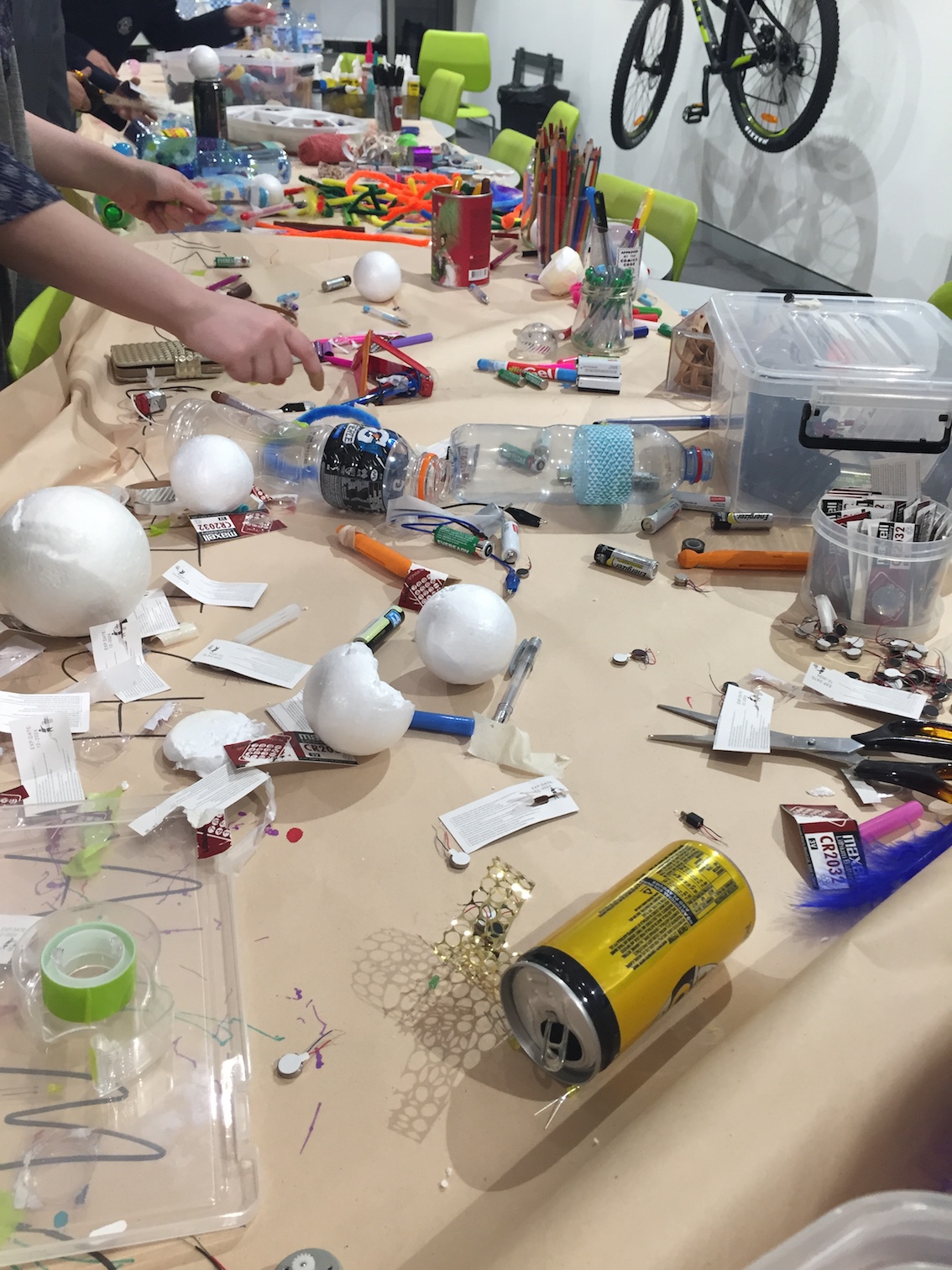
Above: A mass of materials
The evening also had a number of locations that allowed scientific experimentation in chemistry, aeronautics and robotics. The robotics station was one of the most popular places to be.

Throughout the night, teachers were interacting with their students and offering advice and encouragement to manipulate the position of motors, materials, writing tools and so on.  The girls gained great satisfaction from seeing their Bots moving and eventually making them work.

One of the most popular activities was the creation of tiny Bots that use the simple vibration of motors and balance to create movement. The exercise was to get your Bot to move, and at the same time scribe a circle pattern. Lots of fun, and a good introduction to many fundamental elements of robotics.


Above: Some of the Bots in action
e) Celebrating STEM

One other thing that impressed me about this school was the way STEM was being celebrated and shared amongst students. It was cool to be doing STEM at this school, and fun!

Above: STEM news, ideas and celebration


Wednesday, May 31, 2017

Six Steps That Will Change Learners & Classrooms

The terms 'Transformational Teaching' and 'Transformational Learning' are discussed in the academy at times. But is this just academic nonsense or is there some significance to the terms and the practices. What practical advice might the work offer to teachers, parents and those who homeschool?

In the simplest possible terms, Transformational Teaching (TT) is teaching that changes learners by creating the right conditions for learning. We change the way we approach tasks, the questions we ask about the tasks, our expectations for what kids will learn, and our expectations. In effect, it helps to change the way learners understand learning, their co-learners, their teachers and themselves. This is the dead opposite of 'Transactional Teaching'.


The latter can be recognized by the emphasis on transmission of knowledge from teacher to child. Its major concern is what the learner knows and will learn. Transformational Teaching values knowledge too, but it is characterized much more by inquiry, discovery, firsthand experience, critical thinking and the use of varied communication and thinking skills, than simply knowledge transmission. Here are 6 basic steps that will help to create environments in order to change children from simply trying to acquire, soak up or replicate knowledge to learners who develop their abilities in areas like inquiry, discovery, and critical thinking.

6 Key Steps to using Transformational Teaching.

Step 1 - Develop effective routines

If we want to create classroom that encourage inquiry, experimentation, problem solving and lots of interaction, we need to be VERY well organised. Whether quiet places, or noisy ones, we must have good routines.

Step 2 - Organize classroom space & materials well

Transformation learning requires a place, where materials are available, spaces are provided that permit interaction, additional access is given to computers and other key resources.

Step 3 - Establish clear expectations with students about what can and cannot occur

We need to establish some basic rules about sharing space, movement, sharing materials, how class members interact, time frames for task completion and so on. All must be clear and revisited regularly.

Step 4 - Implement routines for the sharing of ideas and discoveries

Classrooms where transformational teaching and learning are practiced, need to be places where ideas are shared and celebrated. Audiences are very important to testing ideas, receiving feedback and learning from one another.

Step 5 - Place a high importance on quality outcomes and behaviour

They will also be classrooms where standards are high. Near enough is not good enough, there must be accountability in terms of quality, task completion respect for others and so on.

Step 6 - Place a priority on communication, feedback, task evaluation, honesty & respect

This is the key to a vibrant engine room in any classroom. Classrooms where there is honesty, generosity and accurate feedback are places where members will take risks as learners. Ensure that these are present and part of your regular maintenance work as a teacher.


What do these classes do?

I'll probably say more about this in a future post but in general terms Transformational Teaching leads to classroom environments where you will see:
  • Much greater interaction between students as well as much greater interaction with the teacher.
  • Much more group work. This will vary based on topic, interest and expertise, not simply general ability.
  • The teacher leading from 'behind' as much as from the front.
  • More celebration of work and achievements.
  • Greater learner autonomy within clear boundaries.
  • Regular demonstration, and expert resource people visiting.
  • Increased use of multi-modal responses (shared use of images, words, drama, art etc).
  • Increased risk taking, experimentation, problem solving and creativity.
  • Finally, we will see higher expectations and standards for work and behaviour.

Wednesday, August 10, 2016

How Can Teaching Change Learners? 6 Steps to transformation

What is Transformational Teaching? In the simplest possible terms Transformational Teaching (TT) is teaching that creates environments that change learners. It changes the way they approach tasks, the questions they ask of the tasks, their expectations for what they will learn from a task, and their expectations for its use and application. It in effect helps to change the way learners understand learning, co-learners, their teachers and themselves.


The opposite of Transformational teaching is 'Transactional Teaching'. This can be recognised by its characteristic transmission of knowledge from teacher to child and its focus on integrating knowledge of others largely as individual learners. Its major concern is what the learner knows and will learn.

While knowledge is important and there is a role for transactional approaches to developing it, there are other ways to learn. Transformational Teaching values knowledge too, but it is characterised much more by inquiry, discovery, firsthand experience, critical thinking and the use of varied communication and thinking skills, than simply knowledge transmission.

6 Key Steps to using Transformational Teaching.

Step 1 - Develop effective routines

What I mean by this is that a classroom that allows inquiry, experimentation, problem solving and lots of interaction needs to be VERY well organised. It is not synonymous with classroom chaos, although there will inevitably be a little more noise.

Step 2 - Organise classroom space & materials well

TT requires a room where materials are available, spaces are provided that permit interaction, additional access is given to computers and other key resources.

Step 3 - Establish clear expectations with students about what can and cannot occur

We need to establish some basic rules about sharing space, movement, sharing materials, how class members interact, time frames for task completion and so on. All must be clear and revisited regularly.

Step 4 - Implement routines for the sharing of ideas and discoveries

Classrooms where TT is practised need to be places where ideas are shared and celebrated. Audiences are very important to testing ideas, receiving feedback and learning from one another.

Step 5 - Place a high importance on quality outcomes and behaviour

Classrooms that are characterised by TT are places where standards are high. Near enough is not good enough, there must be accountability in terms of quality, task completion respect for others and so on.

Step 6 - Place a priority on communication, feedback, task evaluation, honesty & respect

This is the key to a vibrant engine room in any classroom. Classrooms where there is honesty, generosity and accurate feedback are places where members will take risks as learners. Ensure that these are present and part of you regular maintenance work as a teacher.


What do these classes do?

I'll probably say more about this in a future post but in general terms Transformational Teaching leads to classroom environments where you will see:
  • much greater interaction between students as well as much great interaction with the teacher;
  • much more group work (and these will vary based on topic, interest and expertise, not simply general ability;
  • the teacher leading from behind as much as from the front;
  • more celebration of work and achievements;
  • greater learner autonomy within clear boundaries;
  • regular demonstration, and expert resource people visiting;
  • increased use of multi-modal responses (shared use of images, words, drama, art etc);
  • increased risk taking, experimentation, problem solving and creativity; and
  • high expectations and standards for work and behaviour.