Showing posts with label Shakespeare. Show all posts

Wednesday, July 16, 2025

"Literacy Families and Learning" Hits 3 Million Reads!

I'm pleased to report that my blog has now reached over $3,000,000 reads. I want to thank you my readers for your support. Some of you have been reading the blog since 2007! My first post below features my first grandchild (and his Dad). Jake is now aged 22 and is now doing his PhD!

Some interesting facts:

My blog has readers from all continents (not sure about Antarctica!). Posts average 14,000 readers over time, but in 2024 this is closer to 30,000 to 40,000 readers each post. This has come from 507 posts!

Here is a small sample of the most popular posts over time:

'Fathers and Children's Education' (2007) 

20 Simple Travel Games for Children (2009)

Understanding and Developing Creativity (2009)  

Digital Learning for Kids 8 to 13: Fun Learning Games (2011) 

25 Great Apps to Stimulate Literacy, Learning & Creativity (2011) 

Enrichment for Gifted & Talented Children (2011) 

Great Educational Toys for Children (2014) 

Introducing Young Children to Shakespeare (2016)

Newberry, Caldecott & King Children's Awards (2016) 

Why Picture Books Matter, Even for Teenagers & Adults (2018)

70 Historical Picture Books for Children Aged 5-14 (2020) 

The Slow Death of Creativity Imagination and Creativity at School (2020)

Children's Literature that Invites & Encourages Resilience - 6 Great Picture Books to Share (2021) 

Stories for Children by Aboriginal Australians (2021) 

Selling Our Children Short: Educating the Disadvantaged (2023) 

Children's Book Week Awards (2023) 

'Seven New Children's Books that Shouldn't be Missed' (2025) 

Thank you to all of my readers across many nations. Some of my most faithful readers are from the USA, Australia, New Zealand, England, South America and Jordan. 

As we near Children's Book Week in Australia on the 16th to the 23rd September, I thought it was a great time to acknowledge the wonderful Children's Literature that is produced every year in Australia and around the world. 


Thursday, March 9, 2017

Making Shakespeare Exciting For Young Readers

This is a new version of a previous post about the value of Shakespeare for children of all ages, even primary school children  I had little chance as a child to be introduced to Shakespeare until forced to read it at High School. What a terrible way to meet some of the world's greatest literature.  English classes boring and seemingly unrelated to my life.  Shakespeare's plays seemed remote and of little interest. And yet later in life I began to appreciate and love Shakespeare's work.
I've written previously on this blog about the value of Shakespeare for children of all ages, even primary school children (

Is it possible to make Shakespeare accessible for children as young as seven or eight years? Yes, I think it is! A good place to start is either with an abridged version of the great plays or using some of the wonderful prose versions of his work. A well-known theatrical company in Sydney has even begun to present live Shakespeare to primary schools. Bell Shakespeare has set itself the task of introducing primary aged children to Shakespeare's plays, with a plan to teach Shakespeare's work to children as young as six.

Shakespeare Stories for Younger Readers
 
Twelve of Shakespeare's greatest tales come to life in this entertaining collection of short, lively stories specially adapted for young readers. Capturing the vital events and using some of the original wording, the stories serve as a perfect introduction to Shakespeare for preteens and as literate refreshers for older folks.

A wonderful collection of twelve stories that the well-known author Edith Nesbit transformed for her own children. Here we have twelve of Shakespeare's most famous plays - tales of kings, queens, ghosts, and witches. An excellent introduction to the original works suitable for children aged 10+. The collection includes Romeo and Juliet, Hamlet, King Lear, As You Like It, Twelfth Night, The Merchant of Venice, The Tempest, A Midsummer Night's Dream, Cymbeline, The Taming of the Shrew, Pericles, and The Winter's Tale.


Sixty- Minute Shakespeare

I have no doubt that in classrooms where children learn to love words, language and narrative, that they will find Shakespeare exciting, challenging and enriching. There are many resources that will help you. Recently, I had a look at Cass Foster's abridged versions of Shakespeare's plays. The 'Sixty-Minute Shakespeare' series is an ideal alternative for those who lack the time to tackle the unabridged versions. Professor Foster has carefully condensed (without modernizing) the rich poetic language of each play so that it can be completed in about 60 minutes. The abridged versions offer the excitement of Shakespeare's tales, as well as the wonderful imagery in the prose and verse.

Each edition also comes with detailed footnotes on nearly every page explaining the more arcane words and phrases to help the reader better understand and appreciate each play. You will also find practical suggestions for staging, pacing, and thematic exploration very useful. Each script is approximately 70 pages.


'Shakespeare's Hamlet' staged on the page by Nicki Greenberg

This is a remarkable and ambitious work from Nicki Greenberg for high school children. This imaginative and epic 415-page graphic novel will excite many teenage readers. Hamlet has become an expressive black inkblot whose form changes shape according to his circumstances and mood. This is not a kid's picture book! Rather, it is one more attempt to present Shakespeare in new forms. Not just to make it more accessible (for some might find some other word-only attempts less challenging) but to tell it afresh.

There is no doubt that Greenberg’s Hamlet is unique. At 400+ pages it is hardly an easy 'read'. But might it not help the young uninitiated reader of Shakespeare to see new things? Only readers 13+ will be able to help us to answer this question.

The language of Shakespeare is given new emphasis as the play is performed on paper. This is a play 'staged' in a book as the title suggests.  It is a very interesting book but I can't help but feel that a retelling like Leon Garfield’s Shakespeare Stories (see below) is not a better way in. It is hardly stuff for the poor reader, but more likely the gifted who wants to experience Shakespeare with new depth and relevance. It might just do this for some.

Joint winner of the Children's Book Council of Australia (CBCA) Picture Book of the Year 2011

Photo courtesy of the Guardian

Prose Forms for Young Children

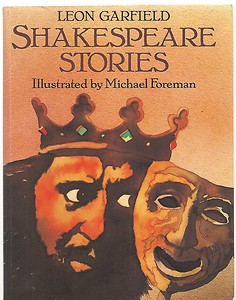
You don't need a theatre company to help you to introduce Shakespeare to young children. One of the easiest ways to get young children interested in Shakespeare's work is to read some of his plays in adapted prose form. While there are some pretty awful attempts to do this, the collections written by Leon Garfield are superb. His first collection 'Shakespeare Stories' was illustrated by Michael Foreman and published by Gollancz in 1984. It features 12 of Shakespeare's best-known works, including 'Twelfth Night', 'The Taming of the Shrew', 'A Midsummer Night's Dream' and 'Macbeth'. Garfield is a brilliant writer of children's fiction and so if anyone was to tackle this project, he would surely be the most likely to succeed in presenting the plays with as much complete dialogue as possible but with adaptations that make the works more accessible without detracting from the language, plots and characterisation of each play. This is how Garfield begins 'A Midsummer Night's Dream':
Hermia, who was small, dark and perfect, loved Lysander; and Lysander loved Hermia. What could have been better than that? At the same time, Helena, who was tall, fair and tearful, loved Demetrius.
But Demetrius did not love Helena. Instead he, too, loved Hermia...who did not love him. What could have been worse than that? 
Garfield's adaptations are engaging and faithful to the plays and if read well to children as young as 7 or 8 will capture their attention. I have used them with children or varied ages and they love to hear Garfield's versions of Shakespeare's work and they want to pick them up and read them. My daughter has also found the Garfield collections wonderful to use with her children aged 6-10.  She has written about this on her own blog (HERE).

A shorter collection, 'Six Shakespeare Stories' was published by Heinemann in 1994 and 'Six More Shakespeare Stories' in 1996.

Other resources

There are a number of other helpful resources and sites for teachers who want to try Shakespeare with children aged 6-12 years.

'Beautiful Stories from Shakespeare' was written by Edith Nesbit in 1907 and is still available in more recent editions (HERE)

A good BBC resource that offers children a simple introduction to Shakespeare and his work (HERE)

The 'Shakespeare 4 Kidz' site is worth a look. Their tag is "Bringing the world of Shakespeare to the young people of the world" (HERE)

'Shakespeare is Elementary' is a great little site developed by an elementary school (Crighton Park) in Novia Scotia Canada. It has some great ideas for getting started (HERE)

You can buy some scripts adapted for young children but I haven't personally tested them (HERE)

The 'Shakespeare for Kids' site also has some helpful advice for teachers using Shakespeare with primary/elementary school children (HERE)

Saturday, April 23, 2016

Introducing Young Children to Shakespeare in the 400th Anniversary of his Death

I've written relatively recently on the value of Shakespeare for children of all ages, even primary school children (HERE). On this the 400th anniversary of his death I thought I'd post it again. There is no better tome to rediscover Shakespeare.

I had little chance as a child to be introduced to Shakespeare until forced to read it at High School. What a terrible way to meet some of the world's greatest literature.  English classes boring and seemingly unrelated to my life.  Shakespeare's plays seemed remote and of little interest. And yet later in life I began to appreciate and love Shakespeare's work.

Is it possible to make Shakespeare accessible for children as young as seven or eight years? Yes, I think it is! A good place to start is either with an abridged version of the great plays or using some of the wonderful prose versions of his work. A company in Sydney has even begun to present live Shakespeare to primary schools. Bell Shakespeare has set itself the task of introducing primary aged children to Shakespeare's plays, with a plan to teach Shakespeare's work to children as young as six.

Sixty- Minute Shakespeare

I have no doubt that in classrooms where children learn to love words, language and narrative, that they will find Shakespeare exciting, challenging and enriching. There are many resources that will help you. Recently, I had a look at Cass Foster's abridged versions of Shakespeare's plays. The 'Sixty-Minute Shakespeare' series is an ideal alternative for those who lack the time to tackle the unabridged versions. Professor Foster has carefully condensed (without modernizing) the rich poetic language of each play so that it can be completed in about 60 minutes. The abridged versions offer the excitement of Shakespeare's tales, as well as the wonderful imagery in the prose and verse.

Each edition also comes with detailed footnotes on nearly every page explaining the more arcane words and phrases to help the reader better understand and appreciate each play. You will also find practical suggestions for staging, pacing, and thematic exploration very useful. Each script is approximately 70 pages.

'Shakespeare's Hamlet' staged on the page by Nicki Greenberg

This is a remarkable and ambitious work from Nicki Greenberg for high school children. This imaginative and epic 415-page graphic novel will excite many teenage readers. Hamlet has become an expressive black inkblot whose form changes shape according to his circumstances and mood. This is not a kid's picture book! Rather, it is one more attempt to present Shakespeare in new forms. Not just to make it more accessible (for some might find some other word-only attempts less challenging) but to tell it afresh.

There is no doubt that Greenberg’s Hamlet is unique. At 400+ pages it is hardly an easy 'read'. But might it not help the young uninitiated reader of Shakespeare to see new things? Only readers 13+ will be able to help us to answer this question.

The language of Shakespeare is given new emphasis as the play is performed on paper. This is a play 'staged' in a book as the title suggests.  It is a very interesting book but I can't help but feel that a retelling like Leon Garfield’s Shakespeare Stories (see below) is not a better way in. It is hardly stuff for the poor reader, but more likely the gifted who wants to experience Shakespeare with new depth and relevance. It might just do this for some.

Joint winner of the Children's Book Council of Australia (CBCA) Picture Book of the Year 2011

Photo courtesy of the Guardian

Prose Forms for Young Children

You don't need a theatre company to help you to introduce Shakespeare to young children. One of the easiest ways to get young children interested in Shakespeare's work is to read some of his plays in adapted prose form. While there are some pretty awful attempts to do this, the collections written by Leon Garfield are superb. His first collection 'Shakespeare Stories' was illustrated by Michael Foreman and published by Gollancz in 1984. It features 12 of Shakespeare's best-known works, including 'Twelfth Night', 'The Taming of the Shrew', 'A Midsummer Night's Dream' and 'Macbeth'. Garfield is a brilliant writer of children's fiction and so if anyone was to tackle this project, he would surely be the most likely to succeed in presenting the plays with as much complete dialogue as possible but with adaptations that make the works more accessible without detracting from the language, plots and characterisation of each play. This is how Garfield begins 'A Midsummer Night's Dream':
Hermia, who was small, dark and perfect, loved Lysander; and Lysander loved Hermia. What could have been better than that? At the same time, Helena, who was tall, fair and tearful, loved Demetrius.
But Demetrius did not love Helena. Instead he, too, loved Hermia...who did not love him. What could have been worse than that? 
Garfield's adaptations are engaging and faithful to the plays and if read well to children as young as 7 or 8 will capture their attention. I have used them with children or varied ages and they love to hear Garfield's versions of Shakespeare's work and they want to pick them up and read them. My daughter has also found the Garfield collections wonderful to use with her children aged 6-10.  She has written about this on her own blog (HERE).

A shorter collection, 'Six Shakespeare Stories' was published by Heinemann in 1994 and 'Six More Shakespeare Stories' in 1996.

Other resources

There are a number of other helpful resources and sites for teachers who want to try Shakespeare with children aged 6-12 years.

'Beautiful Stories from Shakespeare' was written by Edith Nesbit in 1907 and is still available in more recent editions (HERE)

A good BBC resource that offers children a simple introduction to Shakespeare and his work (HERE)

The 'Shakespeare 4 Kidz' site is worth a look. Their tag is "Bringing the world of Shakespeare to the young people of the world" (HERE)

'Shakespeare is Elementary' is a great little site developed by an elementary school (Crighton Park) in Novia Scotia Canada. It has some great ideas for getting started (HERE)

You can buy some scripts adapted for young children but I haven't personally tested them (HERE)

The 'Shakespeare for Kids' site also has some helpful advice for teachers using Shakespeare with primary/elementary school children (HERE)

Read more about the Bell Shakespeare work in Sydney HERE

Tuesday, November 17, 2015

Introducing Young Children to Shakespeare

I've written previously on this blog about the value of Shakespeare for children of all ages, even primary school children (HERE). I had little chance as a child to be introduced to Shakespeare until forced to read it at High School. What a terrible way to meet some of the world's greatest literature.  English classes boring and seemingly unrelated to my life.  Shakespeare's plays seemed remote and of little interest. And yet later in life I began to appreciate and love Shakespeare's work.

Is it possible to make Shakespeare accessible for children as young as seven or eight years? Yes, I think it is! A good place to start is either with an abridged version of the great plays or using some of the wonderful prose versions of his work. A company in Sydney has even begun to present live Shakespeare to primary schools. Bell Shakespeare has set itself the task of introducing primary aged children to Shakespeare's plays, with a plan to teach Shakespeare's work to children as young as six.

Sixty- Minute Shakespeare

I have no doubt that in classrooms where children learn to love words, language and narrative, that they will find Shakespeare exciting, challenging and enriching. There are many resources that will help you. Recently, I had a look at Cass Foster's abridged versions of Shakespeare's plays. The 'Sixty-Minute Shakespeare' series is an ideal alternative for those who lack the time to tackle the unabridged versions. Professor Foster has carefully condensed (without modernizing) the rich poetic language of each play so that it can be completed in about 60 minutes. The abridged versions offer the excitement of Shakespeare's tales, as well as the wonderful imagery in the prose and verse.

Each edition also comes with detailed footnotes on nearly every page explaining the more arcane words and phrases to help the reader better understand and appreciate each play. You will also find practical suggestions for staging, pacing, and thematic exploration very useful. Each script is approximately 70 pages.

'Shakespeare's Hamlet' staged on the page by Nicki Greenberg

This is a remarkable and ambitious work from Nicki Greenberg for high school children. This imaginative and epic 415-page graphic novel will excite many teenage readers. Hamlet has become an expressive black inkblot whose form changes shape according to his circumstances and mood. This is not a kid's picture book! Rather, it is one more attempt to present Shakespeare in new forms. Not just to make it more accessible (for some might find some other word-only attempts less challenging) but to tell it afresh.

There is no doubt that Greenberg’s Hamlet is unique. At 400+ pages it is hardly an easy 'read'. But might it not help the young uninitiated reader of Shakespeare to see new things? Only readers 13+ will be able to help us to answer this question.

The language of Shakespeare is given new emphasis as the play is performed on paper. This is a play 'staged' in a book as the title suggests.  It is a very interesting book but I can't help but feel that a retelling like Leon Garfield’s Shakespeare Stories (see below) is not a better way in. It is hardly stuff for the poor reader, but more likely the gifted who wants to experience Shakespeare with new depth and relevance. It might just do this for some.

Joint winner of the Children's Book Council of Australia (CBCA) Picture Book of the Year 2011

Photo courtesy of the Guardian

Prose Forms for Young Children

You don't need a theatre company to help you to introduce Shakespeare to young children. One of the easiest ways to get young children interested in Shakespeare's work is to read some of his plays in adapted prose form. While there are some pretty awful attempts to do this, the collections written by Leon Garfield are superb. His first collection 'Shakespeare Stories' was illustrated by Michael Foreman and published by Gollancz in 1984. It features 12 of Shakespeare's best-known works, including 'Twelfth Night', 'The Taming of the Shrew', 'A Midsummer Night's Dream' and 'Macbeth'. Garfield is a brilliant writer of children's fiction and so if anyone was to tackle this project, he would surely be the most likely to succeed in presenting the plays with as much complete dialogue as possible but with adaptations that make the works more accessible without detracting from the language, plots and characterisation of each play. This is how Garfield begins 'A Midsummer Night's Dream':
Hermia, who was small, dark and perfect, loved Lysander; and Lysander loved Hermia. What could have been better than that? At the same time, Helena, who was tall, fair and tearful, loved Demetrius.
But Demetrius did not love Helena. Instead he, too, loved Hermia...who did not love him. What could have been worse than that? 
Garfield's adaptations are engaging and faithful to the plays and if read well to children as young as 7 or 8 will capture their attention. I have used them with children or varied ages and they love to hear Garfield's versions of Shakespeare's work and they want to pick them up and read them. My daughter has also found the Garfield collections wonderful to use with her children aged 6-10.  She has written about this on her own blog (HERE).

A shorter collection, 'Six Shakespeare Stories' was published by Heinemann in 1994 and 'Six More Shakespeare Stories' in 1996.

Other resources

There are a number of other helpful resources and sites for teachers who want to try Shakespeare with children aged 6-12 years.

'Beautiful Stories from Shakespeare' was written by Edith Nesbit in 1907 and is still available in more recent editions (HERE)

A good BBC resource that offers children a simple introduction to Shakespeare and his work (HERE)

The 'Shakespeare 4 Kidz' site is worth a look. Their tag is "Bringing the world of Shakespeare to the young people of the world" (HERE)

'Shakespeare is Elementary' is a great little site developed by an elementary school (Crighton Park) in Novia Scotia Canada. It has some great ideas for getting started (HERE)

You can buy some scripts adapted for young children but I haven't personally tested them (HERE)

The 'Shakespeare for Kids' site also has some helpful advice for teachers using Shakespeare with primary/elementary school children (HERE)

Read more about the Bell Shakespeare work in Sydney HERE

Monday, June 16, 2014

Getting Children of All Ages Excited About Shakespeare

I've written previously on this blog about the value of Shakespeare for children of all ages, even primary school children (HERE). I grew up in a home where books weren't read to or with me, so reading was not a pleasurable pursuit at home. So there was little chance that I was ever going to meet Shakespeare until forced to read it at High School. What a terrible way to be introduced to some of the world's greatest literature.  I found English classes boring and seemingly unrelated to my life.  Not surprisingly, I found Shakespeare's plays remote and of little interest. And yet later in life I began to appreciate and love Shakespeare's work.

But is it possible to make Shakespeare accessible for children as young as seven or eight years? Yes, I think it is! A good place to start is either with an abridged version of the great plays or using some of the wonderful prose versions of his work. A company in Sydney has even begun to present live Shakespeare to primary schools.

Bell Shakespeare has set itself the task of introducing primary aged children to Shakespeare's plays, with a plan to teach Shakespeare's work to children as young as six. The company wants to inspire a new generation to love the work. The company sees the program as a form or 'early intervention' where children will be helped to appreciate the complex and rich language of the great epic stories that are the foundation of Shakespeare's work.

Sixty- Minute Shakespeare

I have no doubt that in classrooms where children learn to love words, language and narrative, that they will find Shakespeare exciting, challenging and enriching. There are many resources that will help you. Recently, I had a look at Cass Foster's abridged versions of Shakespeare's plays. The 'Sixty-Minute Shakespeare' series is an ideal alternative for those who lack the time to tackle the unabridged versions. Professor Foster has carefully condensed (without modernizing) the rich poetic language of each play so that it can be completed in about 60 minutes. The abridged versions offer the excitement of Shakespeare's tales, as well as the wonderful imagery in the prose and verse.

Each edition also comes with detailed footnotes on nearly every page explaining the more arcane words and phrases to help the reader better understand and appreciate each play. You will also find practical suggestions for staging, pacing, and thematic exploration very useful. Each script is approximately 70 pages.

'Shakespeare's Hamlet' staged on the page by Nicki Greenberg

This is a remarkable and ambitious work from Nicki Greenberg for high school children. This imaginative and epic 415-page graphic novel will excite many teenage readers. Hamlet has become an expressive black inkblot whose form changes shape according to his circumstances and mood. This is not a kid's picture book! Rather, it is one more attempt to present Shakespeare in new forms. Not just to make it more accessible (for some might find some other word-only attempts less challenging) but to tell it afresh.

There is no doubt that Greenberg’s Hamlet is unique. At 400+ pages it is hardly an easy 'read'. But might it not help the young uninitiated reader of Shakespeare to see new things? Only readers 13+ will be able to help us to answer this question.

The language of Shakespeare is given new emphasis as the play is performed on paper. This is a play 'staged' in a book as the title suggests.  It is a very interesting book but I can't help but feel that a retelling like Leon Garfield’s Shakespeare Stories (see below) is not a better way in. It is hardly stuff for the poor reader, but more likely the gifted who wants to experience Shakespeare with new depth and relevance. It might just do this for some.

Joint winner of the Children's Book Council of Australia (CBCA) Picture Book of the Year 2011

Photo courtesy of the Guardian

Prose Forms for Young Children

You don't need a theatre company to help you to introduce Shakespeare to young children. One of the easiest ways to get young children interested in Shakespeare's work is to read some of his plays in adapted prose form. While there are some pretty awful attempts to do this, the collections written by Leon Garfield are superb. His first collection 'Shakespeare Stories' was illustrated by Michael Foreman and published by Gollancz in 1984. It features 12 of Shakespeare's best-known works, including 'Twelfth Night', 'The Taming of the Shrew', 'A Midsummer Night's Dream' and 'Macbeth'. Garfield is a brilliant writer of children's fiction and so if anyone was to tackle this project, he would surely be the most likely to succeed in presenting the plays with as much complete dialogue as possible but with adaptations that make the works more accessible without detracting from the language, plots and characterisation of each play. This is how Garfield begins 'A Midsummer Night's Dream':
Hermia, who was small, dark and perfect, loved Lysander; and Lysander loved Hermia. What could have been better than that? At the same time, Helena, who was tall, fair and tearful, loved Demetrius.
But Demetrius did not love Helena. Instead he, too, loved Hermia...who did not love him. What could have been worse than that? 
Garfield's adaptations are engaging and faithful to the plays and if read well to children as young as 7 or 8 will capture their attention. I have used them with children or varied ages and they love to hear Garfield's versions of Shakespeare's work and they want to pick them up and read them. My daughter has also found the Garfield collections wonderful to use with her children aged 6-10.  She has written about this on her own blog (HERE).

A shorter collection, 'Six Shakespeare Stories' was published by Heinemann in 1994 and 'Six More Shakespeare Stories' in 1996.

Other resources

There are a number of other helpful resources and sites for teachers who want to try Shakespeare with children aged 6-12 years.

'Beautiful Stories from Shakespeare' was written by Edith Nesbit in 1907 and is still available in more recent editions (HERE)

A good BBC resource that offers children a simple introduction to Shakespeare and his work (HERE)

The 'Shakespeare 4 Kidz' site is worth a look. Their tag is "Bringing the world of Shakespeare to the young people of the world" (HERE)

'Shakespeare is Elementary' is a great little site developed by an elementary school (Crighton Park) in Novia Scotia Canada. It has some great ideas for getting started (HERE)

You can buy some scripts adapted for young children but I haven't personally tested them (HERE)

The 'Shakespeare for Kids' site also has some helpful advice for teachers using Shakespeare with primary/elementary school children (HERE)

Read more about the Bell Shakespeare work in Sydney HERE

Thursday, March 7, 2013

Getting Primary School Children Into Shakespeare

As a child I grew up in a home where books weren't read to or with me, so reading was not a pleasurable pursuit at home. It did hold challenges and pleasures at primary school, but the material that we read was limited. At High School I found English boring and seemingly unrelated to my life.  I can recall being bored by Shakespeare's work. And yet later in life I began to appreciate it and love it.

I was unprepared for Shakespeare as a child, and suspect that there are many children sitting in high school classrooms right now just as bored as I once was. This is a problem. Not because there isn't a world of other literature. There is. My point isn't to argue for a return to an age where a small number of great (mostly male) authors made up a canon of books that all needed to read (mind you we do need to read great books). Instead, I want the children in our schools to have such a love of words, language, and narrative in all its forms, that they will find Shakespeare exciting, challenging and enriching. 

Photo courtesy of the Guardian
In Sydney, a well-known theatre company, Bell Shakespeare has set itself the task of introducing primary aged children to Shakespeare's plays. They plan to teach Shakespeare's plays to children as young as six. Bell Shakespeare will take the plays into the state's primary schools to inspire a new generation to love this great literature. The company sees the program as a form or 'early intervention' where children will be helped to appreciate the complex and rich language of the great epic stories that are the foundation of Shakespeare's work. They hope to overcome the negative reactions of high school by developing an appreciation early. The education head of the theatre company suggests:

''We want to meet them while they're young, so that by the time they reach high school, they aren't disillusioned.''

The company will tour with the primary school program that will have adaptations of well-known plays like 'A Midsummer Night's Dream' and 'Macbeth'. Both have been well received and 'A Midsummer Night's Dream' has been a favourite with test audiences. Teacher who have viewed the plays were not difficult for children as young as 6 and 7 to understand.

Shakespeare in Adapted Prose Forms

But you don't need a theatre company to help you to introduce Shakespeare to young children. One of the easiest ways to get children interested in Shakespeare's work is to read some of his plays in adapted prose form. While there are some pretty awful attempts to do this, the collections written by Leon Garfield are superb. His first collection 'Shakespeare Stories' was illustrated by Michael Foreman and published by Gollancz in 1984. It features 12 of Shakespeare's best-known works, including 'Twelfth Night', 'The Taming of the Shrew', 'A Midsummer Night's Dream' and 'Macbeth'. Garfield is a brilliant writer of children's fiction and so if anyone was to tackle this project, he would surely be the most likely to succeed in presenting the plays with as much complete dialogue as possible but with adaptations that make the works more accessible without detracting from the language, plots and characterisation of each play. This is how Garfield begins 'A Midsummer Night's Dream':
Hermia, who was small, dark and perfect, loved Lysander; and Lysander loved Hermia. What could have been better than that? At the same time, Helena, who was tall, fair and tearful, loved Demetrius.
But Demetrius did not love Helena. Instead he, too, loved Hermia...who did not love him. What could have been worse than that? 
Garfield's adaptations are engaging and faithful to the plays and if read well to children as young as 7 or 8 will capture their attention. I have used them with children or varied ages and they love to hear Garfield's versions of Shakespeare's work and they want to pick them up and read them. My daughter has also found the Garfield collections wonderful to use with her children aged 6-10.  She has written about this on her own blog (HERE).

A shorter collection, 'Six Shakespeare Stories' was published by Heinemann in 1994 and 'Six More Shakespeare Stories' in 1996.

Other resources

There are a number of other helpful resources and sites for teachers who want to try Shakespeare with children aged 6-12 years.

'Beautiful Stories from Shakespeare' was written by Edith Nesbit in 1907 and is still available in more recent editions (HERE)

A good BBC resource that offers children a simple introduction to Shakespeare and his work (HERE)

The 'Shakespeare 4 Kidz' site is worth a look. Their tag is "Bringing the world of Shakespeare to the young people of the world" (HERE)

'Shakespeare is Elementary' is a great little site developed by an elementary school (Crighton Park) in Novia Scotia Canada. It has some great ideas for getting started (HERE)

You can buy some scripts adapted for young children but I haven't personally tested them (HERE)

The 'Shakespeare for Kids' site also has some helpful advice for teachers using Shakespeare with primary/elementary school children (HERE)

Read more about the Bell Shakespeare work in Sydney HERE