Showing posts with label language. Show all posts

Saturday, October 26, 2019

Supporting Preschool Children (0-4) at Home in Literacy, Maths & Technology Education

Readers of this blog might know that I co-wrote an online preschool support program for parents of children 0-4 years that was released in 2018. The Australian Literacy Educators Association has just uploaded the latest modules in this free online program. No catch, just free support and practical ideas for new parents not sure how to help their children to learn. This support program started out with my co-author Anita Ayre (my co-author) preparing activities for her daughter to support her first child (Anita's grandchild). I was asked to partner with her to develop this online program for parents and grandparents. 


The online resource program is available FREE via the 'Australian Literacy Educators Association' website. The resource is called 'Little People's Literacy Learning: A guide for engaging parents and carers'. It offers practical help for parents and carers of children aged 0-5. And again, it's FREE! You don't need to be a member of ALEA to access to the resource is open to all.

This FREE online guide was launched in 2017 for parents and carers comes with hundreds of activities that you can enjoy with your child. Initially, there were 17 units. Now it has grown to 27 with new modules on 'Maths', 'Maths Language', 'Technology Use', 'Measurement', 'Space' and 'Pattern' just released. The modules will help parents to use simple activities as part of life. Some are incidental and others have some limited planning required. But all you need to know is explained in the modules. All activities are designed with an emphasis on learning through collaborative play and shared discovery. Why are so many of the recent modules related to maths? Because language and literacy have many important relationships to these topics.

Anita and I are experienced teachers, parents, and also (these days) active grandparents who love spending quality time with our grandchildren. In this resource, we offer a wealth of suggestions and hints for parents and carers who want to engage with their children in language, literacy learning and mathematics activities. Technology is also linked to many of these topics as well as now having a separate module. All activities are designed with an emphasis on learning through collaborative play and shared discovery. They can all be incorporated into daily life with very little (or often no) preparation! We offer hundreds of integrated examples throughout, including how new technology and multimedia can also enrich the learning experiences of your child with the same richness as other non-technology applications. You'll also find some advice on how to monitor and control screen time.

The resource contains practical and VERY doable common sense activities. You will find it HERE.


Monday, September 25, 2017

Early Childhood Literacy Learning: FREE Resources to Download

I'm proud to share the details of a brand new resource for parents and carers, for which I am one of the authors. 'Little People's Literacy Learning: A Guide for Engaging Parents & Carers' (Anita Ayre & Trevor Cairney) is now available FREE to download. My co-author Anita Ayre conceived the need for a book for new parents, while trying to help her son and daughter-in-law with their first child. They were keen to tap Anita's knowledge of early childhood learning. Part way through the development of the resource, representatives of the Australian Literacy Educators' Association approached me and asked whether I might team up with Anita on this project. After meeting with Anita, and realizing that we shared a common passion for early childhood learning, I agreed to be part of the project.

Initially it was to be a resource book, but ALEA suggested that it might have wider coverage as a downloadable free resource for parents presented in bite sized chunks. In all, 18 of the 26 modules are already available free to download HERE.

Module 1: Learning the names of body parts
Module 2: Exploring Fine Motor Development
Module 3: Similarities and Differences
Module 4: Orientation
Module 5: Relationships between Objects
Module 6: Speaking
Module 7: Reading and Learning
Module 8: Writing
Module 9: Spelling
Module 10: Organisation
Module 11: Gross Motor Development
Module 12: Listening
Module 13: Reading
Module 14: Learning about Books
Module 15: Visual Discrimination
Module 16: Developing Memory
Module 17: Word Recognition
Module 18: Rhythm 
  
The resource is designed to be dipped into as parents see the need to explore specific topics. Please note: More modules have been written and will be released progressively as the designers complete them.


Saturday, December 12, 2015

Simple word, memory & observation games that will shorten any holiday trip with kids

In Australia it's summer and school will be out for 6 weeks across the nation very soon. Many families will be heading for the beaches and waterways to enjoy Christmas in a particularly Aussie way. For some this will involve hours of travel as relatives are visited and exquisite coastal locations sought out. This is always a recipe for children getting bored and frustrated with one another - "...are we there yet!". 

This post is a repeat of some earlier posts, but I hope that it will be useful reminder of some great games that will keep children happily content for hours. I've done posts on travel games for children before and now seems a good time for another. So whether you will be in a car, bus or plane, or just stuck inside on a wet day, these games might just help.

Above: Photo courtesy of the Australian Newspaper

I've included a number of games that we played with our children in the car when they were young, some I used when teaching and a few new ones that I'd love to play with my grandchildren. Some of the newer games are adaptations of some activities from a great resource published by Usborne Children's books, '50 things to do on a journey' (here). This resource has a range of written and verbal activities that cover literacy, mathematics and general knowledge. One thing to note about these games is that you don't have to play every one of them competitively. If you do, you might need to handicap older children.


1. Sound word categories

You start this game by agreeing on 3-5 categories (depending on the age of the children and their vocabularies) for which people will have to be able to think of words that belong to them; for example, an insect, flower, person, country, girl's name, action word. Someone chooses a letter (maybe Mum or Dad to make sure that it isn't too hard) that has to be used by everyone and is applied to each category. The fastest person to quickly name their words earns 3 points, the second gets 2 and the third 1. So for the letter 'f' and the three categories insect, country and girl's name you could say fly, France and Fiona. A parent usually acts as the timer.

2. Top 6 (or 10 if your children get to be good at it)

This activity is a variation on the previous 'Sound Word Categories'. You vary it by choosing a category and then seeing if someone can list 6-10 words that fit the category. For example, think of 10 car names, dogs, books, insects, snakes, footballers etc. The person who thinks of the most words in a category wins.


3. Rhyming words

Pick a word that is easy to rhyme with other real words. Each person takes a turn. The winner is the person who is the last one to think of a rhyming word. For example, heat, seat, meat, bleat, sleet, neat, pleat..... If the children are older they can write the words down simultaneously.

4. Don't say yes

This is a slightly harder game but lots of fun. One person has to answer questions and the others get to ask them questions to which the answer is obviously 'yes', but they must answer every question truthfully without saying 'yes'. If they do say 'yes', or can't answer, the turn ends and the person asking the question earns a point. For example, Karen is asked, "Do you like ice-cream"? To which she might answer, "Most people like milk-based products that are cold." The next person in the car asks a question, but it mustn't be simply the same question. For example, they could ask, "Do you like milk-based products in cones?" To which the reply might be, "Some I like to eat in a wafer case."

5. Spotto......

One of our family's favourite games in the car was 'Spotto windmill'. We lived in the country and often drove for 5-6 hours towards the coast. In key areas there were lots of windmills pumping water for stock. But you don't have to use windmills; you can spot billboards, bridges, trees, birds, and animals, almost anything that is common. The game can be concluded in various ways, such as the first to 30, ending it at a specific landmark or just stopping when you're tired of it or you run out of windmills (or whatever).

6. What's your job

This game starts with someone thinking of a job. Others then guess by trying to find out details about what the person does, where they work, they use tools, what skills you need etc. The skill is in asking just the right questions. Does this person work outdoors? Do they drive something? Do they use special tools? Can they work alone? etc. The aim is to see who can get it right. Every person in the car takes it in turns to ask a question and you keep rotating until someone gets it right. That person gets to pick the next job and it all starts over again.

7. Guess my song

Someone picks a song and they have to hum the first line. Everyone in the car has one guess then the person hums an extra line if no-one gets it after the first round. This continues until someone gets the song.

8. Guess the person

One person in the car thinks of a person everyone knows (e.g. a family member, TV star, book character, teacher, cartoon character, famous person), and then everyone takes turns to ask a question about them. Is it a man or a woman? Are they young or old? Does she have black hair? Does he wear glasses? Is she famous?

9. I Spy..

This is a well-known game. It can be varied for young children by simply asking for categories rather than insisting on letter names or sounds. So the variations can include: "I spy with my little eye, something beginning with" 'p' (letter name) or 'p' (sound name) or even, "that is green". The last variation is a good way to involve very young children and the categories can be very varied. "I spy with my little eye a thing that ...." is black...or, a little thing that bites... or, a person who likes coffee... or, a thing the car has to stop at etc.

10. Back to back words

People think of words that begin the way the last word ends. You will need to demonstrate this a few times and it isn't that suitable for children under 6 years. It might go like this: pot, tree, egg, goat, top, pot, turtle, elf, fog, goldfish. You can make the game harder for older children if you like by asking for the words to fit specific single categories like animals, names, places.


11. Who lives there?

This is a great game. Wait till you stop at traffic lights or you are travelling slowly enough to see a house long enough to remember some details. People take turns adding details to describe who might live there. This can be very creative or an accurate set of predictions. Each player builds (plausibly) on the previous person's clues. For example, first person says, "a mother lives there with her three children". The next person says, "the children are aged 3, 7 and 16". The next person says, "their names are, Sue, Pickle and Wobble.". The next says, "Wobble is named after his Dad (Bobble) who is on a round the world yacht trip" etc. When people run out of ideas you start again. You could vary this by choosing a car. The first person might say, "That car has a family of three children and their parents heading for the seaside".

12. Twenty questions

This starts with someone choosing an object, person, place, country etc that others have to identify. The others in the car have a chance to ask questions (maximum of 20 for each thing chosen). The questions are answered with a 'yes' or a 'no'. When someone thinks they know it they can guess. You can score this different ways (or not all). The person whose word is not guessed can score points as can the person who guesses correctly.

13. Memory game

There are many memory games, but a common one involves thinking of things that are in the car (or the boot/trunk), an imaginary backpack, suitcase, the kitchen at home, the beach where you'll visit. The people in the car add an item to a list and the next person must repeat previous details and add their own. People are eliminated when they forget an item. So it could start like this: "In the car we have a radio", to which someone says, "in the car we have a radio and a steering wheel", which could become "in the car we have a radio and a steering wheel, plus a pesky sister.....". A parent might write them down as you progress to avoid disputes.

14. Never-ending story

This game has two main forms, a single word version and a sentence version. In the word version people in the car take turns adding to a story one word at a time. It might go like this: "It", "was", "the", "first", "day", "of", "the", "monster's", "summer", "camp"....and so on. The members of the game try to make it impossible to add to the story because the last word is pretty much the last word.

The sentence version is slightly more complex but just as much fun.

15. Word association

This game is a bit trickier but can be handled by children 6+. Someone starts with a word and the next person has to add a word that has an association. Using just nouns and verbs is easiest. The game ends when a word is repeated or someone is stuck. You can have winners and losers if you want but it isn't necessary. Here's how it might go. "Dogs", "bark", "bones", "kennel", "growl", "fleas", "wag", "tail", "scratch" etc.

16. Who am I?

The first player thinks of the name of someone who everyone will know then gives a clue about their identity, for example, Big Bird, a relative, a cartoon character etc. The people in the car then take turns trying to guess who it is. If they get it then they have a turn at choosing the identity. For example, if the player chose 'Bob the Builder' they might start like this: "I fix things".

17. Oh no!

This is a great idea for 3-4 people in a car. Someone starts a story with the words "Oh no!" followed by a simple statement. They might say, "Oh no! There's a spider in my pocket." People then take it in turns to add to the story using "but" as their first word to turn a serious circumstance into a not so serious one, and vice versa. They might add, "But it is only plastic". To which someone might say, "but it has dynamite in it". This continues until the players get sick of it or until everyone agrees that an appropriate ending has been found.

18. Special choices
 

This game requires people to choose between two options and give their reasons. Someone has to come up with the choice. For example, "If I had to choose between snakes or caterpillars" might receive the responses" "I'd choose caterpillars because I'm a robin", or "I'd choose a snake to surprise my teacher" and so on.


Above: Photo courtesy of Wiki Commons

19. Twenty-Five
 
The first person chooses a letter or sound at random. Each person then needs to write down (or say) 25 things inside or outside the car that begin with the letter. The game ends either by at the end of set time (say 3 minutes) and the points are tallied. You can score many ways, such as 1 point for every correct word or 1 for each word and 3-5 for each unique word.


20. Teapot 

This game starts with one player picking a verb (action/doing word). The other players in the car then have to ask questions about the verb, but they replace it with the word "teapot." For example, if the word is "swim", the first question asked might be, "Do cars teapot?" Of the course the answer is "No." Players keep asking questions until someone guesses the verb.
'50 Things to do on a journey', Usborne Activity Cards.

'Children's Holiday Activities: 30 simple ways to stimulate learning'.

'Holiday activities: 30 simple ways to stimulate learning'

'Stimulating language, literature & learning in holidays' - Part 1

'Stimulating language, literature & learning in holidays' - Part 2

Thursday, July 10, 2014

20 Great Travel Games for Children (& Adults)

I've done posts on travel games for children before and now seems a good time for another. In Australia most schools are closed for a short winter break and in the Northern Hemisphere it's the long summer break. There is a good chance that many readers will find themselves in cars or buses with children at some stage.

While these days we have videos in cars, ipods for personalized music and varied tablets that allow children to play games individually, no trip would be complete without some group games. Don't avoid them! They're fun and they teach!

Above: Photo courtesy of the Australian Newspaper

In this post I feature some excellent language games that can be easily played in the car on long (or short) journeys. Many of them could also be played in a bus, or in some cases, a train. I've tried to keep the ideas simple and adaptable for use with children of varied ages. They are fun and teach as well. 

I've included a number of games that we played with our children in the car when they were young, some I used when teaching and a few new ones that I'd love to play with my grandchildren. Most of the new ones are adaptations of some activities from a great resource published by Usborne Children's books, '50 things to do on a journey' (here). This great resource has a range of written and verbal activities that cover literacy, mathematics and general knowledge. One thing to note about these games is that you don't have to play every one of them competitively. If you do, you might need to handicap older children.


1. Sound word categories

You start this game by agreeing on 3-5 categories (depending on the age of the children and their vocabularies) for which people will have to be able to think of words that belong to them; for example, an insect, flower, person, country, girl's name, action word. Someone chooses a letter (maybe Mum or Dad to make sure that it isn't too hard) that has to be used by everyone and is applied to each category. The fastest person to quickly name their words earns 3 points, the second gets 2 and the third 1. So for the letter 'f' and the three categories insect, country and girl's name you could say fly, France and Fiona. A parent usually acts as the timer.

2. Top 6 (or 10 if your children get to be good at it)

This activity is a variation on the previous 'Sound Word Categories'. You vary it by choosing a category and then seeing if someone can list 6-10 words that fit the category. For example, think of 10 car names, dogs, books, insects, snakes, footballers etc. The person who thinks of the most words in a category wins.

3. Rhyming words

Pick a word that is easy to rhyme with other real words. Each person takes a turn. The winner is the person who is the last one to think of a rhyming word. For example, heat, seat, meat, bleat, sleet, neat, pleat..... If the children are older they can write the words down simultaneously.

4. Don't say yes

This is a slightly harder game but lots of fun. One person has to answer questions and the others get to ask them questions to which the answer is obviously 'yes', but they must answer every question truthfully without saying 'yes'. If they do say 'yes', or can't answer, the turn ends and the person asking the question earns a point. For example, Karen is asked, "Do you like ice-cream"? To which she might answer, "Most people like milk-based products that are cold." The next person in the car asks a question, but it mustn't be simply the same question. For example, they could ask, "Do you like milk-based products in cones?" To which the reply might be, "Some I like to eat in a wafer case."

5. Spotto......

One of our family's favourite games in the car was 'Spotto windmill'. We lived in the country and often drove for 5-6 hours towards the coast. In key areas there were lots of windmills pumping water for stock. But you don't have to use windmills; you can spot billboards, bridges, trees, birds, and animals, almost anything that is common. The game can be concluded in various ways, such as the first to 30, ending it at a specific landmark or just stopping when you're tired of it or you run out of windmills (or whatever).

6. What's your job

This game starts with someone thinking of a job. Others then guess by trying to find out details about what the person does, where they work, they use tools, what skills you need etc. The skill is in asking just the right questions. Does this person work outdoors? Do they drive something? Do they use special tools? Can they work alone? etc. The aim is to see who can get it right. Every person in the car takes it in turns to ask a question and you keep rotating until someone gets it right. That person gets to pick the next job and it all starts over again.

7. Guess my song

Someone picks a song and they have to hum the first line. Everyone in the car has one guess then the person hums an extra line if no-one gets it after the first round. This continues until someone gets the song.

8. Guess the person

One person in the car thinks of a person everyone knows (e.g. a family member, TV star, book character, teacher, cartoon character, famous person), and then everyone takes turns to ask a question about them. Is it a man or a woman? Are they young or old? Does she have black hair? Does he wear glasses? Is she famous?

9. I Spy..

This is a well-known game. It can be varied for young children by simply asking for categories rather than insisting on letter names or sounds. So the variations can include: "I spy with my little eye, something beginning with" 'p' (letter name) or 'p' (sound name) or even, "that is green". The last variation is a good way to involve very young children and the categories can be very varied. "I spy with my little eye a thing that ...." is black...or, a little thing that bites... or, a person who likes coffee... or, a thing the car has to stop at etc.

10. Back to back words

People think of words that begin the way the last word ends. You will need to demonstrate this a few times and it isn't that suitable for children under 6 years. It might go like this: pot, tree, egg, goat, top, pot, turtle, elf, fog, goldfish. You can make the game harder for older children if you like by asking for the words to fit specific single categories like animals, names, places.


11. Who lives there?

This is a great game. Wait till you stop at traffic lights or you are travelling slowly enough to see a house long enough to remember some details. People take turns adding details to describe who might live there. This can be very creative or an accurate set of predictions. Each player builds (plausibly) on the previous person's clues. For example, first person says, "a mother lives there with her three children". The next person says, "the children are aged 3, 7 and 16". The next person says, "their names are, Sue, Pickle and Wobble.". The next says, "Wobble is named after his Dad (Bobble) who is on a round the world yacht trip" etc. When people run out of ideas you start again. You could vary this by choosing a car. The first person might say, "That car has a family of three children and their parents heading for the seaside".

12. Twenty questions

This starts with someone choosing an object, person, place, country etc that others have to identify. The others in the car have a chance to ask questions (maximum of 20 for each thing chosen). The questions are answered with a 'yes' or a 'no'. When someone thinks they know it they can guess. You can score this different ways (or not all). The person whose word is not guessed can score points as can the person who guesses correctly.

13. Memory game

There are many memory games, but a common one involves thinking of things that are in the car (or the boot/trunk), an imaginary backpack, suitcase, the kitchen at home, the beach where you'll visit. The people in the car add an item to a list and the next person must repeat previous details and add their own. People are eliminated when they forget an item. So it could start like this: "In the car we have a radio", to which someone says, "in the car we have a radio and a steering wheel", which could become "in the car we have a radio and a steering wheel, plus a pesky sister.....". A parent might write them down as you progress to avoid disputes.

14. Never-ending story

This game has two main forms, a single word version and a sentence version. In the word version people in the car take turns adding to a story one word at a time. It might go like this: "It", "was", "the", "first", "day", "of", "the", "monster's", "summer", "camp"....and so on. The members of the game try to make it impossible to add to the story because the last word is pretty much the last word.

The sentence version is slightly more complex but just as much fun.

15. Word association

This game is a bit trickier but can be handled by children 6+. Someone starts with a word and the next person has to add a word that has an association. Using just nouns and verbs is easiest. The game ends when a word is repeated or someone is stuck. You can have winners and losers if you want but it isn't necessary. Here's how it might go. "Dogs", "bark", "bones", "kennel", "growl", "fleas", "wag", "tail", "scratch" etc.

16. Who am I?

The first player thinks of the name of someone who everyone will know then gives a clue about their identity, for example, Big Bird, a relative, a cartoon character etc. The people in the car then take turns trying to guess who it is. If they get it then they have a turn at choosing the identity. For example, if the player chose 'Bob the Builder' they might start like this: "I fix things".

17. Oh no!

This is a great idea for 3-4 people in a car. Someone starts a story with the words "Oh no!" followed by a simple statement. They might say, "Oh no! There's a spider in my pocket." People then take it in turns to add to the story using "but" as their first word to turn a serious circumstance into a not so serious one, and vice versa. They might add, "But it is only plastic". To which someone might say, "but it has dynamite in it". This continues until the players get sick of it or until everyone agrees that an appropriate ending has been found.

18. Special choices
 

This game requires people to choose between two options and give their reasons. Someone has to come up with the choice. For example, "If I had to choose between snakes or caterpillars" might receive the responses" "I'd choose caterpillars because I'm a robin", or "I'd choose a snake to surprise my teacher" and so on.


Above: Photo courtesy of Wiki Commons

19. Twenty-Five
 
The first person chooses a letter or sound at random. Each person then needs to write down (or say) 25 things inside or outside the car that begin with the letter. The game ends either by at the end of set time (say 3 minutes) and the points are tallied. You can score many ways, such as 1 point for every correct word or 1 for each word and 3-5 for each unique word.


20. Teapot 

This game starts with one player picking a verb (action/doing word). The other players in the car then have to ask questions about the verb, but they replace it with the word "teapot." For example, if the word is "swim", the first question asked might be, "Do cars teapot?" Of the course the answer is "No." Players keep asking questions until someone guesses the verb.
'50 Things to do on a journey', Usborne Activity Cards.

'Children's Holiday Activities: 30 simple ways to stimulate learning'.

'Holiday activities: 30 simple ways to stimulate learning'

'Stimulating language, literature & learning in holidays' - Part 1

'Stimulating language, literature & learning in holidays' - Part 2

Wednesday, May 21, 2014

When Imagination, Story & Creativity Work As One

Lydia reading with her Dad
I've written before on this blog about the importance of children's imaginations being fed and stimulated, and the relationship that this has to story, rhyme, drawing, play, craft, dramatisation and language. One key easy way to bring together many of these things is through imaginative recreation, that is, encouraging children to evoke or imagine past events, stories, memories and so on. This often involves the creation, reconstruction, presentation or retelling of a story in new and varied ways.

Story in its own right is critical to learning, communication and well-being. This is something that I've written about many times (for example HERE & HERE).

From a very early age, children begin in various play situations to experiment with story in the form of literature, song, film or even real-life accounts. My youngest granddaughter Lydia has been fascinated by story since her first year of life. As her Dad said one day, she can create a story out of any inanimate object - clothing pegs, pencils, shoes, cups, buckets, toys, objects, cutlery, food and so on. Not all of her stories are re-creations, many are highly original recounts, songs and rhymes, and involve the use of objects to apply names and roles in situations that she creates. Story for Lydia is stimulated by television (e.g. 'Everything's Rosie', 'Charlie and Lola', 'Playschool') as well as books, experience, play situations with adults, playground adventures, nature walks etc.
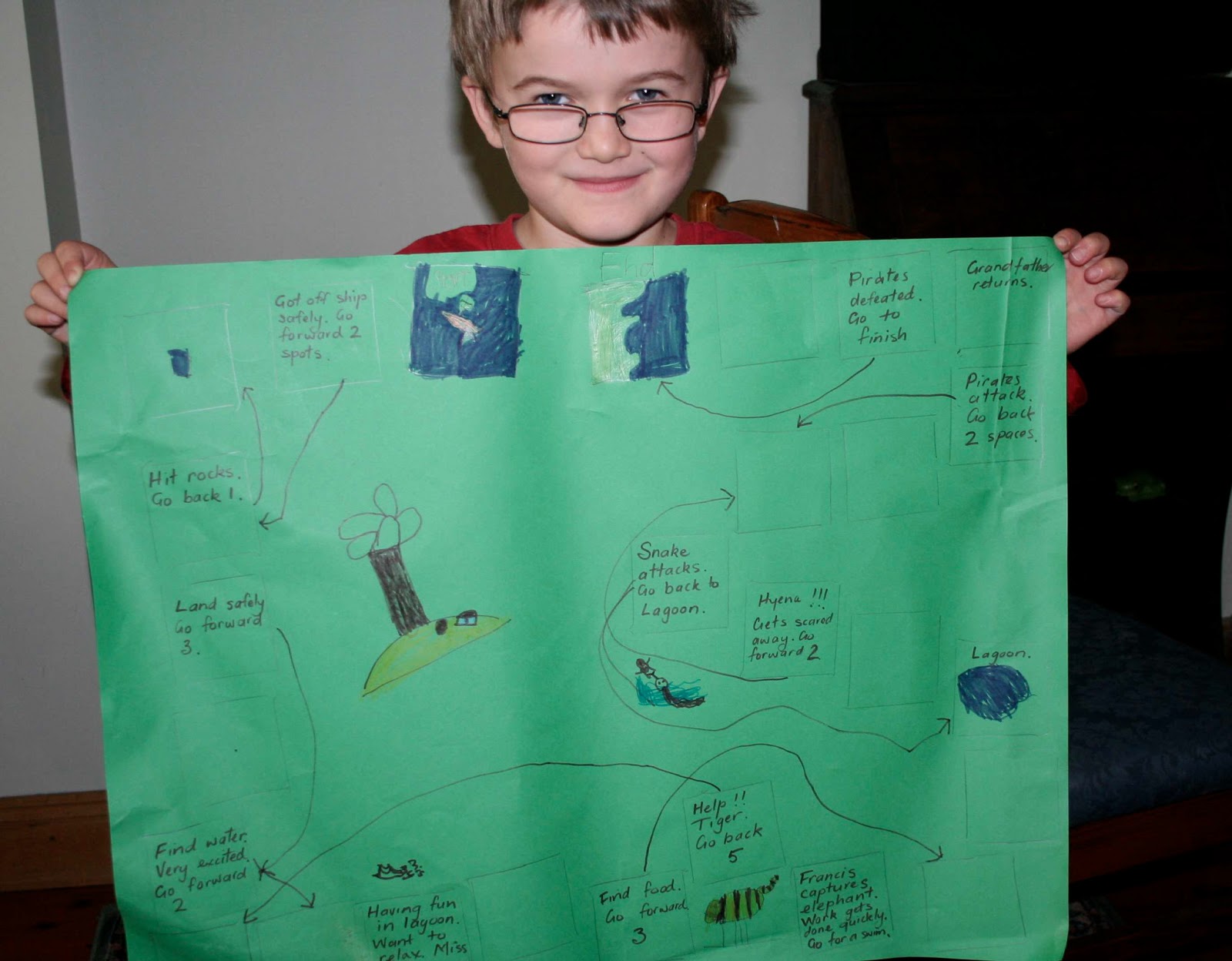
'Swiss Family Robinson' game, made by Sam after watching the film

Young children often quite naturally use re-creation as part of their play. Other children need help and encouragement to do this. Re-creation can be seen in children's experience of story in varied ways, for example:
  • Changing rhymes and songs, e.g. 'Baa Baa Black Sheep' to 'Baa Baa White Sheep' as Lydia does often.
  • Acting out 'Little Red Riding Hood' with the resources of the dress-up box and some friends.
  • Dramatizing a well-known children's song from television or CD or a children's picture book.
  • Using art or drawing to imagine a story character, mythical creature or story setting. 
  • Using Lego (or other toys, props and objects) to re-imagine story alone or with others.
  • Creating something new that grows out of an experience of story.

But why is re-creation so important? While play has a special value (see HERE) and has an important role in any child's intellectual development, imaginative recreation provides direct support to language and literacy development. It helps children to:
  • Play with and understand the complexities of plot development.
  • Comprehend any story at much greater depth.
  • Understand character development in new ways.
  • Enter 'into' a setting as they create an imagined version of the setting and events of a story.
  • Understand story in three dimensions.
  • Appreciate the way the language of story is shaped by, and in turn shapes, characters, settings and plots.

In short, imaginative re-creation is a powerful learning strategy for children that stretches them as language users and learners. As well, it stimulates their creativity and imagination.

Examples of Imaginative Re-creation by Age Group

a) Toddlers (1-3 years)


  • Being encouraged to be a wild thing as the story 'Where the Wild Things Are' reaches the critical moment when Max declares 'Let the wild rumpus start'.
  • Finger Plays and rhymes ('This Little Piggy', 'Incy Wincy', 'Round and Round the Garden')
  • Retelling Thomas the Tank Engine stories using the various engines that feature in the story.
  • Using dolls or soft toys to act out domestic scenarios.
    Using dress-up clothes in association with well-known stories.
  • Creating a story using toy soldiers, Polly Pocket toys, magnetic boards with characters, fuzzy felt and so on.
  • Joining in the television dramatization of a well-known story on a program like 'Playschool'.

b) Early years (4-6 years)

  • Many of the better story apps for iPad or android devices are an innovative way for multiple re-created experiences of stories (see my recent post on this HERE).
  • Drawing maps, key characters (dragons, people) or scenes.
  • Acting out stories with a group of children or with adult family members.
  • Creating an adapted text to re-create part of a story (e.g. poetry, a character interview, telling the story from a different point of view).
  • Using puppets to re-create a story.
  • Using modelling clay or craft materials to create characters to re-create and retell a story.
Creating knights for storytelling

c) Later childhood (7-12 years)

  • More elaborate dramatization, with involvement in making props and costumes.
  • Simple animations using one of the programs readily available (see my previous post on animation HERE).
  • Using materials like Lego to re-imagine a well-known story. The development of Lego with themes that relate to movies and stories has led to an even closer link between this toy and story making
  • Creating a board game that recreates the plot or a specific part of a story (as Sam did).
  • Creating a complex map or plot summary as a device for others to use.
  • Create a script to be acted for a specific part of a story.
  • Write a newspaper report based on an event within a story.
  • Use a variety of written genres to create a new text ('The Jolly Postman' and 'The Jolly Pocket Postman' are published examples of this).
These are just some of the ways that imaginative re-creation can be stimulated.

Summing Up

Children are capable of incredible imagination and creativity. Story is both an outcome of both of these human capacities, as well as means to stimulate their learning and growth in many areas. When imagination, creativity and story come together, we have a very powerful combination to 'stretch' our children.

Other posts

Posts on creativity
The Power of Story
Posts on Play


Friday, January 6, 2012

Creative Storymaking Made Easy


I've written many times on this blog about the power of storytelling as a means to stimulate children's language, literacy, learning and creativity. Rarely do I suggest a commercial aid for such creative storying, but there is one that I've come across that deserves a mention.

Rory's Story Cubes are a simple, but powerful tool for story creation. The aid consists of 9 cubes that have images on all sides. Each 'player' takes turns rolling the cubes. They then look at the top image on the 9 cubes, reorder them as they wish and then create an oral story. While some people are better at this than others, once you've had a few turns you get the idea of it and quickly begin to create original stories. I've used it with three of my grandchildren aged 5, 7 & 9 and all were able to create excellent stories and had a stimulating and fun time doing it. We had fun creating individual stories and group stories.

The original Rory's Story Cubes game contains nine 19mm cubes with 54 iconic images, for example, an eye, lock, wand, sad face, star, letter, bee, turtle, key hole, arrow, torch, lightning and so on.

There have now been two additional expansion sets released. The first consists of 9 cubes with 54 action images or 'picto-verbs' that depict common verbs showing varied actions. Another recent set has been released and focuses on the theme of 'voyages'. You can use the sets separately or can mix them up to create even more elaborate stories.

Story Cubes are an ideal activity for children at home or in small group work at school. At $US14.99 a set I think they're great value. You can buy them at good toy stores. I bought my set from one of my favourite toy stores in Sydney, Monkey Puzzle (at Summer Hill) for $16.95. You can also buy them online in varied places, including HERE and HERE

You will also be able to purchase a larger set of cubes soon for children with special needs. 'Story Cubes MAX' has 30 mm square cubes (almost twice the size) making handling easier for children with fine motor or visual disabilities. The expected recommended retail price will be approximately $US30.

Finally, you can download an iPhone version via iTunes HERE for $US1.99. The app works brilliantly. When you shake the iPhone, it even sounds like you're rolling the real thing.

Thursday, April 28, 2011

When Words and Art Meet

I've just been to see the finalists in the 2011 Archibald Prize. This is Australia's most distinguished prize for portraits. There were many wonderful works but something struck me while viewing the Archibald winners as well as the finalists for the 'Wynne Prize' (for an Australian landscape painting or figure sculpture art prize) and the 'Sulman prize' (for the best subject/genre painting and/or murals/mural).  In a number of cases artists used words as part of their art. While we often consider how images support and add to the written word in books, comics and graphic novels, it seems that increasingly modern artists use words in metaphorical ways to support and add to the meaning of their art.

A wonderful example is finalist Sonia Krestchmar’s acrylic on wood portrait of Sydney-born author Cassandra Golds. Cassandra writes books for children and young adults. Some critics have described Gold's writing as part parable, part surrealist fable and part love story.

Artist Sonia Kretschmar
Kretschmar became familiar with Golds’ work when she was commissioned to illustrate the cover of her novel 'Clair-de-Lune' for Penguin Books in 2004. Since then she has illustrated two other novels by Golds, 'The museum of Mary Child' (2009) and 'The three loves of Persimmon' (2010).

The inspiration for the portrait of Cassandra Golds were some lines from 'The three loves of Persimmon':

Persimmon gazed at him. For a moment she had the strangest feeling that there was a bird trapped inside her ribcage, as if her bones were its prison and it was flapping frantically against them, trying to get out. She opened her mouth, but could find no words.

Author Cassandra Golds
In discussing her portrait Kretschmar commented "As birds, and cages, and cats all seem to be recurring themes in her work, those lines were the perfect catalyst for my concept...Dressing her in a voluminous lace skirt seemed an apt reflection of her 'other time, other worlds' sensibility." The background of the painting is also formed completely from words. All are lines of text taken from 'The three loves of Persimmon', which describe the meeting of the main character with a young male artist who offers to paint her portrait “for an Art Prize”.

I hope to interview Sonia soon in relation to Errol Broome's recently released book 'Dove'.

Monday, June 21, 2010

Rethinking Language and Learning

Please note: This post has been prepared for the 'The Learning Network' sponsored by Richard C. Owen Publishers to promote professional development. I will lead a discussion based on the post with TLN on the 29th June to 1st July. You can find out more about it and register HERE. Regular readers of the blog can also comment in the normal way.

Language and learning were frequently spoken of together in the 1970s, but today if you read many publications on language and literacy and consider major programs at literacy conferences, it is rare. Instead, you are more likely to hear literacy experts talk about multiliteracies, digital literacy or digital literacy across the curriculum.  I find this worrying. Why? Because the shift in terms reflects a loss of understanding that what schools do ultimately is to provide students with the necessary tools for learning and offer them varied opportunities to use them.  It also seriously underestimates the role of language in learning. The following quote from the report 'Digital Literacy Across the Curriculum' (published by Futurelab) will help to illustrate what I mean:
Digital literacy is the skills, knowledge and understanding that enables critical, creative, discerning and safe practices when engaging with digital technologies in all areas of life. Some people associate digital literacy simply with the functional skills of being able to use a computer or particular software package effectively.  But digital literacy is about much more than having access to or being able to use a computer. It’s about collaborating, staying safe and communicating effectively. It’s about cultural and social awareness and understanding, and it’s about being creative... (it's) about knowing when and why digital technologies are appropriate and helpful to the task at hand and when they are not.
While the sentiments expressed in relation to digital literacy are worthwhile, 'learning' isn't mentioned once. While learning is implied in the statement, technology is central, not learning and the quest for knowledge. The report speaks of "engaging with digital technologies" not learning. As well, when knowledge and understanding are mentioned, it is in relation to technology, not learning. And while the use of digital literacy for "tasks" and "communication" is noted, learning about the world is not the focus.

The same document represents 'digital literacy' diagrammatically as depicted below. Note that it is digital literacy that is represented centrally with all else supporting or related to it. Once again, 'learning' isn't mentioned, and while 'information' and 'communication' do appear, 'knowledge' does not.


The way the report positions digital literacy is even more surprising when you consider that one of the aims of 'Futurelab' is to transform teaching and learning, "...making it more relevant and engaging to 21st century learners through the use of innovative practice and technology."

We need to reposition learning at the centre of the curriculum, not as something that is peripheral, or a by product of skills instruction in any area (including digital literacy), but the very focus of our teaching.

Three Elders whose work can help us shift the focus

The above report should offer a warning of the need to avoid the 'tool' becoming the end or focus of learning. Instead, we need to keep in mind that keyboards and the Internet are simply the means for wider learning and the acquisition of, or construction of knowledge. While the UK report offers much insight into the use of the Internet and digital forms of literacy, it offers little about learning and how language and literacy in all their forms are essential for learning. It seems that many today have forgotten the wisdom of our elders. In the 1970s as a Curriculum Consultant I drew on the classic James Moffet work Teaching the Universe of Discourse (1968) that helpfully defined English as:
  • language (knowledge and manipulation of usage, vocabulary, structure, style),
  • in use (skill in reading, writing, listening, speaking),
  • in context (of literature, media, personal expression and everyday communication).
What Moffet's work did was to stress that language always has purpose, audience and modality and that it is always situated. There are skills to be learned but they serve something else - learning! 

In the 1970s Michael Halliday's timeless work Learning how to mean: Explorations in the development of language (1975) stressed that a quest for meaning is central as we:
  • learn language (we learn language as we interact with others and encounter our world),
  • learn through language (we use language to build up a picture of the world in which we live), and
  • learn about language (we understand the nature and functions of language).
One of the many useful insights from Halliday's work was his reminder that the meanings we express in and through language (“content”), cannot be separated from the words used to encode them. The artificial curriculum separation into English where language is taught, and subjects like science and maths where 'content' is taught, is unhelpful (even if practical and perhaps necessary up to a point). Halliday's work supported the instincts of many good teachers that integrated approaches and frequent varied opportunities for interaction are critical pathways to learning.

But it was Douglas Barnes in From Communication to Curriculum (1976) who pulled together language, learning and pedagogy. He stressed that it is learning that must always be at the centre of the curriculum.  He also reminded us that if language (including of course literacy) was defined narrowly as a means to transmit knowledge or information, then learning would become simply the replication of other people's knowledge and information.  Instead, he argued for what he called an 'Interpretation' model as opposed to a 'Transmission' model of teaching and learning. Each broad category (which he was quick to point out are somewhat idealised and never applied in pure forms), could be differentiated based on how the teacher viewed knowledge, what the teacher valued in the students, the way they viewed their role, and how student participation was evaluated.  An 'Interpretation' teacher:
  • believes that knowledge exists in the knower's ability to organise thought and action,
  • values the learner's commitment to interpreting reality,
  • perceives the teacher's task as setting up dialogue in which learners can reshape knowledge through interaction with others, and
  • perceives the learner as already possessing systematic and relevant knowledge and the means to reshape it.
Hence, Barnes argued for the establishment of classroom contexts that offered students opportunities to learn as they looked always for the relationship between new and existing knowledge. Language for Barnes was a vehicle for learning that required teachers to think carefully about how classrooms and teaching and learning activities were structured.

There isn't time to consider Vygotsky, Bruner, Briton, Rosen, Freire, Cazden, Bernstein, Cook-Gumperz, Harste, Ken and Yetta Goodman, Cambourne, Margaret Meek and others, but all have wisdom to offer on the relationship of learning to language and curriculum; perhaps in another post. Or perhaps via the TLN discussion.

Reflecting on the above

My recent post on handwriting (HERE) and this current post, both in their own way, pose a similar question: how can we maintain a right relationship between language and learning?  Crayons like keyboards are examples of technology (remember that technology can be defined as the use and knowledge of tools, techniques, crafts, systems or products) that can be used to learn and deepen our understanding and knowledge of many things. In my handwriting post I argued that we have neglected the use of a simple form of technology, failing to see its role as a tool for learning.  In this post, I warn against the dangers of a blindly embracing technology. It is important to understand the potential, limitations and dangers of all forms of technology.  Technology is good if used well; servants to learning and useful for life.

Some questions to ponder:
  • What does a curriculum look like that manages to locate learning at the centre of the literacy curriculum in elementary or primary schools?
  • What might a secondary school curriculum look like that doesn't artificially separate learning language, learning through language and learning about language?
  • How do we harness the richness of new media and digital literacy without shifting the focus from meaning and learning to simply the celebration and use of the tool?
  • What place do textual forms like narrative play in this age of new communication technology, media and digital literacy?
I look forward to hearing from members of the TLN network or from other regular readers of this blog. 

Related posts and references

The following posts are some of those on this blog that have some relevance to the topic of the current post.

'Handwriting: The servant of language, learning and development' (HERE)
'A search for meaning: The heart of literacy' (HERE)
'Children as bloggers' (HERE)
'Improving Comprehension: Sketch to Stretch' (HERE)
'Firsthand experience and literacy learning' (HERE)
'Making history come alive with literature' (HERE)
'Reading to learn: Using text sets' (HERE)
'Improving comprehension series' (HERE)
'The power of literature series' (HERE)
'Online reading is different' (HERE)

References cited above

Barnes, D. (1976). From communication to curriculum. Harmondsworth: Penguin.
Halliday, M.A.K. (1975) Learning how to mean: Explorations in the development of language. London: Edward Arnold.
Moffett, J. (1968). Teaching the universe of discourse. Boston: Houghton Mifflin.