Showing posts with label fun activities at home. Show all posts

Friday, December 15, 2023

Holiday Ideas to Stimulate Children, Reduce Screen Time & Keep Parents or Carers Sane!

In Australia, our schools will close in the third week of December for the Summer holidays which last about 6 weeks. After over two years of COVID isolation, lock downs and disrupted schooling, life is just starting to return to normal. As we enter holiday periods with our children and grandchildren, it's helpful to plan a little. While some children might go to summer camps, or holidays with families, there will be plenty of time either at home or away for children to become bored. Hopefully, the solution is NOT just to simply increase their screen time.


If Christmas falls in winter as it does in the US and other northern hemisphere nations, then outdoor activities will be hard. But there are plenty of things to be done inside that are stimulating and fun. In Australia, traveling to catch up with family and friends, the beach, hiking, boating, fishing and more take up lots of time. But there is still time to fill at home because some children end up home while parents go to work for at least part of the holidays.


At Christmas, many families have ongoing traditions that you continue in families or schools. One special tradition in our family is to make the traditional English Plum Pudding using a recipe passed down on my mother’s side first used by her English and Scottish ancestors in the 1800s. Family legend is that one of our relatives worked as a cook in Holyrood Palace in Edinburgh and that the recipe was passed down to family members generation by generation. I used to make the pudding as a child with my grandfather and I’ve carried that tradition on first with one of my daughters, and these days also a second pudding with one of my granddaughters. Perhaps you have your own traditions?


I've written a number of posts in the past about things to do in the holidays with kids (here), as well as simple travel games to fill the time on trips with your children (here). There is also an earlier post on ‘Planning With Kids’ that offers '20 Great Holiday or Travel Activities for Kids (5-15)'. To maintain some balance, you might also read my post on why 'Boredom is still good for children!'.


In this post, I thought I'd revisit some of the ideas and add a few new ones. Holidays offer an opportunity to stimulate your children's minds, and help prepare them for another year of school in 2023.


My criteria for choosing holiday activities are that they should:


  • Stimulate creativity
  • Encourage exploration and discovery
  • Involve using hands as well as their minds
  • Encourage interaction between you and your children
  • Foster language and literacy development 
  • Increase their knowledge
  • Keep them interested


1.      An Excursion


The untold great places for an excursion wherever you live. Are you near or in Sydney? Why not enjoy one of the wonderful walking tours of the historic rocks? We took 4 of our grandchildren on a self guided tour of the Rocks during school holidays a few years and had so much fun. The tour we used was free. We were provided with a map and commentary that allowed us to have an adventure together as we explored the historic area. We acted out varied scenarios along the way and took photos to share with other friends & family.


2.      Why not get your children to create an animation, with one of many apps. 


This sounds a big deal but it's not with the right app. I wrote a post about some wonderful apps for digital story telling a few years ago (HERE). One of my favourites is 'Puppet Pals. For one thing, it's VERY easy to use. Your children will work it out in minutes. Puppet Pals is available as a free app for the iPod Touch, iPhone and iPad. Most apps are available for other devices as well. It's essentially a simple way to create an animated movie using 'cut-out' themed characters and a variety of backdrops and scenes to create an animated 'puppet' play.


There is a free version that comes with Wild West backgrounds and actors.  However, you can also purchase different themes for as little as $US0.99 or the 'Director's Cut' in which you can access all the themes for $US2.99. These allow you to obtain a range of additional scenarios and characters based on themes such as monsters, space, pirates, arthropod armada, Christmas and so on. You can even make your backdrops and characters.


It's a very simple app to use that provides very easy story boarding. You can record dialogue, move characters around, create some simple effects, change backdrops and settings and characters. While ideally, before creating the animation, the writer/producer prepares plot summaries and story ideas, but I've seen my grandchildren make excellent animations on their first take. One they used is the 'Arthropod Armada' theme from 'Director's Cut'. 

As a teacher, I also could see myself using a smart board to collaboratively develop a story with my class before introducing individuals and groups to this smart little app.


3. Books with a difference


a)  Pick some special books they haven't seen - try to borrow or buy at least 2 books for each child. Based on their interests try to choose books they'll enjoy, not simply books you'd like them to read. Opportunity shops, book exchanges and libraries are also a great place to start looking for some cheap second hand books. I have another post on book exchanges, op shops and web exchange sites here. Alternatively, take them to your local library to choose some.


b)  Use Books as a creative stimulus - While the sheer joy of the book is usually enough, sometimes books can stimulate many wonderful creative activities. For example:

After reading Maurice Sendak's "Where the Wild Things are" go outside and dramatise it. Let one child be Max and let others take turns at being the wild things. Make a boat out of bits of wood, or even have a go at making one out of a large cardboard box (or several).


After reading Jeannie Baker's book "Where the Forest Meets the Sea" (a book about the Daintree Rainforest in which all the pictures are collage), encourage them to make a collage out of natural materials (and maybe some wool, straws etc to supplement) in response to Baker's pictures. Or read a second book and have them use collage in response.


Or after reading Graeme Base's "The Waterhole" get them to paint the waterhole (they can draw the animals, cut them out and paste them around the waterhole).

4. Dramatisation


Dramatisation is an excellent way to respond to a book. If you have a dress-up box all the better. Let your children either re-tell the story through dramatisation or improvise. Get involved to help set the pattern for turn taking etc. I play a mean wolf, and an even better Grandma!


5.   Writing with a difference 


Introduce children aged from 5 to diaries or holiday journals.


a) Scrapbooks & journals - Make this fun, not a school activity. Some might prefer to just make a holiday scrapbook by pasting in tickets, leaves they collect, food wrappers etc. But you can also show them how to create a travel diary.


b) A holiday blog - Tech savvy mums and dads might encourage their children to write online. Why not set up a family blog that can be read by friends and relatives (even if only for two weeks). You could use this as part of a trip away, or just use it at home. Older children could set up the blog themselves and all family members could contribute. Let them have access to a digital camera and a scanner and the sky is the limit. See my post on 'Children as bloggers' (here).

c) Start a family joke or riddle book - Maybe offer them some jokes as models ("Knock, knock", "Why did the centipede cross the road"....) etc.

6. Craft

a) Structured Craft ideas - simple beadwork, noodle craft, mask making, making plaster moulds (and painting them), anything for young children that requires paper tearing, gluing, glitter, stickers, works well.

b) Unstructured creative craft - Stock up when you go to the supermarket with simple materials like paper plates (good for masks), brown paper bags, sticky tape, glue, cotton balls, tooth picks, paper cupcake holders, straws (cutting up and threading), noodles (for threading).


c) Play dough - You can buy cheap coloured modelling clay but home-made playdough works well. My wife 'Carmen's can't fail' recipe is 1 tablespoon of oil, 1 cup of plain flour, 0.5 cup of cooking salt, 2 tablespoons Cream of Tartar, 1 cup of water, colouring. Mix together and put in a saucepan on medium heat until it binds together, stirring all the time. Fold together by hand. If you keep it in a sealed plastic bag it will last for ages in or  outside the fridge.


There are endless things to do with play dough. Try to move beyond just cutting out shapes (which kids still love). Encourage them to make a house, a farmyard, a bed, and an aquarium. Use some plastic animals with the play dough or small plastic people. If you don't mind tossing the play dough out you can let them use sticks, plants etc to make simple dioramas. Kids will create complex stories as they manipulate the play dough.

7. Creative Play

I've written a number of previous posts on play (here) but planning for play is important. While you can say to your children go outside and 'play', doing some simple planning at times will lead to more stimulating play times.

a) Dress-up box - If you don't have one take the kids to an Op shop to start one. You might even pick up some gems like old helmets, hats, belts (you can cut them down), handbags etc.


b) Water play
 - This is hard in cold weather, but maybe you could make bath-time special for young children with extra bubbles, different stuff to take into it. In warmer weather give them a bucket of water and some things to scoop, sieve etc - obviously only UNDER SUPERVISION. Above, it's pick on Grandad day!


c) Build a cubby house - No not with wood, just use a table, some chairs, wardrobes (hitch the blankets into the top of the doors, some pegs and sheets and blankets. By draping them over other objects you should be able to create a special space (about 2x2 metres is enough for three small kids). Or you could try your hand at making one from large cardboard boxes. I've done both types and the fun was the same on both occasions.


Try to get at least 1.5 metres of height. Have the kids 'help' and then get them to collect some special things to have in the cubby. 


I used to let my grandchildren have my cheap transistor radio from my shed (lots of fun). We also had a tea set. Sometime they had toys with them and games. If you're up to it, climb in as well and read some stories. I've seen a cubby of this kind amuse kids for half a day. Then of course for the adventurous you can share some snack food as well. You can even build a cubby inside! See my post on cubbies (here).


d) Indoor and back yard fun


Treasure hunts - Write the clues on paper using words and pictures depending on ages and make the treasure worthwhile (chocolate, a coupon for an ice cream in the kitchen etc). For something a little more challenging why not try a map with grid references (see picture opposite).


e) Cooking


Kids love cooking with their mothers or fathers. Do simple stuff. Nicole (Planning With Kids) has lots of great ideas for cooking with kids on her site. Don't forget to make it a language activity as well by getting them to follow the recipes.


Wrapping up - A few basics hints


  • Have a strategy for the holidays - map out a timetable (post it on the wall) and try to plan a few significant events and think through the general structure of each day.
  • If you have younger children still at home, being joined by school kids on holidays, try to think about how you will cope with all their interests and think about varying daily routines a little.
  • Pace yourself - don't use all your best ideas in the first few days (you'll wear them and yourself out and you'll struggle to keep up the variation later).
  • Expect bad weather - think about some ideas that will work in rainy weather as well. It's called the "Law of Holidays" - expect lots of wet weather and a day or two of sick kids.


HAVE FUN!

Monday, June 6, 2022

Ten Wonderful New Picture Pooks to Enjoy with Children Aged 2-7 years

1. 'Seree's Story' by Irma Gold & Wayne Harris


Seree loves nothing more than eating sweet, mushy bananas, rolling in squelchy mud and playing with her family in the jungle.

But one day, she is captured and put to work in a circus. All she wants is to find her mother, and freedom.

This is a very special picture book. The tale of a young elephant taken by poachers torn away from her mother and the extended family. Destined for a circus as a perfomer on the other side of the world. 

The poignant story is enriched by the incredible illustrations of Wayne Harris. Children will love the story and be challenged by its environmental message. 

The book also had information after the story about the endangered elephants of the world. Suitable as a read-aloud for infants classes and a book that children aged 5-7 will enjoy reading.


2. 'The Echidna Near My Place', by Sue Whiting & illustrated by Cate James

This is the latest addition to the Nature Storybooks series from walker Books. It tells the story of a child and its Nanna, and as with other books in the series it includes factual information on each double page spread as well as the continuing fictional story of a child and her Nanna who both love animals.

As a young child and their Nana go for walks together, they follow a short-beaked echidna keenly observing and discussing what its life might be life. Learn with them about what Echidnas eat, where they live, and how they protect themselves.

Cate James' illustrations are delightful. When you see this little echidna curled up in a defensive position, you feel like you want to gently touch the page to see if its quills might just spike you.

A lovely book which will teach and engage children in this delightful story as well as the magical images.

3. 'Freddy the Not-Teddy' by Kristen Schroeder & illustrated by Jean Tapper

This is such a lovely and heart warming story about a little boy called Jonah and his favourite stuffed toy called Freddy. He's a little unusual. Just what is Freddy?

A funky duck, a peculiar platypus, a punk rock penguin? When Jonah’s teacher announces that they’re going to have a Teddy Bears’ Picnic, it seems that if Jonah wants to take Freddy, Freddy will have to go in disguise!

But it's not easy to make a toy that looks much like a duck to look like a teddy for the school Teddy Bears' picnic.

Children will love finding out just what happens when Jonah stands up for himself and for his beloved Freddy the 'not-teddy'. Children (and adults) will by Kristen Schroeder that is delightfully illustrated by Jean Tapper.  I just love it!

4. 'Get Ready, Mama!' Sharon Giltrow & illustrated by Arielle Li

This is a funny book that children aged 3-6 will love having read to them. Every parent will also love sharing this story in which the parent and the child seem to swap roles; or do they?!

Children will love the irony of a tale where the child has to get Mum ready to go to school. Will Mum ever get out of bed, get her clothes on, make it to the table, go to the bathroom and race for the car? Or, might she even sneak back into bed!!

Kylie Howarth's delightful text is complemented perfectly with Arielle Li's gorgeous illustrations to create a wonderful book that will be a favourite with many children.

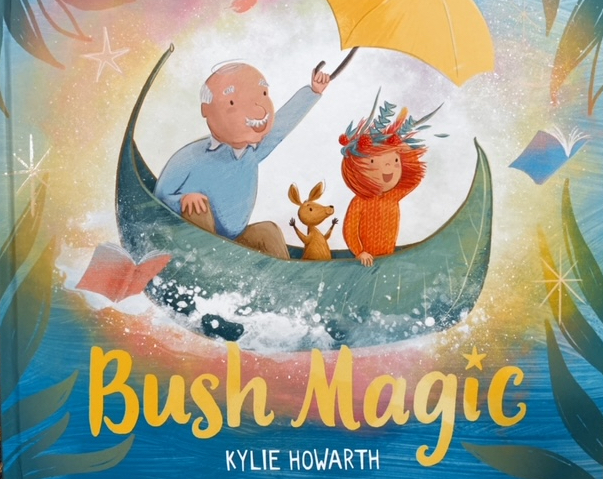
5. 'Bush Magic' by Kylie Howarth

This is a book that many grandparents and parents will enjoy sharing with their children.

6. 'Tasmanian Devil' by Claire Saxby & illustrated by Max Hamilton

Seeing the name Claire Saxby on any book will get me to pick it up and open it quickly. This new book is another in the 'Nature Storybook' series from Walker Books. As usual, Claire Walker's text is special as she introduces 'two little imps'. These feisty Tasmanian Devils might look cute, but they will wrestle, shriek and growl at each other. And they are scavengers feeding mostly on dead animals. Cute they might be, but don't get too close!

I love Max Hamilton's illustrations. While they might look cute asleep in their burrow, I can almost hear them growling and shrieking. Don't get too close!

Having the background facts and details at the back of each of the books in this series will also satisfy the curious reader who wants to know more about these special animals.

7. 'Old Fellow' by Christopher Cheng & illustrated by Liz Anelli

 This is such a beautiful book. Liz Anelli's wonderfully detailed and true to life drawings are just gorgeous. The 'Old Fellow' looks exactly like and old fellow should, and shows much of the central character's personality. As he does his early morning stretch, and takes the dog for a walk, there is much to see.

Liz Anelli's illustrations are also stunning. Her line and water colour images are just so true to life and rich in real-life situations. So too is the portrayal of the two key characters; an old man and his dog as they do their daily walk and come across other people who cross their paths each day. A wonderful book.

8. 'Jack's Jumper' by Sara Acton

Sara Acton is an award-winning author and illustrator of children’s books. "She lives on the Central Coast of NSW with one husband, two children, a mischievous dog and a cat called Poppy, who’s definitely in charge."

I've previously reviewed her book 'Dinosaur Day Out' and this latest book is equally as engaging delightfully illustrated.

This lovely story centres around Jack's jumper that was once his big brother Paul's jumper.

"Paul and Jack used to do everything together. But now he's always busy doing something else... somewhere else."

The lovely text is so well supported by the 'softness' of Sara Acton's water colour illustrations. This is wonderful story about a little boy who misses his big brother, and who's relationship with him changes as they grow older; but their bond remains. 

This book will warm the hearts of readers aged 4-7 years.

9. 'Jigsaw' by Bob Graham

Bob Graham is one of Australia's finest author/illustrators. His many books have been delighting children (and teachers) for more decades than it is polite to mention. I've been a big fan for a long time.

This book is not due to release until early July. But get a copy as soon as you can, because I'm sure they will sell quickly!

Serendipity and positive thinking come into play as a family searches for a missing puzzle piece in Bob Graham’s enchanting story with a sweet surprise ending.

A puzzle arrives in the mail from an unknown source. “Oh, let’s do it!” say Kitty and Katy and Mum when a thousand-piece jigsaw puzzle mysteriously arrives in the post. “I have time on my hands,” agrees Dad. Starting in winter with the edges, by autumn they’re almost done, only to discover that one piece is missing. 
As a puzzle lover who has lost not just one but up to three pieces of a single puzzle, I know the agony of getting to the end and not being able to complete it!! I also know the joy that occurs when after many days scouring for each piece, the last one is found hiding. Enjoy!
As in all of Bob Graham’s work, the beauty here is in the details, with visual perspectives that offer a bird’s-eye view or even take us underfoot, wordless sequences letting us in on a secret. Is it sheer luck – or perhaps the power of hope – that creates an ending to the story?
10. 'My Dad Thinks he's a Pirate' by Katrina Germain & illustrated by Tom Jellet
What a delightfully engaging title for a children's book. The title alone made me want to read it. What child wouldn't want their Dad to think he was a pirate?!

This 'special Dad' is full of 'Dad jokes' and surprises. With all of his "hearties" in tow, they head off on many adventures. With the constant repeated refrain "My Dad thinks he's a pirate" we know that these kids don't buy this Dad's belief in his persona.

Katrina Germein's text is wonderful as usual, and Tom Jellett's illustrations are again excellent and fun. This is a funny story that children aged 3-6 will find hilarious. If your children loved it, you will also enjoy some of their earlier books, including 'My Dad Loves to Toot', 'My Dad Thinks he's Funny' and 'My Dad Still Thinks he's Funny' (& a few other titles as well)!


Tuesday, March 31, 2020

Ideas for 'Doing' School at Home During the Covid-19 Virus

Around the world there are many families trying to manage life at home during the Covid-19 Pandemic. While every family's situation and each nation is dealing with this problem in different ways, all families face similar challenges. As a trained teacher, author of varied learning activities for parents,  and devoted father and grandfather I've tested these ideas and many more. But due to the Corona Virus many parents across the world have found themselves acting as teachers at home. This is a nightmare for some, but it can be rewarding and even fun!

Many are asking:
  • How can I as a parent, who isn't a trained teacher, make this work?
  • What if my child gets through all of the school work in a couple of hours?
  • How can I make some of the work fun and engaging?
  • How do I juggle my paid work if I'm working at home as a parent at the same time?
In this post, I want to lay out some basic principles for teaching your children at home (I'll come back to some of the above questions later) and offer some practical ideas. In future posts, I will outline further practical ideas to make home learning not only effective but exciting and fun, even if you aren't a trained teacher. The ideas have all been tested by me and my wife who was also a teacher with children aged 5-12 years. Some of them will work for older children too, or if you have a wide age range in your family, one of the older children might become the 'teacher' for one or two of the activities. But first some DO's and some implied DON'Ts.

#1 Do establish some basic rules - these must be complied with if your children hope to do some of the other things that they might enjoy more than school work (e.g. computer games, TV, online activities, social media, outdoor games and exercise if still possible and allowed in your country). You need some basic rules for your children and you need to stick to them (stick them up on the wall). And as the 'teacher' one of the most important rules for you is to be consistent in applying the rules.

#2 Do complete the work that your children's teachers are setting - but don't assume that it has to be done first (especially if it's all hard and demanding). Some private schools will have sent your child home with very prescriptive guidelines for what is to be done and when. This might require online activities, class participation using varied platforms for online, prescribed content, media, group work and so on. But, you do have some freedom even in such prescription. If there's a meltdown, all school prescriptions might be set aside for an hour or two. This is about emotional 'survival', for you and your children.


#3 Do program in physical activities outside (weather permitting). There are many things that can be done with varied age groups. Board games (I've written about this on my blog), online games, sport, watching special programs via available content streams like Netflix, Disney, STAN etc.

#4 If you are able, DO establish a place within your home or apartment where school activities take place. Rather than private spaces in bedrooms I'd recommend 'public' places like the dining room, or a family room (if you are lucky enough to have such a place). In this space, you might have a shared computer (if you aren't able to have more than one device), a tablet (or two perhaps), hopefully internet access etc. When they enter this space for the activities of school, it is school! Insist on this.

# 5 Do provide time for marking work (if that is the task of the parent not teachers) and give good feedback and praise. Much of this will take place as you supervise, but do read written work and give some feedback to your children. Try to be constructive, not just critical. And do find something to commend.

# 6 Do be consistent! Discipline for the teacher always breaks down when they are inconsistent towards children in the class (or group at home). This will happen even faster for the parent if you let one child away with bad behaviour or attitude, but not the others.

# 7 Do build into the day planned 'Tension Breakers'. 'Tension breakers' (i.e. things to stop chaos when the wheels are falling off the family, or a child is having a meltdown!) are used when everyone seems to have had enough. Try to use activities that involve all children and hopefully at least one parent in the activities. Here are some examples:

a) Sure Fire Mimes - You can make up your own but make sure that they are suitable for varied ages. For example:

* You are trying to teach someone to knit
* You are a cat washing yourself
* You are a pirate being forced to walk the plank
* You are a tightrope walker at a circus
* You are a famous pianist walking onto the stage
* You are paddling a kayak when you lose your only paddle
* You are making a snowman
* You are decorating a birthday cake

b) Rearranging clothes - One child leaves the room and makes a minor alteration to his or her clothing (must be visible). They might leave a button undone, loosen a belt, undo, slightly rearrange their clothes or hair, and so on.

c) Five minute fillers - there are lots of options here. They are challenges of one kind or another. Try to make them such that children of varied ages can do well at most of them.

  • Making paper snakes
Give each child a small piece of identical paper (perhaps 10cm x 5cm, but the photo is using a Post-it note) and ask each child to see how they can tear the paper into a single 'snake' by working along the paper from out edge to the middle. The longest unbroken 'snake' wins.

  • Never ending story
As the 'teacher' you start a simple story that the children add to (maximum of 6 words), until you run out of inspiration. At first be generous if some find it hard to stick to 6 words. For example:

Oscar went for a ride...
He ran into ...
Who could have guessed that ...?
How would he possibly ...?
Fortunately, ....
But ...
How could he ever ...?
I guess that he ...

  • Who's that talking behind my back?
One child stands about 4 metres away from everyone and once they are blindfolded and looking away someone chosen by the parent is asked to whisper 'very' softly just two words. The blindfolded person has to guess who it was.

  • Ventriloquists

Give each child a turn to repeat a 3-5 word sentence without moving their lips. The group votes to decide who was best at it (the parent has 2 votes!). For example, "my front tooth is aching".

You can trot out tension breakers like the above when everyone seems to be getting tired, or as a reward after a more demanding task.

In my next few posts I will share some other ideas that might help to make learning at home more interesting. These will include:

  • Helpful educational apps to use on tablets or phones
  • Outdoor activities that can work
  • Books that are great for reading aloud
  • Poems for sharing
  • Art activities that are easy and fun
  • Cooking lessons
  • Fun activities outside