Showing posts with label Indigenous language. Show all posts

Monday, September 2, 2013

'Welcome to My Country' - A Review & Author Interview

Allen and Unwin recently published a wonderful book called 'Welcome to My Country' by Laklak Burarrwanga, Ritjilili Ganambarr, Merrkiyawuy Ganambarr-Stubbs, Banbapuy Ganambarr, Djawundil Maymuru, Sarah Wright, Sandie Suchet-Pearson and Kate Lloyd. The book is a collaboration between three academics and six Indigenous women from Bawaka and Yirrkala. It is a publication that literally welcomes you to the Country of Laklak Burarrwanga in Arhhem Land Northern Australia. This is a coastal land of crystal clear waters filled with fish, turtle, crab and stingray. The land that adjoins has varied bush fruits, pandanus for weaving, wood for spears, and all that is needed for daily life. But this isn't just a beautiful country, it is a land rich in meaning. This is the place where Laklak Burarrwanga heard great stories, told them to others and learned the great history of her people. These stories were learned from a special library, "a library in the land". This is a library that you cannot destroy.

Laklak's personal story includes her long walk across Arnhem Land as a child, and her people's fight for land rights and the right to have a say in their children's schooling. Laklak and her family are a proud and successful Indigenous community. There are many things to love about this book. First, I love the fact that the book records the richness of the history of the people of this special place in a manner that preserves the voices of the Indigenous women and the authenticity of their stories. The non-Indigenous academics who offered leadership to the project have done what few have done before; they have contributed and led the project, but they haven't attempted to reinterpret or explain for others. Rather, the narrator is always an authentic voice of the people whose stories are being told. Second, I appreciate the richness of the stories and the choices that have been made to introduce the reader to the people and their country. Third, I enjoyed the varied genres used to communicate the story of this country. This place welcomes the reader through story, recount, poetry, exposition, lists, explanation and song. Finally, this is a book that changed the authors. The writing of the book and the collaboration between these eight women has enriched their lives. And of course, good writing should always do this. What a wonderful work!

Ros Moriarty, author of 'Listening to Country', expresses her delight in the book this way:
 
Welcome to My Country is a beautifully warm, inviting experience. As soon as I read 'When the moon goes past you can see its reflection (in the water) like the inside of your heart', I knew this would be a very special read. Being immersed in an 'experience' is the way I would describe this book. It is an enticing journey into the heart of Yolngu life, in all its wonder across the physical, artistic and spiritual world. I love the conversational style - we walk, talk and sit down with family on every page. Lovely. 

In the interview that follows Sarah Wright (the University of Newcastle), Kate Lloyd (Macquarie University), and Sandie Suchet-Pearson (Macquarie University) answer my questions and share their insights into the wonderful collaboration that has led to the creation of this special book. 

The Interview

1. How did this special collaboration with the Yolŋu people come about?

Our research collaboration at Bawaka began in 2006 when we (Sarah Wright, Kate Lloyd, and Sandie Suchet-Pearson who are geographers at Newcastle and Macquarie Universities) formed a partnership with Laklak and her extended family who own and manage the successful tourism business Bawaka Cultural Experiences (BCE). BCE is centered on Bawaka homeland two hours south of Yirrkala in north east Arnhem Land. We were introduced by a mutual friend who asked us whether we would be interested in working collaboratively with some amazing women from Northeast Arnhem Land. Of course, we said yes.

From that initial visit, our relationship has grown. It has been a long-term endeavor where we have learnt to trust and respect each other. All of us are teachers in some way, either at the University, at schools in Arnhem Land or as educators working with visitors who come to learn at Bawaka. As teachers, we share a desire to create and distribute knowledge. For Laklak and the other Yolŋu women in our team, it is really important to teach other people about Yolŋu culture and the complexity of Yolŋu knowledge. This is part of their mission in life and part of Laklak’s responsibilities as Elder and Eldest sister. She sees books and other outputs as a way of communicating Yolŋu knowledge to diverse audiences that include tourists, university students, and the general public. It is also a way of reclaiming knowledge that has been provided to academic researchers but is no longer easily accessible to Yolngu people, and of creating a rich resource for cultural transmission for their children.

We have told other stories with Laklak and her family. In 2008, we published a book on weaving and culture (published by the Centre for Urban and Regional Studies at the University of Newcastle). The sharing of these stories was made possible by our being women, since in Yolŋu culture basket weaving is women’s business. From the start, our shared womanhood, including our families and children, was an important part of our connection.

This most recent book aims to encourage readers to understand and respect different cultures and is part of the family’s strong desire for non-Indigenous and Indigenous people to learn from each other. As Laklak says in the book:

“I see a boy standing with a spear learning in the bush university, the real life the land and nature. I also see the boy sitting on a rock at Bawaka playing with a computer. This kid can see a wider world, learning through a computer. That is the new generation, mixing the knowledges together. The boys can change over, the boy with the spear can play with the computer and vice versa.”

2. How did your own research team’s collaboration come about?

Our research team is broad. There are the academic researchers Kate, Sarah and Sandie. We were all starting our careers at a similar time and wanted to create a research team that would work collaboratively in a different way from the lone endeavour that you often find in academia. We started working together in 2004. Then we developed our research relationship with Laklak and family in 2006 so our research team became an intercultural team of Indigenous and non-Indigenous researchers, and of people working within universities as well as beyond them. Our research team grew to include the four sisters, elders and caretakers for Bawaka country Laklak Burrawanga, Ritjilili Ganambarr, Merrkiyawuy Ganambarr-Stubbs, Banbapuy Ganambarr - and their daughter, Djawundil Maymuru.

Now we are trying to include Bawaka Country as part of our research team too. For Indigenous people, it is important to take the knowledge and agency of animals, plants, winds and other aspects of Country seriously. It is a world-view that is not human-centric. So we are expanding our thinking to see the ways animals and other aspects of Country are important in our collaboration. 

3. Is there a next step to the project and the desire to tell the story of Laklak and the Yolŋu people?

This book is just one part of a collaborative journey we have been on since 2006 when Laklak asked us to work with them to assist them telling stories to tourists as part of their cultural tourism business. We are all committed to long term collaboration and it has taken us on a lot of twists and turns along the way. We have written, and will continue to write, academic articles together as well as writing books aimed at university students and children. The book has been a long term project and so the next step is for all the authors and their families to go up to Bawaka and celebrate the book and spend time with each other. Laklak says that that this is her last book but who knows…

4. Are there other stories to be told from Bawaka country?

There are layers and layers of stories, some too sacred to be shared and so much that still can be told. There are many, many other stories that Laklak and her family are keen and willing to share. You don’t have to just read it from our book, Laklak and her family invite you to come to Bawaka, sit on the beach, have a cup of tea and listen to the stories (for more information see - http://www.lirrwitourism.com.au/.)

The stories will take us where they do. We are constantly surprised! There is a connection between us that endures. In reflecting on our collaboration during our first book we wrote:

“We feel that writing this book has been like creating a basket. We have tried to make sure that the colors go together and that we have woven something big and beautiful that’s full of meaning and knowledge. We’ve made a connection with each other that’s like a thread linking us together. In the same way the baskets are connected we are all connected now. We all have a desire to work together to build understanding between cultures and to help others learn about, and learn from, Yolŋu culture (Burarrwanga et al. 2008, p. 36).

Above image courtesy of Bawaka.com.au

5. How do you hope to see this book used? What has been its impact so far?

We would like to see it used in a range of contexts and we can see it reaching people of all ages. There are stories and messages suitable for young people and we have recently written teaching notes which can be accessed via (http://www.allenandunwin.com) so that the book can be used in primary and secondary schools in all sections of the curriculum including maths, science, English, geography and history. It is also accessible to a broader audience including people working in cutting edge science, to help communicate Indigenous world views, including an Indigenous understanding of mathematics and science. We have had wonderful feedback from a range of people from kids to people working in public health at the University and from those in Indigenous policy setting.

Laklak and her family also recognize the book as important knowledge. At the book launch up in Arnhem Land, Elders and representative from different clans came to pay respect to the book and acknowledge the importance of this written form. That was really important to us all and we hope there will be ongoing positive impacts for the community in Arnhem Land - not least because all of the royalties for the book are going up there!

6. Is there some part of the story of the Yolŋu people that has personally touched each of you? How has hearing the story of this people changed you?

Writing this book has been a journey for all of us. We have learnt so much about and from each other. For example, in working on the text for this book and discussing the tone we wanted to use, Laklak asked us, ‘‘Do you understand? Do you feel it? Because you need to feel it and have emotions about it to write it in the book and for the readers to start understanding it.’’

For us to be able to engage meaningfully with Laklak, her family, and Bawaka, requires a deep emotional investment. The emotional entanglements are fundamental to our work and need to be explicitly acknowledged and foregrounded. Exploring the terrain beyond the words of our research invigorates our reflections and findings, adding other registers for meaning and understanding to be conveyed and developed. To borrow de Carteret’s (2008) metaphor, words from our storytelling encounters become like the thread for patterns in lace: the spaces in between make the patterns visible and more meaningful.

Working with Laklak and her family has fundamentally changed the way we think about ourselves. We have been challenged to see ourselves as deeply connected with each other and with our environment. There is no individual that stands separate from anyone else or from Country. It has taken our initial desire for collaboration to a depth we would never have envisioned when we began.

7. Can you see ways that the stories of the Yolŋu connect with European stories?

Yes, the stories in some ways connect strongly with European stories, though in other ways they teach us quite different messages. One of the main messages of the book is about sustainability and connection. Laklak introduces the reader to some of the Bawaka/Yolŋu relationships that weave everything together and ensure we remain in balance. Through the stories, songs and actions, she shows how these relationships are kept alive. As non-Indigenous people listen to the stories, hopefully they will think about what they mean for them and how they can live in a connected way in any place. The importance of connection and sustainability doesn’t seem to be stressed as strongly in non-Indigenous stories, or certainly not in the same way, though they are themes that have been increasingly important within contemporary Australian children’s literature. In a way, sustainability is a new story for non-Indigenous people, but for Yolŋu, it is fundamental.

There are other similarities and connections between Yolŋu and European stories. For example, the story of Djet tells about a boy who doesn’t share. This concept of sharing and greed is common in European stories too. It is in everything from 'Charlie and the Chocolate Factory' to episodes on Peppa Pig.

Yolŋu stories, whether about sustainability, sharing or any of the other major themes in the book, emphasize the messages as fundamentally important. They are understood in very deep ways, and are not provided just as entertainment. These are also stories that are animate in the land unlike European stories that are often understood as fiction. Djet, the sea-eagle, is always there with his cries reminding Yolŋu about sharing. It is a real thing, and very alive. 

Thank you to Sarah Wright, Kate Lloyd, and Sandie Suchet-Pearson for taking to time to answer my questions. 

Monday, May 6, 2013

Appreciating Aboriginal Dreamtime Stories*

An Introduction for non-Australians
 
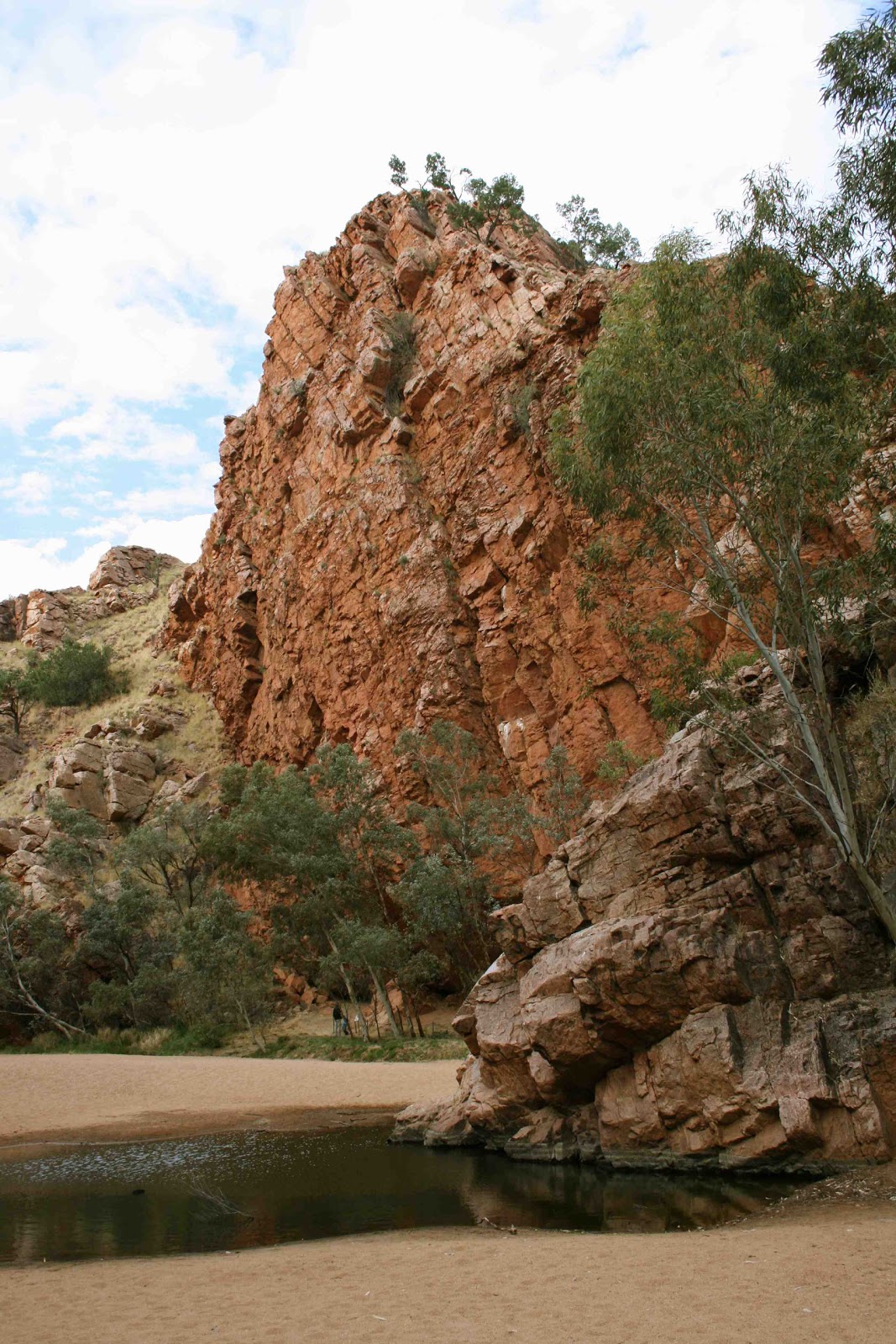
Emily Gap N.T.
Indigenous Australians were the original inhabitants of the continent we know today as Australia. They include Aboriginal Australians and Torres Strait Islanders. Together they make up 2.5% of Australia's population today.  It is believed that they are amongst the oldest races on earth with estimates suggesting that they first arrived on this continent between 40,000 and 125,000 years ago. They are an ancient people with a rich and unique culture. There is enormous diversity across the many nations and clans, with an estimated 250-300 spoken languages with 600 dialects. Sadly fewer than 200 of these languages remain and most are in danger of being lost.  Like many non-Indigenous Australians I see the preservation of Indigenous languages and their stories as of critical importance. While travelling in Central Australia last year this was brought into sharp focus for me.

An encounter with the 'The Three Caterpillars'

Mparntwe or Alice Springs is home to the Arrernte people, Indigenous Australians who have called this beautiful place home for at least 45,000 years.  It is at the geographical centre of Australia. The photo opposite is of a place called 'Emily Gap'. At this place I was able to view Indigenous rock art that tells the story of how three caterpillars named Yeperenye, Ntyarlke and Utnerrengatye created the MacDonnell Ranges.

 The Arrernte people, believe the ranges were formed by giant caterpillars that entered this world through one of the gaps in the escarpment of the area. In traditional stories the caterpillar ancestors, Yeperenye, Utnerrengatye and Ntyarlke are the major creation forces of the Alice Springs area. These stories tell how they arrived from all directions, first stopping at Mparntwe, a particularly sacred site in Alice Springs, where they battled with the Irlperenye (green stink bug).

'Three Caterpillars' - Emily Gap
The Caterpillars fled when the Irlperenye (stink bug) started to kill them. The ranges around Alice Springs are the seen as the remains of the many caterpillars. The gaps in the ranges like Emily Gap indicate where the stink bugs tore the heads from the bodies of the caterpillars. The rock formations around the area are and the few surviving Yeperenye went on to sculpt the rivers and trees along the tops of the ranges.

'The Three Caterpillars' were painted on the cliff face at some point in time. The dark red and light orange stripes were created by red ochre and white lime blended with animals fats and applied to the rock surface.

Indigenous Dreamtime stories are associated with specific Indigenous clans and nations and their lands and these stories are passed on to younger generations by elders and storytellers. They have survived for thousands of years but the loss of traditional languages and the separation of many Indigenous people from their traditional land is a threat to their survival. While some of these stories are secret, or are seen as of such a sacred nature that they are only told by specific people (e.g. told by men to men, or by women to women), in the last 40 years many Indigenous Dreamtime stories have been shared through children's books.

As a non-Indigenous Australian I love these stories and read them to my children and grandchildren from a very young age. I would like to see more of them written down by the people who own these stories so that others can enjoy them. Thankfully, many are being recorded but just as many aren't. For example, to date I haven't come across a written version of 'The Three Caterpillars' that I learned of when exploring Alice Springs.

Some of my favourite Indigenous Stories

Some of my favourite Indigenous Dreamtime stories have been passed down to all Australian children through the storytelling and wonderful art of Dick Roughsey (1924-1985) or Goobalathaldin to use his tribal name. He was from the island of Langu-narnji in the Gulf of Carpentaria in northern Australia. His first picture book 'The Giant Devil Dingo' received wide acclaim for the richness of the storytelling, the distinctiveness of his painted illustrations, with their vibrant colours, fascinating detail, and the integration of art and word. It tells of Old Eelgin, the grasshopper woman who was evil and had taught her giant dingo Gaiya to kill men for food. But one day Gaiya meets his match in the Chooku-Chooku (butcher-bird) brothers.

Another of my favourite works by Roughsey is 'The Rainbow Serpent' first published in 1975 and still available. It won the Children's Book Council of Australia award for best picture book in 1976. Goorialla (the Rainbow Serpent) travelled across Australia to find his tribe. As he travelled his tracks formed the mountains, the creeks, lagoons and rivers. The Bil-bil brothers plot to kill him. When Goorialla's anger is spent and he disappears into the sea the world is changed.

Dick Roughsey and Percy Trezise (1923-2005) formed a strong partnership to produce many wonderful books together. While Trezise was not Indigenous he became Roughsey's brother in a traditional Aboriginal ceremony and was given the name 'Warrenby'. Roughsey lived with his wife and their six children on Mornington Island, but often spent half the year on the North Queensland mainland. He and Percy Trezise discovered and studied the art of Aboriginal cave galleries in the Laura region of Cape York. The Quinkin gallery inspired the award-winning books 'The Quinkins' and 'Turramulli' the 'Giant Quinkin'.
'The Quinkins' is a wonderful story that tells of the Yalanji tribe of Cape York and their encounters with the Quinkins, spirit people of the land with two tribes: Imjim and the Timara. Imjim were small fat-bellied fellows who stole children while Timara were funny and whimsical spirits who like to play tricks. They were tall and very thin and lived in the cracks of the rocks, and they didn't like the Imjim. This is the story of two children, Boonbalbee and Leealin.  This book was an IBBY Honour book in 1980, and was the Children's Book Council Book of Australia Picture Book of the Year in 1979.  As I travelled through northern Australia and looked at the crevices in the rocks the echoes of this story made me think, "could these be Quinkin rocks?"

There are so many of their titles that I love and have enjoyed sharing with children. These include 'The Cave Painters' by Percy Trezise (1988) which tells of the experiences of two Bullanji children Nonda and Mayli as they travel to visit their mother's people, the Yalanji who live in 'Quinkin Country'. 'The Magic Firesticks' (Trezise & Roughsey) is another story of the Yalanji people in Cape York and tells how the people discovered the way to light fires, not simply sustain fires once they were alight. After monsoonal fires quenched all their fires two young men (Bandicoot and Curlew) travel to a far off Fire Mountain where it was said Didmunja (a wise man) had magic sticks which could produce fire when you wanted it.

'Banana Bird and the Snake Man' (Trezise & Roughsey) tells of a time when people who were later to become birds, animals, plants and reptiles were still in human form. The snake men of Cape York were cannibals who would kill people and hang them in trees to be collected later when they were hungry. This story tells of the triumph of Coucal the brother of Banana Bird man who avenges his brother's death and destroys the Snake men. 

Another wonderfully simple book is 'When the snake bites the sun' told by David (Bungal) Mowaljarlai, which was retold and illustrated by Pamela Lofts. This delightful story of the Ngarinyin tribe of Western Australia, tells the story of the sun and why it is as it is today. This was one of a series of simple picture books for preschool children produced in the 1980s some of which are still available. Other books in the series included 'Dunbi the owl', 'Echidna and the shade tree' and 'How the birds got their colours'. We owe Pamela Lofts (who lives in Alice Springs) a great debt for recording and illustrating many Indigenous stories. You can find a full list here.

Tiddalik Rock (Wollombi NSW)
'What made Tiddalik Laugh' has been produced in various versions of varied authenticity. It is based on the 'Cylorana platycephala' (or Water-holding Frog) that swells as it swallows water. It is sometimes referred to as 'Molok' as well as 'Tiddalik'. The version I first read was Joanna Troughton's beautifully (and amusingly) illustrated version, although this might not be the most authentic traditional version of the story. Tiddalik woke up one morning with an unquenchable thirst. He began to drink all the fresh water he could find till he was satisfied and every creek and billabong was dry. All the creatures and plant life began to die, so the other animals decided to do something about it. But how could they get the water back? Wombat had the answer, make him laugh? But how? The amusing solution involved Platypus in Troughton's version of the story. The story is said to have originated in South Gippsland Victoria but is common along the Eastern seaboard of Australia, so this is unclear. The photo of this rock (opposite) known as Tiddalik rock is located near Wollombi in NSW.

'Enora and the Black Crane', by Arone Raymond Meeks is another fine example of a traditional story being turned into a picture book. Arone Meeks is a member of the Kokoimudji tribe from the Laura area of far North Queensland. This story tells of Enora and how his killing of a crane led to birds acquiring their colours and him becoming the black crane. Winner of Australian IBBY Award for Children's Literature (1994), CBCA picture book of the year (1992) and UNICEF Ezra Jack Keats International Award Silver medal (1992). Arone Meeks also illustrated Catherine Berndt's wonderful book 'Pheasant and Kingfisher' (1987) that was shortlisted by the CBCA in 1988 and won the Crichton Award for Meeks in the same year.


A more recent book which I love is the 'Papunya School Book of Country and History' (2001). This isn't really a Dreamtime story, it is the story of the Anagu people of Central Australia. It offers a balanced telling of the people, their place, their culture and history. It does a good job in speaking of some of the difficult issues arising from the impact of white settlers. It is a wonderful collaboration between well-known non-Indigenous advocate Nadia Wheatley and Indigenous writers, storytellers and artists from the staff and students of Papunya School.

Another more recent community collaboration is 'Our World: Bardi Jaawi: Life At Ardiyooloon' (2011) by One Arm Point Remote Community School.  Ardiyooloon is home to the Bardi-Jaawi people and sits at the end of a red dirt road at the top of the Dampier Peninsula, 200km north of Broome in the north-west of Western Australia. 'Our World: Bardi-Jaawi Life at Ardiyooloon' takes readers inside the lives of the children of a remote Indigenous community; lives that are very different to those experienced by most Australians. Worthy Honour book in the CBCA awards for 2011 in the 'Eve Pownall Award' for Information Books.

Yet another wonderful collaborative book is 'Playground' (2011) compiled by Nadia Wheatley with illustrations and design by Ken Searle, has been short-listed for the 2011 Children's Book Council of Australia (CBCA) Awards. This is an unusual book isn't quite a graphic novel, but then again, it isn't simply a reference book.  Drawing on the stories of 80 Indigenous Australian Elders, 20 Indigenous secondary students and with Indigenous Historian Dr Jackie Huggins as adviser and critical friend, Nadia Wheatley has created a unique collaborative work.  The book offers a wonderful insight into experiences of childhood for Aboriginal and Torres Strait Islander people from 1900 to the present.

With stunning photographs and illustrations, it takes us into the daily life of Indigenous children (past and present) who are connected with their land from birth. The stories and drawings help the reader to understand Indigenous life in all its facets - learning, playing, understanding and respecting the earth, the first days of life, relationships in families, what 'home' was, languages, daily food gathering and hunting, the place of song, dance, art and ceremony.  With the arrival of European people there have been adaptations, but Indigenous children remain embedded in their culture. Daily life is different, but Indigenous children are still learning from country and community. This book would be a good introduction for readers who want to know more about Indigenous people not simply read their stories.

Some other great resources

Based on an Aboriginal Dreamtime story of Waatji Pulyeri (the Blue Wren)


Lovely example of Indigenous Storytelling, 'How the Kangaroo Got its Pouch' A Wirrajuri tale


Some brief further notes on Indigenous Australians

In Central Australia the Indigenous people are called the Anangu. Within this group there are many different language groups including the Pintupi, Warlpiri, Anmatyerre, Pitjantjatjara and Arrente. All Indigenous Australians come from different 'Ngurra' (homelands or traditional countries) and within their rich cultural traditions have stories, drawings, dances other cultural practices that have been passed down through the generations for millennia.  There has been a wonderful balance and 'bond' between people and their land. They see their ancestors as their teachers and for thousands of years they have taught their children the knowledge of ancestors and a history seen within the very rocks, water courses, hills, fauna and flora of their place. This has been passed down often (but not exclusively) through story. Often these stories are told in the context of place and have been oral, but in the last century some of these stories have been written down so that they can enrich all people, even if perhaps not understanding their full significance.

There is a deep sadness that many non-Indigenous Australians feel that there has been some loss of language and stories of these unique people. It was with a mixture of joy and sadness that I caught glimpses of the rich connection between Indigenous people and their land while I travelled across Central Australia.  The joy comes from the richness I could see in this connection, but the sadness is that for many Indigenous Australians this connection is made more difficult by their dislocation from traditional lands. My hope is that more Indigenous stories will be captured in written and spoken forms.

Note: * This is a revised version of a post I wrote in 2011

Thursday, August 18, 2011

Indigenous Tales of The Dreamtime

Emily Gap N.T.
An Introduction for non-Australians

Indigenous Australians were the original inhabitants of the continent we know today as Australia. They include Aboriginal Australians and Torres Strait Islanders. Together they make up 2.5% of Australia's population today.  It is believed that they are amongst the oldest races on earth with estimates suggesting that they first arrived on this continent between 40,000 and 125,000 years ago. They are an ancient people with a rich and unique culture. There is enormous diversity across the many nations and clans, with an estimated 250-300 spoken languages with 600 dialects. Sadly fewer than 200 of these languages remain and most are in danger of being lost.  Like many non-Indigenous Australians I see the preservation of Indigenous languages and their stories as of critical importance. Recently, while travelling in Central Australia this was brought into sharp focus for me.

An encounter with the 'The Three Caterpillars'

Mparntwe or Alice Springs is home to the Arrernte people, Indigenous Australians who have called this beautiful place home for at least 45,000 years.  It is at the geographical centre of Australia. The photo opposite is of a place called 'Emily Gap' that I visited in July while exploring Central Australia. At this place you will find Indigenous rock art that tells the story of how three caterpillars named Yeperenye, Ntyarlke and Utnerrengatye created the MacDonnell Ranges.

 The Arrernte people, believe the ranges were formed by giant caterpillars that entered this world through one of the gaps in the escarpment of the area. In traditional stories the caterpillar ancestors, Yeperenye, Utnerrengatye and Ntyarlke are the major creation forces of the Alice Springs area. These stories tell how they arrived from all directions, first stopping at Mparntwe, a particularly sacred site in Alice Springs, where they battled with the Irlperenye (green stink bug).

'Three Caterpillars' - Emily Gap
The Caterpillars fled when the Irlperenye (stink bug) started to kill them. The ranges around Alice Springs are the seen as the remains of the many caterpillars. The gaps in the ranges like Emily Gap indicate where the stink bugs tore the heads from the bodies of the caterpillars. The rock formations around the area are and the few surviving Yeperenye went on to sculpt the rivers and trees along the tops of the ranges.

'The Three Caterpillars' were painted on the cliff face at some point in time. The dark red and light orange stripes were created by red ochre and white lime blended with animals fats and applied to the rock surface.

Indigenous Dreamtime stories are associated with specific Indigenous clans and nations and their lands and these stories are passed on to younger generations by elders and storytellers. They have survived for thousands of years but the loss of traditional languages and the separation of many Indigenous people from their traditional land is a threat to their survival. While some of these stories are secret, or are seen as of such a sacred nature that they are only told by specific people to certain people (e.g. told by men to men, or by women to women), in the last 40 years many Indigenous Dreamtime stories have been shared through children's books.

As a non-Indigenous Australian I love these stories and would like to see more of them written down by the people who own these stories so that others can enjoy them. Thankfully, many are being recorded but just as many aren't. For example, to date I haven't come across a written version of 'The Three Caterpillars' that I learned of when exploring Alice Springs.

Some of my favourite Indigenous Stories

Some of my favourite Indigenous Dreamtime stories have been passed down to all Australian children through the storytelling and wonderful art of Dick Roughsey (1924-1985) or Goobalathaldin to use his tribal name. He was from the island of Langu-narnji in the Gulf of Carpentaria in northern Australia. His first picture book 'The Giant Devil Dingo' received wide acclaim for the richness of the storytelling, the distinctiveness of his painted illustrations, with their vibrant colours, fascinating detail, and the integration of art and word. It tells of Old Eelgin, the grasshopper woman who was evil and had taught her giant dingo Gaiya to kill men for food. But one day Gaiya meets his match in the Chooku-Chooku (butcher-bird) brothers.

Another of my favourite works by Roughsey is 'The Rainbow Serpent' first published in 1975 and still available. It won the Children's Book Council of Australia award for best picture book in 1976. Goorialla (the Rainbow Serpent) travelled across Australia to find his tribe. As he travelled his tracks formed the mountains, the creeks, lagoons and rivers. The Bil-bil brothers plot to kill him. When Goorialla's anger is spent and he disappears into the sea the world is changed.

Dick Roughsey and Percy Trezise (1923-2005) formed a strong partnership to produce many wonderful books together. While Trezise was not Indigenous he became Roughsey's brother in a traditional Aboriginal ceremony and was given the name 'Warrenby'. Roughsey lived with his wife and their six children on Mornington Island, but often spent half the year on the North Queensland mainland. He and Percy Trezise discovered and studied the art of Aboriginal cave galleries in the Laura region of Cape York. The Quinkin gallery inspired the award-winning books 'The Quinkins' and 'Turramulli' the 'Giant Quinkin'.
'The Quinkins' is a wonderful story that tells of the Yalanji tribe of Cape York and their encounters with the Quinkins, spirit people of the land with two tribes: Imjim and the Timara. Imjim were small fat-bellied fellows who stole children while Timara were funny and whimsical spirits who like to play tricks. They were tall and very thin and lived in the cracks of the rocks, and they didn't like the Imjim. This is the story of two children, Boonbalbee and Leealin.  This book was an IBBY Honour book in 1980, and was the Children's Book Council Book of Australia Picture Book of the Year in 1979.  As I travelled through northern Australia and looked at the crevices in the rocks the echoes of this story made me think, "could these be Quinkin rocks?"

There are so many of their titles that I love and have enjoyed sharing with children. These include 'The Cave Painters' by Percy Trezise (1988) which tells of the experiences of two Bullanji children Nonda and Mayli as they travel to visit their mother's people, the Yalanji who live in 'Quinkin Country'. 'The Magic Firesticks' (Trezise & Roughsey) is another story of the Yalanji people in Cape York and tells how the people discovered the way to light fires, not simply sustain fires once they were alight. After monsoonal fires quenched all their fires two young men (Bandicoot and Curlew) travel to a far off Fire Mountain where it was said Didmunja (a wise man) had magic sticks which could produce fire when you wanted it.

'Banana Bird and the Snake Man' (Trezise & Roughsey) tells of a time when people who were later to become birds, animals, plants and reptiles were still in human form. The snake men of Cape York were cannibals who would kill people and hang them in trees to be collected later when they were hungry. This story tells of the triumph of Coucal the brother of Banana Bird man who avenges his brother's death and destroys the Snake men. 

Another wonderfully simple book is 'When the snake bites the sun' told by David (Bungal) Mowaljarlai, which was retold and illustrated by Pamela Lofts. This delightful story of the Ngarinyin tribe of Western Australia, tells the story of the sun and why it is as it is today. This was one of a series of simple picture books for preschool children produced in the 1980s some of which are still available. Other books in the series included 'Dunbi the owl', 'Echidna and the shade tree' and 'How the birds got their colours'. We owe Pamela Lofts (who lives in Alice Springs) a great debt for recording and illustrating many Indigenous stories. You can find a full list here.

Tiddalik Rock (Wollombi NSW)
'What made Tiddalik Laugh' has been produced in various versions of varied authenticity. It is based on the 'Cylorana platycephala' (or Water-holding Frog) that swells as it swallows water. It is sometimes referred to as 'Molok' as well as 'Tiddalik'. The version I first read was Joanna Troughton's beautifully (and amusingly) illustrated version, although this might not be the most authentic traditional version of the story. Tiddalik woke up one morning with an unquenchable thirst. He began to drink all the fresh water he could find till he was satisfied and every creek and billabong was dry. All the creatures and plant life began to die, so the other animals decided to do something about it. But how could they get the water back? Wombat had the answer, make him laugh? But how? The amusing solution involved Platypus in Troughton's version of the story. The story is said to have originated in South Gippsland Victoria but is common along the Eastern seaboard of Australia, so this is unclear. The photo of this rock (opposite) known as Tiddalik rock is located near Wollombi in NSW.

'Enora and the Black Crane', by Arone Raymond Meeks is another fine example of a traditional story being turned into a picture book. Arone Meeks is a member of the Kokoimudji tribe from the Laura area of far North Queensland. This story tells of Enora and how his killing of a crane led to birds acquiring their colours and him becoming the black crane. Winner of Australian IBBY Award for Children's Literature (1994), CBCA picture book of the year (1992) and UNICEF Ezra Jack Keats International Award Silver medal (1992). Arone Meeks also illustrated Catherine Berndt's wonderful book 'Pheasant and Kingfisher' (1987) that was shortlisted by the CBCA in 1988 and won the Crichton Award for Meeks in the same year.


A more recent book which I love is the 'Papunya School Book of Country and History' (2001). This isn't really a Dreamtime story, it is the story of the Anagu people of Central Australia. It offers a balanced telling of the people, their place, their culture and history. It does a good job in speaking of some of the difficult issues arising from the impact of white settlers. It is a wonderful collaboration between well-known non-Indigenous advocate Nadia Wheatley and Indigenous writers, storytellers and artists from the staff and students of Papunya School.

Another more recent community collaboration is 'Our World: Bardi Jaawi: Life At Ardiyooloon' (2011) by One Arm Point Remote Community School.  Ardiyooloon is home to the Bardi-Jaawi people and sits at the end of a red dirt road at the top of the Dampier Peninsula, 200km north of Broome in the north-west of Western Australia. 'Our World: Bardi-Jaawi Life at Ardiyooloon' takes readers inside the lives of the children of a remote Indigenous community; lives that are very different to those experienced by most Australians. Worthy Honour book in the CBCA awards for 2011 in the 'Eve Pownall Award' for Information Books.

Yet another wonderful collaborative book is 'Playground' (2011) compiled by Nadia Wheatley with illustrations and design by Ken Searle, has been short-listed for the 2011 Children's Book Council of Australia (CBCA) Awards. This is an unusual book isn't quite a graphic novel, but then again, it isn't simply a reference book.  Drawing on the stories of 80 Indigenous Australian Elders, 20 Indigenous secondary students and with Indigenous Historian Dr Jackie Huggins as adviser and critical friend, Nadia Wheatley has created a unique collaborative work.  The book offers a wonderful insight into experiences of childhood for Aboriginal and Torres Strait Islander people from 1900 to the present.

With stunning photographs and illustrations, it takes us into the daily life of Indigenous children (past and present) who are connected with their land from birth. The stories and drawings help the reader to understand Indigenous life in all its facets - learning, playing, understanding and respecting the earth, the first days of life, relationships in families, what 'home' was, languages, daily food gathering and hunting, the place of song, dance, art and ceremony.  With the arrival of European people there have been adaptations, but Indigenous children remain embedded in their culture. Daily life is different, but Indigenous children are still learning from country and community. This book would be a good introduction for readers who want to know more about Indigenous people not simply read their stories.

Some other great resources


Based on an Aboriginal Dreamtime story of Waatji Pulyeri (the Blue Wren)


Lovely example of Indigenous Storytelling, 'How the Kangaroo Got its Pouch' A Wirrajuri tale


Some brief further notes on Indigenous Australians

In Central Australia the Indigenous people are called the Anangu. Within this group there are many different language groups including the Pintupi, Warlpiri, Anmatyerre, Pitjantjatjara and Arrente. All Indigenous Australians come from different 'Ngurra' (homelands or traditional countries) and within their rich cultural traditions have stories, drawings, dances other cultural practices that have been passed down through the generations for millennia.  There has been a wonderful balance and 'bond' between people and their land. They see their ancestors as their teachers and for thousands of years they have taught their children the knowledge of ancestors and a history seen within the very rocks, water courses, hills, fauna and flora of their place. This has been passed down often (but not exclusively) through story. Often these stories are told in the context of place and have been oral, but in the last century some of these stories have been written down so that they can enrich all people, even if perhaps not understanding their full significance.

There is a deep sadness that many non-Indigenous Australians feel that there has been some loss of language and stories of these unique people. It was with a mixture of joy and sadness that I caught glimpses of the rich connection between Indigenous people and their land while I travelled across Central Australia.  The joy comes from the richness I could see in this connection, but the sadness is that for many Indigenous Australians this connection is made more difficult by their dislocation from traditional lands. My hope is that more Indigenous stories will be captured in written and spoken forms.