Showing posts with label Indigenous education. Show all posts

Saturday, July 16, 2016

Australian Indigenous Literature: A review of 8 wonderful books

Magabala Books is Australia's leading Indigenous publisher. Based in the pearling town of Broome in the far north of Western Australia, it is one of the most remote publishing houses in the world. Since its incorporation in 1990, Magabala has been recognised as a producer of quality Indigenous Australian literature. Its books can be found on its own website or through other online stores and search engines. You can also find teaching resources for most of their books on the site HERE. This will be very helpful for teachers.

Magabala is a not-for-profit organisation that preserves, develops and promotes Australian Aboriginal and Torres Strait Islander language and cultures. It has released more than one hundred and fifty titles from a range of genres, many of which are still in print.

While I've enjoyed Magabala's books for some time, recently I had the chance to visit the publisher and consider all of their titles. As well, I was able to buy some for myself and as gifts for children in my family. In this post I want to review just some of the wonderful material that they publish.


1. 'Tjarany Roughtail' by Gracie Greene and Joe Tramacchi and illustrated by Lucille Gill

Tjarany Roughtail contains eight dreamtime stories from the Kukatja people of Western Australia’s remote Kimberley Region. Each story is complemented by beautiful artworks painted by Aboriginal artist Lucille Gill that visually explain each story using traditional dot paintings. Told in English and Kukatja.

This wonderful book offers mysteries of the Dreamtime centred on the cultural history of the Kukatja people of the Kimberley region of Western Australia. Told in English and Kukatja, the book includes magnificent paintings, maps, kinship diagrams, exercises and language notes. Children aged 7-12 will love this book and gain a greater appreciation of the richness of Aboriginal culture and story.

The book was the winner of the Australian Children's Book Council (CBCA) Eve Pownall Award for Information Books (1993), and was also shortlisted for the NSW Premier's Literary Awards.

2. 'Two Mates' by Melanie Prewett and illustrated by Maggie Prewett

The true story of the special mateship between two boys who have grown up together in Broome; Jack is Indigenous and Raf is non-Indigenous. The boys share their daily life as they search for hermit crabs, go hunting for barni, fish for salmon, explore the markets, eat satays and dress up as superheros. At the end of the book it is revealed that Raf is in a wheelchair due to spina bifida. The book offers some additional information on this condition at the end of the book. 

This is a lovely story that shows that true friendship sees no barriers in race or disability.  This would be a wonderful book to share with children aged 5-8 years. There are also some teaching notes on the Magabala site HERE.


3. 'Joshua and the Two Crabs' by Joshua Button


Joshua Button is a young Indigenous author with a keen interest in the saltwater country he has grown up in. His observations of his family’s fishing trip to Crab Creek give us a unique opportunity to see this adventure through his eyes. Joshua’s illustrations evoke the beauty of Crab Creek—a tidal creek that lies in the mangroves of Roebuck Bay near Broome in Australia’s north west.

I had the pleasure of spending some time at Roebuck Bay just last week. This is an exquisite place where I spent hours looking at the sheer beauty and the rich marine life. Some of the stars of the wildlife are definitely the crabs. Watching them scurry (at great speed), eating, digging and leaving their intriguing marks on the red sand was a great joy. My photos below show a little of this beauty.


4. 'Our World Bardi Jaawi, Life at Ardiyooloon' written and illustrated by the students of One Arm Point Remote Community School 

Ardiyooloon is home to the Bardi Jaawi people and sits at the end of a red dirt road at the top of the Dampier Peninsula, 200km north of Broome in the Kimberley region of Western Australia. This vibrant book is bursting with life and activity and takes readers inside the lives of the children of a remote Indigenous community.

This wonderful book is inspired by the stories of the elders and the beautiful beauty of the land and culture of Ardiyooloon. The many chapters in the richly illustrated book consider the history, language, food and cultural practices of the Bardi Jaawi people. The children's illustrations enrich the many factual texts that consider fishing, bush food, special events, language and the wildlife of this wonderful place. For example, on one double page the children describe and draw 23 different saltwater creatures that are found in their world. The authenticity of the waters and the richness and colour of the illustrations, make you want to dip again and again into this beautiful book.


The book was the winner of the Speech Pathology Australia's Indigenous Book of the Year 2011 and was also shortlisted in the Children's Book Council of Australia (CBCA) awards in the same year.

Comprehensive teacher notes for the book can be downloaded here

5. 'The Grumpy Lighthouse Keeper', by Terrizita Corpus and illustrated by Maggie Prewett

This amusing tale takes place on a stormy wet-season night at the Broome lighthouse. Meet Cassius the hermit crab, Jacob the jellyfish, Bruce the bluebone and more sea creatures as they head down the beach and race up the lighthouse staircase to escape a wild storm — all while the lighthouse keeper is out checking the lamp for passing ships. When he discovers his bed has been taken over by slimy sea creatures, he is very grumpy.

This is a more contemporary work of fiction situated in the lighthouse at Cable Beach in Broome. The lighthouse keeper's house and the ruins of the lighthouse remain, plus a new less visually attractive unmanned lighthouse (see below). The beautiful watercolour illustrations complement the funny text. My final recommendation is that any book that has a crab named 'Trev' would have to be good! It will be well received by children aged 4-7 years.

Above: The modern lighthouse
'
The Grumpy Lighthouse Keeper' is inspired by the iconic Broome lighthouse and the remains of the old lighthouse keeper’s house that sits on the edge of the world-renowned Cable Beach. This is a beautiful place with great wild beauty and the rich colours of the earth so synonymous with the remote north west.


6. 'Do Not Go Around the Edges' by Daisy Utemorrah and illustrated by Pat Torres

This remarkable book weaves together the story of Daisy Utemorrah’s life with a collection of playful parables and poems. It explores themes such as Creation, tradition, memories, family and most importantly, country. 'Do Not Go Around the Edges' imbues a simple autobiographical story with humour and depth, and will appeal to adults and children alike. Retold with love and honour, be transported to a place where time stands still...

Daisy Utemorrah was an elder of the Wunambal people from the Mitchell Plateau area in the far north Kimberley. She was born in 1922 at Kunmunya Mission and her family background gave her fluency in three Aboriginal languages. Daisy was recognised for her work as a poet and a teacher. This was her first book and of course was published by Magabala in 1991. It won the Australian Multicultural Children’'s Book Award the following year, and was also shortlisted for the Children’'s Book Council of Australia (CBCA) award for Younger Readers. As well, Pat Torres won the prestigious international IBBY award for illustration for her work on this book in 1994.

It is a remarkable book for various reasons. It integrates Daisy's unique autobiographical story with a variety of traditional Aboriginal Dreamtime themes, focussing on memories, family, creation and country, the important relationship between a people and their land. It is beautifully told with simplicity and economy of words, and it weaves Daisy's traditional languages with her stories and the wonderful illustrations of Broome-based Djugan artist Pat Torres. Here is a sample:

I am the native cat, I dance everywhere.
I hop, skip and jump.
I jump on the flat stone
and dance and wobble my bum and hold my hips
And then I dance again.


7. 'The Mark of the Wagarl' by Lorna Little and illustrated by Janice Lyndon

Maadjit Walken is the Sacred Rainbow Serpent. She is the mother spirit and creator of Nyoongar Country in the south west of Western Australia. She formed the landscape and the waterways, and made her first child Maadjit Wagarl, the Sacred Water Snake, the guardian spirit of all the rivers and fresh waters. The Mark of the Wagarl is the story of how a little boy dared to question the wisdom of his elders and why he received the Sacred Water Snake for his totem. Janice Lyndon’s pastel illustrations resonate with the cultural power of the Maadjit Wagarl and the landscape of the south west. This is a revised edition.

This is a traditional Aboriginal Dreamtime story featuring a well-known character - the Rainbow Serpent - who appears in other books for children, most notably 'The Rainbow Serpent' by Dick Roughsey. The slightly more contemporary illustrations are designed to appeal to a new generation who should love this book.

Comprehensive teacher notes for the book can be downloaded here from the Magabala website.


8. 'Ngay janijirr ngank. This is my word', by Magdalene Williams, illustrated by Pat Torres and with photos by Maria Mann.

A beautifully illustrated account of the life of Magdalene Williams of the Nyulnyul people. Raised in the confines of Beagle Bay mission in the Kimberley, she was nevertheless exposed to her traditional culture through her Elders. Magdalene's account of the coming of the missionaries, and the destruction of law and culture is interwoven with the richness and diversity of her Nyulnyul stories.

I love this book for the beauty of the language and the power of the stories that Magdalene Williams tells. The work is also well illustrated by Pat Torres and has wonderful photos from Maria Mann. The opening line gives a sense of what is to come as she tells the story of the Nyulnyul people of Beagle Bay:

"A long time ago in Ngarlan, the place where Beagle Bay now stands, a very strange and frightening thing happened."

The book also contains several wordlists. Helpfully, these include Nyulnyul to English and English to Nyulnyul, selected phrases, traditional names of the family members mentioned, and also a pronunciation guide. This is a book that works at many levels, it has an engaging story, it raises cultural awareness, offers language study and more.  Children aged 7-12 will enjoy this excellent book.


Further reading

Other previous posts on Indigenous literature HERE.
Other reviews on children's literature HERE.



Monday, May 6, 2013

Appreciating Aboriginal Dreamtime Stories*

An Introduction for non-Australians
 
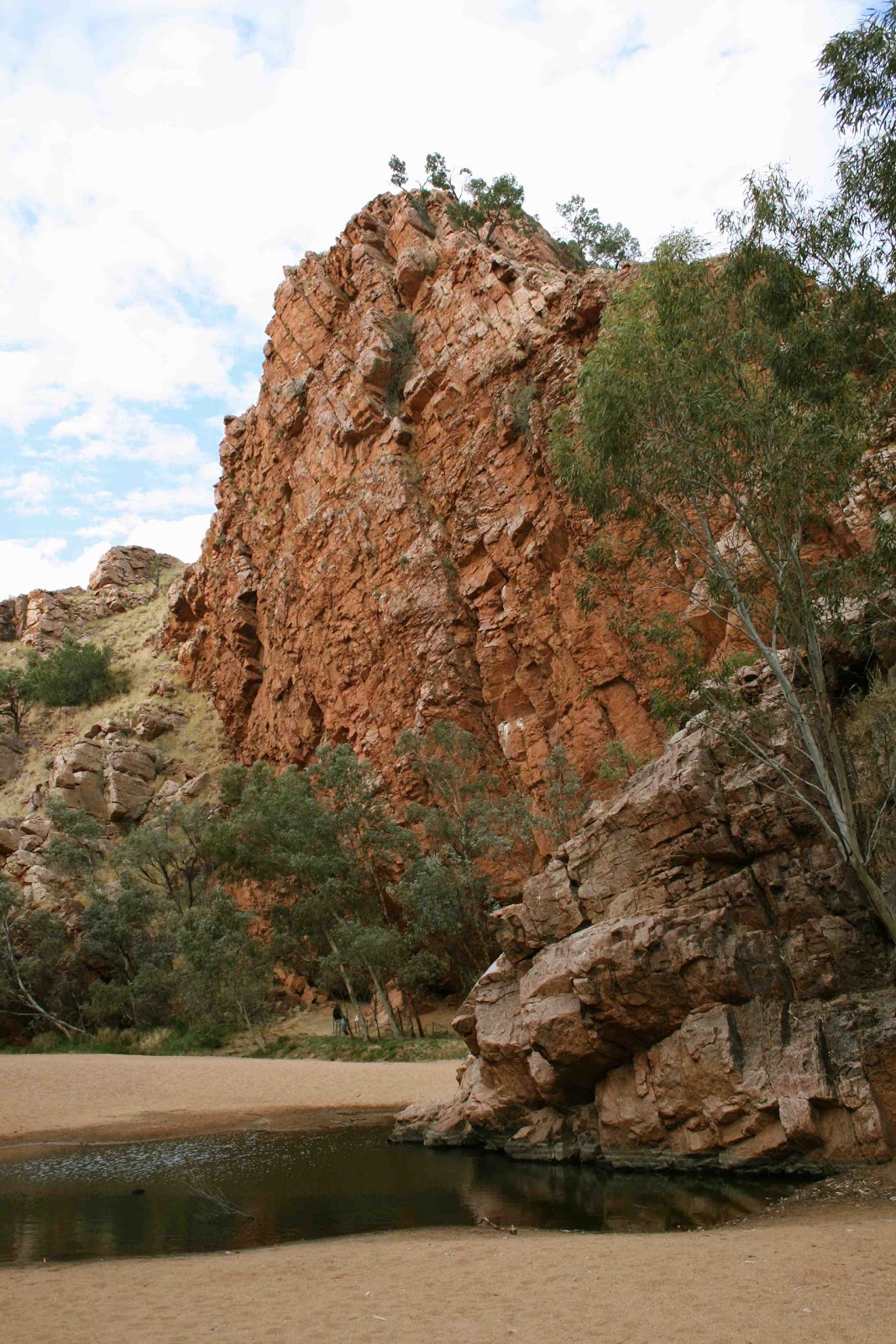
Emily Gap N.T.
Indigenous Australians were the original inhabitants of the continent we know today as Australia. They include Aboriginal Australians and Torres Strait Islanders. Together they make up 2.5% of Australia's population today.  It is believed that they are amongst the oldest races on earth with estimates suggesting that they first arrived on this continent between 40,000 and 125,000 years ago. They are an ancient people with a rich and unique culture. There is enormous diversity across the many nations and clans, with an estimated 250-300 spoken languages with 600 dialects. Sadly fewer than 200 of these languages remain and most are in danger of being lost.  Like many non-Indigenous Australians I see the preservation of Indigenous languages and their stories as of critical importance. While travelling in Central Australia last year this was brought into sharp focus for me.

An encounter with the 'The Three Caterpillars'

Mparntwe or Alice Springs is home to the Arrernte people, Indigenous Australians who have called this beautiful place home for at least 45,000 years.  It is at the geographical centre of Australia. The photo opposite is of a place called 'Emily Gap'. At this place I was able to view Indigenous rock art that tells the story of how three caterpillars named Yeperenye, Ntyarlke and Utnerrengatye created the MacDonnell Ranges.

 The Arrernte people, believe the ranges were formed by giant caterpillars that entered this world through one of the gaps in the escarpment of the area. In traditional stories the caterpillar ancestors, Yeperenye, Utnerrengatye and Ntyarlke are the major creation forces of the Alice Springs area. These stories tell how they arrived from all directions, first stopping at Mparntwe, a particularly sacred site in Alice Springs, where they battled with the Irlperenye (green stink bug).

'Three Caterpillars' - Emily Gap
The Caterpillars fled when the Irlperenye (stink bug) started to kill them. The ranges around Alice Springs are the seen as the remains of the many caterpillars. The gaps in the ranges like Emily Gap indicate where the stink bugs tore the heads from the bodies of the caterpillars. The rock formations around the area are and the few surviving Yeperenye went on to sculpt the rivers and trees along the tops of the ranges.

'The Three Caterpillars' were painted on the cliff face at some point in time. The dark red and light orange stripes were created by red ochre and white lime blended with animals fats and applied to the rock surface.

Indigenous Dreamtime stories are associated with specific Indigenous clans and nations and their lands and these stories are passed on to younger generations by elders and storytellers. They have survived for thousands of years but the loss of traditional languages and the separation of many Indigenous people from their traditional land is a threat to their survival. While some of these stories are secret, or are seen as of such a sacred nature that they are only told by specific people (e.g. told by men to men, or by women to women), in the last 40 years many Indigenous Dreamtime stories have been shared through children's books.

As a non-Indigenous Australian I love these stories and read them to my children and grandchildren from a very young age. I would like to see more of them written down by the people who own these stories so that others can enjoy them. Thankfully, many are being recorded but just as many aren't. For example, to date I haven't come across a written version of 'The Three Caterpillars' that I learned of when exploring Alice Springs.

Some of my favourite Indigenous Stories

Some of my favourite Indigenous Dreamtime stories have been passed down to all Australian children through the storytelling and wonderful art of Dick Roughsey (1924-1985) or Goobalathaldin to use his tribal name. He was from the island of Langu-narnji in the Gulf of Carpentaria in northern Australia. His first picture book 'The Giant Devil Dingo' received wide acclaim for the richness of the storytelling, the distinctiveness of his painted illustrations, with their vibrant colours, fascinating detail, and the integration of art and word. It tells of Old Eelgin, the grasshopper woman who was evil and had taught her giant dingo Gaiya to kill men for food. But one day Gaiya meets his match in the Chooku-Chooku (butcher-bird) brothers.

Another of my favourite works by Roughsey is 'The Rainbow Serpent' first published in 1975 and still available. It won the Children's Book Council of Australia award for best picture book in 1976. Goorialla (the Rainbow Serpent) travelled across Australia to find his tribe. As he travelled his tracks formed the mountains, the creeks, lagoons and rivers. The Bil-bil brothers plot to kill him. When Goorialla's anger is spent and he disappears into the sea the world is changed.

Dick Roughsey and Percy Trezise (1923-2005) formed a strong partnership to produce many wonderful books together. While Trezise was not Indigenous he became Roughsey's brother in a traditional Aboriginal ceremony and was given the name 'Warrenby'. Roughsey lived with his wife and their six children on Mornington Island, but often spent half the year on the North Queensland mainland. He and Percy Trezise discovered and studied the art of Aboriginal cave galleries in the Laura region of Cape York. The Quinkin gallery inspired the award-winning books 'The Quinkins' and 'Turramulli' the 'Giant Quinkin'.
'The Quinkins' is a wonderful story that tells of the Yalanji tribe of Cape York and their encounters with the Quinkins, spirit people of the land with two tribes: Imjim and the Timara. Imjim were small fat-bellied fellows who stole children while Timara were funny and whimsical spirits who like to play tricks. They were tall and very thin and lived in the cracks of the rocks, and they didn't like the Imjim. This is the story of two children, Boonbalbee and Leealin.  This book was an IBBY Honour book in 1980, and was the Children's Book Council Book of Australia Picture Book of the Year in 1979.  As I travelled through northern Australia and looked at the crevices in the rocks the echoes of this story made me think, "could these be Quinkin rocks?"

There are so many of their titles that I love and have enjoyed sharing with children. These include 'The Cave Painters' by Percy Trezise (1988) which tells of the experiences of two Bullanji children Nonda and Mayli as they travel to visit their mother's people, the Yalanji who live in 'Quinkin Country'. 'The Magic Firesticks' (Trezise & Roughsey) is another story of the Yalanji people in Cape York and tells how the people discovered the way to light fires, not simply sustain fires once they were alight. After monsoonal fires quenched all their fires two young men (Bandicoot and Curlew) travel to a far off Fire Mountain where it was said Didmunja (a wise man) had magic sticks which could produce fire when you wanted it.

'Banana Bird and the Snake Man' (Trezise & Roughsey) tells of a time when people who were later to become birds, animals, plants and reptiles were still in human form. The snake men of Cape York were cannibals who would kill people and hang them in trees to be collected later when they were hungry. This story tells of the triumph of Coucal the brother of Banana Bird man who avenges his brother's death and destroys the Snake men. 

Another wonderfully simple book is 'When the snake bites the sun' told by David (Bungal) Mowaljarlai, which was retold and illustrated by Pamela Lofts. This delightful story of the Ngarinyin tribe of Western Australia, tells the story of the sun and why it is as it is today. This was one of a series of simple picture books for preschool children produced in the 1980s some of which are still available. Other books in the series included 'Dunbi the owl', 'Echidna and the shade tree' and 'How the birds got their colours'. We owe Pamela Lofts (who lives in Alice Springs) a great debt for recording and illustrating many Indigenous stories. You can find a full list here.

Tiddalik Rock (Wollombi NSW)
'What made Tiddalik Laugh' has been produced in various versions of varied authenticity. It is based on the 'Cylorana platycephala' (or Water-holding Frog) that swells as it swallows water. It is sometimes referred to as 'Molok' as well as 'Tiddalik'. The version I first read was Joanna Troughton's beautifully (and amusingly) illustrated version, although this might not be the most authentic traditional version of the story. Tiddalik woke up one morning with an unquenchable thirst. He began to drink all the fresh water he could find till he was satisfied and every creek and billabong was dry. All the creatures and plant life began to die, so the other animals decided to do something about it. But how could they get the water back? Wombat had the answer, make him laugh? But how? The amusing solution involved Platypus in Troughton's version of the story. The story is said to have originated in South Gippsland Victoria but is common along the Eastern seaboard of Australia, so this is unclear. The photo of this rock (opposite) known as Tiddalik rock is located near Wollombi in NSW.

'Enora and the Black Crane', by Arone Raymond Meeks is another fine example of a traditional story being turned into a picture book. Arone Meeks is a member of the Kokoimudji tribe from the Laura area of far North Queensland. This story tells of Enora and how his killing of a crane led to birds acquiring their colours and him becoming the black crane. Winner of Australian IBBY Award for Children's Literature (1994), CBCA picture book of the year (1992) and UNICEF Ezra Jack Keats International Award Silver medal (1992). Arone Meeks also illustrated Catherine Berndt's wonderful book 'Pheasant and Kingfisher' (1987) that was shortlisted by the CBCA in 1988 and won the Crichton Award for Meeks in the same year.


A more recent book which I love is the 'Papunya School Book of Country and History' (2001). This isn't really a Dreamtime story, it is the story of the Anagu people of Central Australia. It offers a balanced telling of the people, their place, their culture and history. It does a good job in speaking of some of the difficult issues arising from the impact of white settlers. It is a wonderful collaboration between well-known non-Indigenous advocate Nadia Wheatley and Indigenous writers, storytellers and artists from the staff and students of Papunya School.

Another more recent community collaboration is 'Our World: Bardi Jaawi: Life At Ardiyooloon' (2011) by One Arm Point Remote Community School.  Ardiyooloon is home to the Bardi-Jaawi people and sits at the end of a red dirt road at the top of the Dampier Peninsula, 200km north of Broome in the north-west of Western Australia. 'Our World: Bardi-Jaawi Life at Ardiyooloon' takes readers inside the lives of the children of a remote Indigenous community; lives that are very different to those experienced by most Australians. Worthy Honour book in the CBCA awards for 2011 in the 'Eve Pownall Award' for Information Books.

Yet another wonderful collaborative book is 'Playground' (2011) compiled by Nadia Wheatley with illustrations and design by Ken Searle, has been short-listed for the 2011 Children's Book Council of Australia (CBCA) Awards. This is an unusual book isn't quite a graphic novel, but then again, it isn't simply a reference book.  Drawing on the stories of 80 Indigenous Australian Elders, 20 Indigenous secondary students and with Indigenous Historian Dr Jackie Huggins as adviser and critical friend, Nadia Wheatley has created a unique collaborative work.  The book offers a wonderful insight into experiences of childhood for Aboriginal and Torres Strait Islander people from 1900 to the present.

With stunning photographs and illustrations, it takes us into the daily life of Indigenous children (past and present) who are connected with their land from birth. The stories and drawings help the reader to understand Indigenous life in all its facets - learning, playing, understanding and respecting the earth, the first days of life, relationships in families, what 'home' was, languages, daily food gathering and hunting, the place of song, dance, art and ceremony.  With the arrival of European people there have been adaptations, but Indigenous children remain embedded in their culture. Daily life is different, but Indigenous children are still learning from country and community. This book would be a good introduction for readers who want to know more about Indigenous people not simply read their stories.

Some other great resources

Based on an Aboriginal Dreamtime story of Waatji Pulyeri (the Blue Wren)


Lovely example of Indigenous Storytelling, 'How the Kangaroo Got its Pouch' A Wirrajuri tale


Some brief further notes on Indigenous Australians

In Central Australia the Indigenous people are called the Anangu. Within this group there are many different language groups including the Pintupi, Warlpiri, Anmatyerre, Pitjantjatjara and Arrente. All Indigenous Australians come from different 'Ngurra' (homelands or traditional countries) and within their rich cultural traditions have stories, drawings, dances other cultural practices that have been passed down through the generations for millennia.  There has been a wonderful balance and 'bond' between people and their land. They see their ancestors as their teachers and for thousands of years they have taught their children the knowledge of ancestors and a history seen within the very rocks, water courses, hills, fauna and flora of their place. This has been passed down often (but not exclusively) through story. Often these stories are told in the context of place and have been oral, but in the last century some of these stories have been written down so that they can enrich all people, even if perhaps not understanding their full significance.

There is a deep sadness that many non-Indigenous Australians feel that there has been some loss of language and stories of these unique people. It was with a mixture of joy and sadness that I caught glimpses of the rich connection between Indigenous people and their land while I travelled across Central Australia.  The joy comes from the richness I could see in this connection, but the sadness is that for many Indigenous Australians this connection is made more difficult by their dislocation from traditional lands. My hope is that more Indigenous stories will be captured in written and spoken forms.

Note: * This is a revised version of a post I wrote in 2011

Wednesday, September 7, 2011

Indigenous Literacy Day

Today is Indigenous Literacy Day!

In recognition of the importance of this day I have provided links below to some of my previous posts dealing with Indigenous literacy and education issues.

'Better education outcomes for Indigenous students' HERE

'Indigenous tales of the Dreamtime' HERE

'Indigenous students making literacy progress' HERE

'The Lucky Country: How are the kids faring?' HERE 

'Australia Day: A time for storytelling and action' HERE 

'Catching a glimpse of our nation through children's literature' HERE

'Requiem for a Beast: A review' HERE

Thursday, August 18, 2011

Indigenous Tales of The Dreamtime

Emily Gap N.T.
An Introduction for non-Australians

Indigenous Australians were the original inhabitants of the continent we know today as Australia. They include Aboriginal Australians and Torres Strait Islanders. Together they make up 2.5% of Australia's population today.  It is believed that they are amongst the oldest races on earth with estimates suggesting that they first arrived on this continent between 40,000 and 125,000 years ago. They are an ancient people with a rich and unique culture. There is enormous diversity across the many nations and clans, with an estimated 250-300 spoken languages with 600 dialects. Sadly fewer than 200 of these languages remain and most are in danger of being lost.  Like many non-Indigenous Australians I see the preservation of Indigenous languages and their stories as of critical importance. Recently, while travelling in Central Australia this was brought into sharp focus for me.

An encounter with the 'The Three Caterpillars'

Mparntwe or Alice Springs is home to the Arrernte people, Indigenous Australians who have called this beautiful place home for at least 45,000 years.  It is at the geographical centre of Australia. The photo opposite is of a place called 'Emily Gap' that I visited in July while exploring Central Australia. At this place you will find Indigenous rock art that tells the story of how three caterpillars named Yeperenye, Ntyarlke and Utnerrengatye created the MacDonnell Ranges.

 The Arrernte people, believe the ranges were formed by giant caterpillars that entered this world through one of the gaps in the escarpment of the area. In traditional stories the caterpillar ancestors, Yeperenye, Utnerrengatye and Ntyarlke are the major creation forces of the Alice Springs area. These stories tell how they arrived from all directions, first stopping at Mparntwe, a particularly sacred site in Alice Springs, where they battled with the Irlperenye (green stink bug).

'Three Caterpillars' - Emily Gap
The Caterpillars fled when the Irlperenye (stink bug) started to kill them. The ranges around Alice Springs are the seen as the remains of the many caterpillars. The gaps in the ranges like Emily Gap indicate where the stink bugs tore the heads from the bodies of the caterpillars. The rock formations around the area are and the few surviving Yeperenye went on to sculpt the rivers and trees along the tops of the ranges.

'The Three Caterpillars' were painted on the cliff face at some point in time. The dark red and light orange stripes were created by red ochre and white lime blended with animals fats and applied to the rock surface.

Indigenous Dreamtime stories are associated with specific Indigenous clans and nations and their lands and these stories are passed on to younger generations by elders and storytellers. They have survived for thousands of years but the loss of traditional languages and the separation of many Indigenous people from their traditional land is a threat to their survival. While some of these stories are secret, or are seen as of such a sacred nature that they are only told by specific people to certain people (e.g. told by men to men, or by women to women), in the last 40 years many Indigenous Dreamtime stories have been shared through children's books.

As a non-Indigenous Australian I love these stories and would like to see more of them written down by the people who own these stories so that others can enjoy them. Thankfully, many are being recorded but just as many aren't. For example, to date I haven't come across a written version of 'The Three Caterpillars' that I learned of when exploring Alice Springs.

Some of my favourite Indigenous Stories

Some of my favourite Indigenous Dreamtime stories have been passed down to all Australian children through the storytelling and wonderful art of Dick Roughsey (1924-1985) or Goobalathaldin to use his tribal name. He was from the island of Langu-narnji in the Gulf of Carpentaria in northern Australia. His first picture book 'The Giant Devil Dingo' received wide acclaim for the richness of the storytelling, the distinctiveness of his painted illustrations, with their vibrant colours, fascinating detail, and the integration of art and word. It tells of Old Eelgin, the grasshopper woman who was evil and had taught her giant dingo Gaiya to kill men for food. But one day Gaiya meets his match in the Chooku-Chooku (butcher-bird) brothers.

Another of my favourite works by Roughsey is 'The Rainbow Serpent' first published in 1975 and still available. It won the Children's Book Council of Australia award for best picture book in 1976. Goorialla (the Rainbow Serpent) travelled across Australia to find his tribe. As he travelled his tracks formed the mountains, the creeks, lagoons and rivers. The Bil-bil brothers plot to kill him. When Goorialla's anger is spent and he disappears into the sea the world is changed.

Dick Roughsey and Percy Trezise (1923-2005) formed a strong partnership to produce many wonderful books together. While Trezise was not Indigenous he became Roughsey's brother in a traditional Aboriginal ceremony and was given the name 'Warrenby'. Roughsey lived with his wife and their six children on Mornington Island, but often spent half the year on the North Queensland mainland. He and Percy Trezise discovered and studied the art of Aboriginal cave galleries in the Laura region of Cape York. The Quinkin gallery inspired the award-winning books 'The Quinkins' and 'Turramulli' the 'Giant Quinkin'.
'The Quinkins' is a wonderful story that tells of the Yalanji tribe of Cape York and their encounters with the Quinkins, spirit people of the land with two tribes: Imjim and the Timara. Imjim were small fat-bellied fellows who stole children while Timara were funny and whimsical spirits who like to play tricks. They were tall and very thin and lived in the cracks of the rocks, and they didn't like the Imjim. This is the story of two children, Boonbalbee and Leealin.  This book was an IBBY Honour book in 1980, and was the Children's Book Council Book of Australia Picture Book of the Year in 1979.  As I travelled through northern Australia and looked at the crevices in the rocks the echoes of this story made me think, "could these be Quinkin rocks?"

There are so many of their titles that I love and have enjoyed sharing with children. These include 'The Cave Painters' by Percy Trezise (1988) which tells of the experiences of two Bullanji children Nonda and Mayli as they travel to visit their mother's people, the Yalanji who live in 'Quinkin Country'. 'The Magic Firesticks' (Trezise & Roughsey) is another story of the Yalanji people in Cape York and tells how the people discovered the way to light fires, not simply sustain fires once they were alight. After monsoonal fires quenched all their fires two young men (Bandicoot and Curlew) travel to a far off Fire Mountain where it was said Didmunja (a wise man) had magic sticks which could produce fire when you wanted it.

'Banana Bird and the Snake Man' (Trezise & Roughsey) tells of a time when people who were later to become birds, animals, plants and reptiles were still in human form. The snake men of Cape York were cannibals who would kill people and hang them in trees to be collected later when they were hungry. This story tells of the triumph of Coucal the brother of Banana Bird man who avenges his brother's death and destroys the Snake men. 

Another wonderfully simple book is 'When the snake bites the sun' told by David (Bungal) Mowaljarlai, which was retold and illustrated by Pamela Lofts. This delightful story of the Ngarinyin tribe of Western Australia, tells the story of the sun and why it is as it is today. This was one of a series of simple picture books for preschool children produced in the 1980s some of which are still available. Other books in the series included 'Dunbi the owl', 'Echidna and the shade tree' and 'How the birds got their colours'. We owe Pamela Lofts (who lives in Alice Springs) a great debt for recording and illustrating many Indigenous stories. You can find a full list here.

Tiddalik Rock (Wollombi NSW)
'What made Tiddalik Laugh' has been produced in various versions of varied authenticity. It is based on the 'Cylorana platycephala' (or Water-holding Frog) that swells as it swallows water. It is sometimes referred to as 'Molok' as well as 'Tiddalik'. The version I first read was Joanna Troughton's beautifully (and amusingly) illustrated version, although this might not be the most authentic traditional version of the story. Tiddalik woke up one morning with an unquenchable thirst. He began to drink all the fresh water he could find till he was satisfied and every creek and billabong was dry. All the creatures and plant life began to die, so the other animals decided to do something about it. But how could they get the water back? Wombat had the answer, make him laugh? But how? The amusing solution involved Platypus in Troughton's version of the story. The story is said to have originated in South Gippsland Victoria but is common along the Eastern seaboard of Australia, so this is unclear. The photo of this rock (opposite) known as Tiddalik rock is located near Wollombi in NSW.

'Enora and the Black Crane', by Arone Raymond Meeks is another fine example of a traditional story being turned into a picture book. Arone Meeks is a member of the Kokoimudji tribe from the Laura area of far North Queensland. This story tells of Enora and how his killing of a crane led to birds acquiring their colours and him becoming the black crane. Winner of Australian IBBY Award for Children's Literature (1994), CBCA picture book of the year (1992) and UNICEF Ezra Jack Keats International Award Silver medal (1992). Arone Meeks also illustrated Catherine Berndt's wonderful book 'Pheasant and Kingfisher' (1987) that was shortlisted by the CBCA in 1988 and won the Crichton Award for Meeks in the same year.


A more recent book which I love is the 'Papunya School Book of Country and History' (2001). This isn't really a Dreamtime story, it is the story of the Anagu people of Central Australia. It offers a balanced telling of the people, their place, their culture and history. It does a good job in speaking of some of the difficult issues arising from the impact of white settlers. It is a wonderful collaboration between well-known non-Indigenous advocate Nadia Wheatley and Indigenous writers, storytellers and artists from the staff and students of Papunya School.

Another more recent community collaboration is 'Our World: Bardi Jaawi: Life At Ardiyooloon' (2011) by One Arm Point Remote Community School.  Ardiyooloon is home to the Bardi-Jaawi people and sits at the end of a red dirt road at the top of the Dampier Peninsula, 200km north of Broome in the north-west of Western Australia. 'Our World: Bardi-Jaawi Life at Ardiyooloon' takes readers inside the lives of the children of a remote Indigenous community; lives that are very different to those experienced by most Australians. Worthy Honour book in the CBCA awards for 2011 in the 'Eve Pownall Award' for Information Books.

Yet another wonderful collaborative book is 'Playground' (2011) compiled by Nadia Wheatley with illustrations and design by Ken Searle, has been short-listed for the 2011 Children's Book Council of Australia (CBCA) Awards. This is an unusual book isn't quite a graphic novel, but then again, it isn't simply a reference book.  Drawing on the stories of 80 Indigenous Australian Elders, 20 Indigenous secondary students and with Indigenous Historian Dr Jackie Huggins as adviser and critical friend, Nadia Wheatley has created a unique collaborative work.  The book offers a wonderful insight into experiences of childhood for Aboriginal and Torres Strait Islander people from 1900 to the present.

With stunning photographs and illustrations, it takes us into the daily life of Indigenous children (past and present) who are connected with their land from birth. The stories and drawings help the reader to understand Indigenous life in all its facets - learning, playing, understanding and respecting the earth, the first days of life, relationships in families, what 'home' was, languages, daily food gathering and hunting, the place of song, dance, art and ceremony.  With the arrival of European people there have been adaptations, but Indigenous children remain embedded in their culture. Daily life is different, but Indigenous children are still learning from country and community. This book would be a good introduction for readers who want to know more about Indigenous people not simply read their stories.

Some other great resources


Based on an Aboriginal Dreamtime story of Waatji Pulyeri (the Blue Wren)


Lovely example of Indigenous Storytelling, 'How the Kangaroo Got its Pouch' A Wirrajuri tale


Some brief further notes on Indigenous Australians

In Central Australia the Indigenous people are called the Anangu. Within this group there are many different language groups including the Pintupi, Warlpiri, Anmatyerre, Pitjantjatjara and Arrente. All Indigenous Australians come from different 'Ngurra' (homelands or traditional countries) and within their rich cultural traditions have stories, drawings, dances other cultural practices that have been passed down through the generations for millennia.  There has been a wonderful balance and 'bond' between people and their land. They see their ancestors as their teachers and for thousands of years they have taught their children the knowledge of ancestors and a history seen within the very rocks, water courses, hills, fauna and flora of their place. This has been passed down often (but not exclusively) through story. Often these stories are told in the context of place and have been oral, but in the last century some of these stories have been written down so that they can enrich all people, even if perhaps not understanding their full significance.

There is a deep sadness that many non-Indigenous Australians feel that there has been some loss of language and stories of these unique people. It was with a mixture of joy and sadness that I caught glimpses of the rich connection between Indigenous people and their land while I travelled across Central Australia.  The joy comes from the richness I could see in this connection, but the sadness is that for many Indigenous Australians this connection is made more difficult by their dislocation from traditional lands. My hope is that more Indigenous stories will be captured in written and spoken forms.

Tuesday, January 27, 2009

Australia Day: A time for storytelling & action

Today is Australia Day, the official national day of our nation. It is celebrated on the 26 January each year. It commemorates the arrival of the First Fleet in 1788, which marked the start of British colonisation. Until recently it has been a day that some Australians have found hard to celebrate because for almost two centuries the nation largely ignored the fact that Australia’s first settlers were our Indigenous Australians who archaeologists suggest have been here for 40,000 years. Not surprisingly, Indigenous Australians have found it even harder to celebrate this day because for them the day is also a reminder of their loss when the British established occupation and control of this great land.

The bicentennial celebrations in 1988 were a significant time of discussion and opened up even more intense debate between Indigenous and non-Indigenous Australians. Since then much has happened culminating in Prime Minister Kevin Rudd’s apology in parliament on the 13th February 2008 on behalf of the nation. Most see this as an important first step in full reconciliation. The announcement of Professor Michael (Mick) Dodson’s AM as Australian of the Year in 2009 is also highly symbolic, important and deserved, for he is seen by many as the father of the reconciliation movement.

All of this is good, but as I argued in a previous post (here), there is no point in saying sorry if there is no action and outcomes to address the significant injustices that Indigenous Australian’s experience every day. I look forward to how our collection action can make a difference in the coming years.

So while I’m a keen supporter of the idea of a national day we need to continue to recognise the traditional owners of the land on which our nation has been built. I don’t see this as needing political action, and I don't want it be tokenistic, but I do believe that there are many stories to be told, ongoing attention to reconciliation and action to address inequities. I also see this as very important, and not simply symbolic. Saying sorry must always be accompanied by action. Australia’s federal government has shown resolve in recent times to address the significant educational needs of Indigenous children, particularly in remote communities, but we will await a later assessment of the outcomes.

Parents and teachers can also play their part in creating awareness of the issues. One way this can be done is by sharing some of the stories that address Indigenous issues. One of my favourite children’s books that seeks to do this is the acclaimed picture book ‘My Place’ by Nadia Wheatley (writer) and Donna Rawlins (illustrator) which was published in 1987 and was read widely in Australia’s bicentennial year. This book makes a strong statement about the fact that Indigenous Australians were here for thousands of years before white settlement. It is a very clever book that takes one suburban block and tells the story of this place in reverse chronological sequence decade by decade from 1988 back to 1788 when the first British Fleet landed at Botany Bay. It also acknowledges the special importance of the land and a sense of place for Indigenous people (see my post on the literary theme ‘sense of place’ here). The overall meaning of the book is shaped by multiple narrative recounts of the families who have lived in this spot, 'my place' and the changing nature of the physical landscape and built environment.

Collectively, as a nation, we have much to do to build an Australia that demonstrates justice and equitable delivery of basic services such as health, education and employment for all Australians. Today is a great day to remember this and recommit to joint action.


Related links

Key themes in children’s literature: A sense of place (here)
Better educational outcomes for Indigenous Australians (here)

Friday, May 2, 2008

Indigenous students making literacy progress

A new literacy program introduced by the West Australian government has led to significant literacy gains for indigenous students in 42 remote communities at Kiwirrkurra in the Gibson Desert. The key seems to be straight forward – mandate that teachers spend the first two hours of the day to guided reading, guided writing and word games. As I discussed in a previous post, time on task is important for success in anything. One of the most basic insights from literacy research in the 1960s and 1970s was the repeated observation by researchers like the late Dame Marie Clay in New Zealand and Richard Allington in the USA that struggling readers read less than successful readers.

Paige Taylor reports in the Australian Newspaper that "The literacy of children at Kiwirrkurra in the Gibson Desert, 700km west of Alice Springs, was so poor four years ago that only a handful had the reading and writing skills to attempt the West Australian Government's annual written literacy exam for all students in Years 3, 5 and 7. Of those who sat the test, not one met the national benchmarks."

Mitchell Drage, is a Pinikura-Thudgara man and is one of the few indigenous school principals in Australia. He reports, "Their progress really has been incredible." Mr Drage suggests that community support for the school at Kiwirrkurra has been the key and he credits the encouragement of community leader Jimmy Brown - a Lutheran pastor who speaks nine Aboriginal dialects - for the children's interest in school. Mr Brown's approach is simple: "I tell them school is good and they come by themselves, they don't have to be told."

The Department of Education and Training's analysis of the strategy shows that, since its introduction, 70 per cent of Aboriginal students in remote West Australian schools have demonstrated moderate to very high improvement in their reading standards. In 2007, 66% of Year 3 students in remote communities achieved state reading benchmarks compared to 48% in 2005. For Year 5, the gains were from 31% (2005) to 42% (2007).

The Australian report can be read in full here.


Saturday, March 1, 2008

Better education outcomes for Indigenous students

On Wednesday 13th February the Australian Parliament finally offered an apology to Indigenous Australians (HT to Jason Goroncy for posting the full text of the apology and speech by the Prime Minister). Prime Minister Rudd's delivery of the apology to the Australian Parliament can be viewed here.


This simple action is seen by many as an important first step in reconciliation and the addressing of inequities faced by Indigenous Australians. My personal hope is that the apology by the parliament will be shared by many Australians, and will lead to positive action that will make a difference to the lives of Indigenous Australians.

Much has written about the reasons for this apology, especially the Stolen Generation. Non-Australians readers of this blog can find out more about this by reading the Bringing them Home report which was the result of a national inquiry into the practice initiated by the Australian government to remove many young Aboriginal children from their families between 1910 and 1970. Now that the long awaited apology has been delivered, it is time for action. It is encouraging that the Federal government has already flagged housing, education and health as critical areas for action. As an educator let me share some thoughts about educational inequity in this country.

Australia has one of the best school systems in the world. In a major OECD assessment project Australia has been ranked equal-sixth in reading. The assessment project is called the Programme for International Student Assessment (PISA). It is an internationally standardised assessment that is administered to 15-year-olds in schools. The survey has been conducted in 2000, 2003, 2006 and will be conducted again in 2009. A total of 57 countries participated in 2006 and 62 will take part in the survey in 2009. I have been a member of the national advisory committee since its inception. The tests are typically administered to between 4,500 and 10,000 students in each country.

Dr Sue Thomson is the national project manager for PISA in Australia and recently offered the following comments on the performance of Indigenous Australian students in the Age Newspaper:

"Australia's lowest-performing students are most likely to come from indigenous communities, geographically remote areas and poor socioeconomic backgrounds. About 40% of indigenous students, 23% of students from the lowest category of socioeconomic status, and 27% of students from remote schools are not meeting a proficiency level in science that the OECD deems necessary to participate fully in a 21st-century workforce and society."

In relation to literacy and numeracy, the National Indigenous English Literacy and Numeracy Strategy published in 2000 by the Commonwealth Department of Education Science and Training concluded that:

"Seven out of every ten Indigenous students in Year 3 are below the national literacy standard, compared to just three out of ten for other Australians. On average, Indigenous students miss out on up to one day of schooling every week, compared to around just three days every term for other Australian students. This means Indigenous students are, on average, missing out on more than a year of primary school and more than a year of secondary school. It is not surprising then that some 18% of Australia’s ‘at risk’ youth are Indigenous. Improving the educational opportunities and achievements of Indigenous Australians is an urgent national priority."

While more recent reports suggest there has been some slight improvement, the proportion of Indigenous students achieving accepted benchmarks, continues to be below the proportions for non-Indigenous students, with the greatest gap in the Northern Territory and remote regions of Australia. Little has changed in the last 8 years. Something to note from the above quote is the mention of school attendance. You don't have to be a rocket scientist to know that literacy assessments like PISA and State based basic skills tests largely test school literacy. We shouldn't be surprised when students who miss lots of school don't do as well as students who have good attendance records. And of course you cannot separate under-achievement at school from issues of health, housing, family breakdown and crisis. Hence, it is encouraging that the Federal government intends to work on housing, health and education in parallel. If justice for Indigenous students is to be achieved then concerted efforts by all levels of government as well as interested community agencies will be needed.