Thursday, September 1, 2011

Making Reading Exciting for Boys


I've written a number of posts on boys and book for this blog. In an earlier post, 'The Challenge of Boys and Reading' I suggested that one of the great priorities when sharing books with boys is to make it interesting, enjoyable and satisfying. Encounters with books should stimulate every boy's imagination, enjoyment, curiosity, knowledge, sense of fun, creativity, sense of adventure, enjoyment of language and offer opportunities to learn new things.  For too many boys, encounters with books speak of boredom, inadequacy and separation from fun. This feeds a sense of failure, frustration and lack of interest in reading. Our job as parents and teachers is to break this cycle.

The fundamentals

1. Boys are more likely to be attracted to books and reading when they offer opportunities to discover, experiment, explore, learn new things, make them laugh, consider the curious or unusual, help them to play, see how things work, share trivia, tricks and facts with other boys, explore the unknown, and generally do interesting things.

2. Boys need to understand the value of story and storytelling from an early age. This can be acquired through early books, the stories you share with them (anecdotes, memories, tall tales etc), traditional stories and fantasy. Until boys value story, they will struggle to cope with reading.

3. Fathers and mothers need to learn how to listen to and read with your sons. Reading to and with you should be enjoyable, not boring or a chore. See my previous post on this topic (here).

4. Fathers have a key role to play in boys' literacy and learning development (see my post on research in this area here).

5. Pretty much every act of reading is relational. For boys, if the book is connected with people with whom they share strong relationships, then they will read. If parents, significant community leaders and teachers that boys love and respect value reading then they will too.

6. Whoever reads to them and with them should keep the following in mind:

Choices - Help them to make good choices, including stuff they can read and that they'll find interesting.
Enjoyment - Make it seem important, interesting and fun, not just a task.
Forms - Introduce them to as many different forms of reading as possible.
Model - Make sure you enjoy it too! If you're bored, they'll be bored. If you're having fun, they will too.
Early intervention - Start early and do it often. Don't wait till your boy is seven before you start reading to and with him. It's not impossible by then but it's tougher. 
Giving boys support and getting help

For many boys the narrative form is the best way into literacy, but some boys are reluctant to read storybooks. Having said this, all humans love stories, even if only in non-book forms like anecdotes, yarns, ballads, songs, jokes, video games etc. Our aim as parents or teachers is to develop boys who can read every imaginable genre when it is appropriate to their needs. We want them to read in a sustained way written text presented in traditional print forms (e.g. books, magazines, letters), electronic forms, or in fact everyday text found anywhere within the child's world. So we should seek to explore any form of reading available and then gently push them to explore other forms of reading, as well as to read in more sustained ways and for all imaginable purposes.

Varied pathways into reading

I've written before about the need for varied 'Pathways to Literacy', but below I've tried to offer a range of ideas for boys aged from beginning readers to young teenagers. All are meant to offer an alternative pathway for pushing forward reluctant readers. They are roughly in order of increasing difficulty and age appropriateness, but some examples are relevant across all ages.

Introduce them to magazines - boys will love to flick through the pages of magazines on topics that interest them. Something like National Geographic is ideal (or a children's version of this type of magazine like 'Kids Almanac'). If they are expendable (e.g. old National Geographics), let them cut out interesting pictures and get them to make a book by sticking them in and then labelling them. Later you can write words for them that they dictate or you can encourage them from a very early age to try to 'write' (see my previous post on 'When do children start writing' here) words that go with the pictures.

Explore websites together - from about 3 years most boys will love to explore computers with you. Choose some simple websites (I list a few on the sidebar of this blog site), National Geographic Kids is worth a look. The Australian Museum has a great site called 'Wild Kids' where lots of facts and pictures can be found about animals - great fun to explore (and it's reading!). Show them how you open the site. Then explore the pages of the site pointing to and reading words. Don't make this a reading lesson, the text is peripheral to the exploration, images etc. But you are 'warming them up' to print. There are some greats sites to explore on sharks, reptiles etc.

Explore factual books together - boys love to learn new things. Borrow factual books from the library about space, dinosaurs, cars, trains, reptiles, sea creatures, insects, how things work etc. Boys will flick pages and look at pictures for ages. Sit with them and selectively draw attention to words. Perhaps use the book as a springboard to other activities (e.g. craft, drawing) and encourage the use of writing to label or supplement drawings. A brilliant example of this type of book is 'The Way Things Work' by David Macaulay (the author's website is also worth a visit here). This book explains with words, diagrams and pictures how things work, for example, electricity, pulleys, microscopes, smoke detectors etc. This can be flicked through or read. It isn't a simple book but is ideal for an older boy who isn't keen on stories but may respond to a more difficult factual book that will encourage him to read for more sustained periods. And this is one of our aims, to give them reading 'stamina'.

A sub-category of this approach is the use of 'key fact' books. Many boys will love books that offer a mix of drawings and pictures with facts about things that fascinate them. Some of these books use extended text, but others use short 'sharp' statement with good accompanying graphics or images. Popular topic areas with boys include:
  • Egyptology
  • Jet planes
  • Weather
  • Animals of all kinds
  • History
  • Sport
  • Science
  • Engineering
Here are a couple of examples:

A recently published book is 'Into the Unknown' by Stewart Ross with illustrations by the incredible Stephen Biesty. This wonderful hard cover book from Walker Books tells the story of 14 famous journeys throughout history, including 'Pytheas the Greek Sails to the Arctic Circle in 340BC', 'Admiral Zheng He Crosses the Indian Ocean in 1405-07', 'Neil Armstrong & Buzz Aldrin Land on the Moon in 1969', 'Marco Polo Rides the Silk Road to China in 1271-74' and many more.

Each story has multiple drawings, maps and a giant fold out cross-section. Boys will read and look through this book for hours. You will also enjoy reading this exciting book to boys. There are many other 'cross-section' books by Stephen Biesty and others (here), including 'Egypt in Cross Section', 'Castles' and 'Rome'.

There is a sub-group in this category that present interesting short facts that boys love dipping into, showing to friends and revisiting again and again

1001 Unbelievable Facts, by Helen Otway (there is a whole series of '1001 Fact..' books, 'Backpack Books' published by DK)
100 Things You Should Know About Ancient Rome, by Fiona MacDonald
Dinosaurs (Pocket Series), produced as part of a series of non-fiction books by DK Publishing

There are also scientific books produced by major organizations like museums. A wonderful example is My Panda Book, by Stuart P. Levine. This is one of a series of books published in partnership with the Smithsonian.

A wonderful example of a fact book that my wife bought for me (and which I've shared with my grandson) is 'One Small Step'. This was produced to commemorate the first moon landing on July 20th 1969. The book is a replica of a scrapbook put together by a 12 year old boy whose grandad was working in the Houston Control Room on the day when man first made it to the moon. It’s a collection of Moon-landing memorabilia (e.g. space menus, certificates, transcript of the first steps exchange etc), photographs and so on. It also has more recent space science information, including the future of space travel.

Joke books - There are numerous joke books that boys will use for hours with family and friends. For some reluctant readers joke books are the place that they will drift to in order to avoid sustained reading. The aim isn't to allow this to happen, but these books if managed well can be a way to get boys reading more difficult material. There are lots of books of this type; the following are just a couple of examples.

Knock Knock Who's There: My First Knock Knock Book by Tad Hills is a great introduction to humour in books with answers under flaps.
The Everything Kids' Joke Book
, by Michael Dahl offers Jokes for upper Primary children (aged 7-12 years) plus a second section on how to write jokes.
The Family Joke Book, by Brad Taylor

Books that encourage boys to make and do things - there are many examples of books of this type. They show boys how to make simple things, conduct science experiments and so on. Places like the National Geographic stores can be a good place to look for books of this type. A well-known recent example is The Dangerous Book for Boys. This book offers a range of ideas for making and doing things. For example, how to make the greatest paper plane in the world, building a tree house, all about dinosaurs, making a G0-cart, how to go fishing, juggling, all about Australian snakes, skimming stones and so on. This isn't a simple book (about grade 4-5 standard) but the content will help boys to 'stretch' themselves. It is also a great book for boys to read and 'do' with an adult.


Graphic novels and comics - While this category often uses narrative, there are many good examples that are non-fiction. Whereas the comic is essentially a sequence of pictures with conversation and texts, the Graphic Novel is a more complex text.  Graphic novels use a combination of text and varied art. More recent examples also draw on music, sound, related web-based resources and so on.  They can include biographies, narratives, memoirs and journals, classic story retellings etc. For example, there are now graphic-novel editions of the works of Shakespeare, and many classics such as 'The Red Badge of Courage', 'Beowulf', 'Greek myths', 'The Adventures of Robin Hood' and even 'The Canterbury Tales'. Nicki Greenberg's 427 page 'Hamlet' offers us one of the most ambitious efforts I have seen as she presents (in fact she 'stages') Shakespeare's play as a graphic novel. Mind you, not many boys will find this accessible.

Most boys will prefer simpler examples of this form. For example, Raymond Briggs has used the format to powerful effect with works like 'When the Wind Blows' (1986) that tells of the impact of an atomic blast on an elderly British couple who approach the impending disaster as if they were simply trying to survive the Blitz of WWII.


Some people lump comics and graphic novels together but they are different forms. Whereas the graphic novel uses more extended text mixed with varied illustrations and images, the comic makes use of sequenced pictures and speech balloons. There is still a place for comic books (see my previous post on this here). There are also an emerging range of electronic comics that boys will enjoy including many classic comic series like 'Archie' but I doubt that this is the future of reading for many boys. Putting traditional comics online simply to read won't appeal in the same way that graphic novels will or gaming.

eBooks - I've written quite a bit in recent times about the limitations and opportunities of eBooks to help get boys into reading. While many of the earliest examples of electronic books are either simply novels for readers or picture books with more gadgets than words, boys like gadgets and some are more likely to look at an eBook than a traditional paper version.  Like any book, parents and teachers still need to give boys support in choosing and engaging with the text not just the gadgets.

There are a number of good examples that many boys will enjoy reading that I've reviewed previously (here, here & here). My recent favourite is 'The Fantastic Flying Books of Mr Morris Lessmore' by William Joyce (Moonbot Studios). It is a story about people who devote their lives to books and how books in turn enrich our lives. It is a poignant, humorous allegory about the power of story. It uses a variety of illustrative and animation techniques to create a moving story.  It is presented in a style that offers echoes of the great silent films of the past. It has so many features, but on the whole they don't necessarily distract from the story. The reader can repair books, descend deep into a great storm, learn the piano, become 'lost in a book', and fly through a magical world of words. There is a surprise on each page of this app which boys love.
 

Gaming - While parents who want their boys to read usually see video and computer games as the enemy of reading, some of the most popular games for boys and effectively games in which they create their own world and narratives. Many have asked whether gaming might have crossover impacts on reading in more conventional ways. You can read a report on this topic that explores the possibilities of gaming for reading here. I'm not yet convinced that encouraging gaming will lead to boys who read books as well, but for some boys it might just act as a bridge. I intend to blog on this at some future time when I think I have more to say on the topic.

Books for Boys - I've written a number of posts on good books for boys (including here, here & here), so I won't repeat them here, except to list just 12 wonderful books to read to and with boys. These books will rarely fail if you read them with boys aged 7-12 years and do it with excitement and passion.

'Boy: Tales of Childhood' by Roald Dahl (1984)
'Prince Caspian' by C.S. Lewis (1951)
'The Hobbit' by J.R. Tolkien (1937)
'Rowan of Rin' by Emily Rodda (1993)
'The Machine Gunners' by Robert Westall (1975)
'Strange Objects' by Gary Crewe (1990)
'The Pinballs' by Betsy Byars (1977)
'Watership Down' by Richard Adam (1972)
'The Adventures of Tom Sawyer' by Mark Twain (1876) 'A Wrinkle in Time' by Madeleine L'Engle (1962)
'The Wheel on the School' by Meindert DeJong (1972)
'Incident at Hawk's Hill' by Allan W. Eckert (1971)

A final comment on literature

As I've stressed above, while it isn't essential for children to begin reading via books or fiction, there is a critical place for traditional forms like children's literature because of the importance of narrative to people. What I'm saying is that while boys might start reading in many different ways, they shouldn't be allowed to avoid the narrative form. As I commented in the third part of a series of posts on the 'Power of Literature' (here) I believe that while it is possible to learn to read without a rich tradition of books and literature, I would argue that it isn’t possible without a foundation of narrative and story. Why? Expert in narrative Harold Rosen offers the perfect answer to my question:
Narratives in all their diversity and multiplicity make up the fabric of our lives; they are constitutive moments in the formation of our identities and our sense of community affiliation.
We build our relationships with one another, share our humanity through the stories we tell about our own lives and those that we have heard from others. So our aim in using factual forms of reading, and alternative forms like graphic novels and factual texts is of worth in it's own right, but it shouldn't completely replace rich narrative forms like literature.

Related posts

All my posts on boys and education (here)
Pam Allyn's excellent book 'Pam Allyn's Best Books for Boys' which I reviewed here.

Thursday, August 25, 2011

Why I Love Book Parades

'Jasmine' (Deltora Quest)
It's Children's Book Week in Australia. This is a time when the Children's Book Council announces its prize winning books (here) and all schools place special importance on books. As well, community libraries and book shops celebrate literature. This is usually the biggest week of the year for Teacher Librarians. It is the culmination of weeks of preparation and increased attention given to literature and in fact, all books.

The recipe is similar. Librarians display books in the library, children are introduced to the shortlist from the CBCA awards, books are read and reviewed, various forms of reader response are encouraged including craft, art, drama, movement, writing and so on. And, if the students are lucky enough, their teachers join with the Teacher Librarian to put on displays, set up a book sale for parents to donate to the school and give to their children, and they plan a parade usually attended by parents and other guests.

'Harry Potter'
The parade is a big event where children and teachers dress in costume to represent a favourite book character, an assembly is held to which parents are invited and there is a general celebration of books.

Yesterday I had the privilege of visiting a school in Sydney (North Ryde) to see some of my grandchildren take part in a parade, visit the library to buy some books and support the cake stall. It was a wonderful event. The children were all dressed in costume, including our youngest grandchild just 9 weeks old.

There were so many highlights, here are a few:
  • My grandchildren chose their favourite characters and dressed like them.
  • The teachers at North Ryde school were all in costume and looked fantastic.
  • The Teacher Librarian was the wonderful host of the event (and was hilarious). She was clearly well loved by the children and showed her love for the kids and for books.
  • The whole school engaged in the Librarian's creation (and my grandchildren's favourite activity lately),  'What's that shortlister'?  The purpose is for the children to guess the name of one of the shortlisted books based on some simple clues. It was a lot of fun.
The whole school playing 'What's that shortlister'?
All in all, this was a wonderful celebration of Book Week and a wonderful reminder of the importance of Teacher Librarians. It was also a positive demonstration of the quality of public education in this country.

I'd love to hear your stories about book week.

Why are Book Week celebrations important?

There are lots of reasons why the work of teachers, students and parents is worth it, here are just two:

1. It reminds everyone that books offer more than just a good story. Literature can act as
a mirror to enable readers to reflect on life problems and circumstances
a source of knowledge
a source of ideological challenge
a means to peer into the past, and the future
a vehicle to other places
a means to reflect on inner struggles
an introduction to the realities of life and death
a vehicle for the raising and discussion of social issues
2. Celebrations of books in this way reminds everyone that books are an important part of multiple communities, including families, classes, schools and the neighbourhood. Books can help to build common ground, and give us stories and language to share. Books are a form of 'glue' that binds people together.

Star of the show, the Teacher Librarian
We must never underestimate the importance of literature in families and schools. Congratulations to all teacher librarians, principals, teachers, parents and children who took part in book week this year.

Other readings and resources
 
I say much more about the importance of literature in my book Pathways to Literacy.

There are lots of practical posts on Children's literature HERE


Saturday, August 20, 2011

CBCA Announces 2011 Children's Literature Awards


The Children's Book Council Australia yesterday announced the winners of its 2011 book of the year awards. This coincides with the start of Children's Book Week in Australia (20-26 August). The theme for Book Week in 2011 is 'One World, Many Stories'. As usual there are some stunning books recognised and perhaps some surprises. Once again, I stress that all shortlisted books and, in fact the longer list of over 100 books on the 2011 Notable Book List, should be considered (here). We have a wealth of wonderful writers in this country.

Book of the Year for Older Readers 

WINNER - 'The Midnight Zoo' by Sonya Hartnett (Viking) Winner
HONOUR Books - 'Graffiti Moon' by Cath Crowley (Pan Macmillan)
'The Life of a Teenage Body-Snatcher' by Doug MacLeod (Penguin)

Book of the Year for Younger Readers

WINNER - 'The Red Wind' by Isobelle Carmody (Viking)
HONOUR Books - 'Just a Dog' by Michael Gerard Bauer (Omnibus, Scholastic)
'Violet Mackerel's Brilliant Plot' by Anna Branford (Walker Books)


Early Childhood Book of the Year

WINNER - 'Maudie and Bear' by Jan Ormerod, illustrated by Freya Blackwood (Little Hare Books)
HONOUR Books -'The Tall Man and the Twelve Babies' by Tom Niland Champion, Kilmeny Niland & Deborah Niland (Allen & Unwin)
'Look See, Look at Me' by Leonie Norrington, illustrated by Dee Huxley (Allen & Unwin)

Picture Book of the Year

JOINT WINNERS - 'Mirror' by Jeannie Baker (Walker Books)
'Hamlet' by Nicki Greenberg (Allen & Unwin)
HONOUR Books - 'Why I Love Australia' by Bronwyn Bancroft (Little Hare Books)
'My Uncle's Donkey' by Tohby Riddle (Viking)

Eve Pownall award for Best Information Book 

WINNER - 'The Return of Word Spy' by Ursula Dubosarsky, illustrated by Tohby Riddle (Viking)
HONOUR Books -  'Drawn from the Heart: A Memoir' by Ron Brooks (Allen & Unwin)
'Our World: Bardi Jaawi: Life at Ardiyooloon' by One Arm Point Remote Community School (Magabala Books)

There are so many wonderful authors and illustrators in this list and some remarkable books.

Older Readers Book of the Year

a) Winner

'The Midnight Zoo' by Sonya Hartnett

It is World War II in Eastern Europe and Tomas and his younger brother, Andrej, have escaped Romany that has been overrun by the Germans. They carry Wilma, their baby sister, in a sack and reach an abandoned town where they discover a zoo. In it they find a wolf, monkey, bear, eagle, lioness, seal, chamois and llama with some surprising events as they contemplate what next.

This is a brilliantly crafted story with an unlikely plot that her skill makes work. A wartime fable where animals are abandoned and a group of children lose their freedom, hope and place. War has turned the world of these children and creatures upside down. How will it end? Hartnett's stories are usually full of the unexpected, what will be the fate of the abandoned? Sonya Hartnett is a wonderful writer. Winner of the prestigious Astrid Lindgren Memorial Award in 2008 for children's literature, she is a deserving winner of this award for a memorable book.

b) Honour Books

'Graffiti Moon' by Cath Crowley

Lucy has never met him, but she is sure she is in love with Shadow a mysterious graffiti artist whose work is scattered throughout the city. It is the last night of Year 12 and she goes looking for him. Instead she meets the last guy she would ever hook up with, Ed.  After a disaster of a first date Ed says he knows how to find Shadow. They spend the night tracking down Shadow’s art and learning a lot about herself and Ed as well.

'The Life Of A Teenage Body-Snatcher' by Doug MacLeod

Why is sixteen-year-old Thomas Timewell in a graveyard in the dead of night, with shovel in hand? 'The Life of a Teenage Body-Snatcher' is set in England in the 1820s and takes the reader into the engrossing world of resurrectionists, people who liberate corpses from the grave for the purpose of medical research. Thomas' grandfather had a final wish, to donate his body to research, but his family denies this after death. Thomas decides to do something about it. He has a chance meeting with a resurrectionist, Plenitude. Thomas is drawn further into the strange and gruesome world of body-snatching.

This is a clever story from Doug Macleod which rather than being a bland horror story is a complex tale filled with suspense, humour, action and even some romance. A great book!

Younger Readers Book of the Year

a) Winner - 'The Red Wind: The Kingdom Of The Lost Book One' by Isobelle Carmody

This is the first book in a new book series for younger readers.  Brothers Zluty and Bily live happily in their little house in the desert. They have created their own little world centred on their stone house, but a storm is in the offing. Every year Zluty journeys to the great forest while Bily stays to tend their desert home. Each year Zluty returns with exciting tales of his adventures. But this year a red wind sweeps through their land, changing everything and each boy must fight for their survival.
b) Honour Books

'Just A Dog' by Michael Gerard Bauer

A family is given runt of a dalmatian from a pedigree litter, but it obviously had a non-pedigree father. As a pup it whines until it is taken upstairs to sleep, and as it grows so does its impact on the family. The book shares many stories of the dog through Corey's eyes. Behind each story we see the loyalty of the dog to the family, the background being the disintegration of Corey's family. The dog is always there, and its death has an added impact on everyone. Any reader 9-12 years will enjoy this lovely book.

'Violet Mackerel's Brilliant Plot' by Anna Branford -

Violet Mackerel is a girl with lots of theories, ideas and interests, a family full of love and difficulties, and a longing for a blue china bird she saw at the market, small enough to fit in the palm of her hand.

Violet Mackerel spots a blue china bird at the Saturday markets where her Mum has a stall to sell knitting and she wants to own it. But this will set her back $10 and she doesn't have the money. Violet knows she will have to come up with 'a plot', a brilliant plot! She gives the matter much thought and settles on archaeology as part of the answer to her problem, with a surprising outcome.

This is a delightful short novel for children aged 7-10 years, and will be loved especially by girls. Anna Branford has created a wonderful character in Violet who should sustain interest in the series of books to follow. Sarah Davis has provided excellent watercolour illustrations that appear on monochrome (or greyscale) throughout the book and add to the story, especially the development of Violet's character. The second book in the series - 'Violet Mackerel's Remarkable Recovery' - is out. You can read my previous review of Anna's work here.

Early Childhood Book of the Year

'Maudie And Bear' by Jan Ormerod, illustrated by Freya Greenwood - Jan Ormerod has given us five separate stories in this delicious picture book.  Perhaps Maudie is a bit spoilt, at the very least, she is self-focussed as small children can be, but she tests this to the limit and Bear passes the test every time. Maudie's world revolves around Maudie and Bear's world revolves around her too!  But like any good friend he is patient and reliable and loves her unconditionally. Maudie is so confident of Bear's love that she makes demands, throws the odd tantrum, lays down all the rules and lets Bear do all the work, knowing he will love her unconditionally. And he does right to the end.

Jan Ormerod is an illustrator herself, so it is an unusual collaboration to 'let go' to another creator. She has chosen well in Freya Blackwood, who won the prestigious 2010 Kate Greenaway medal for her book (written by Margaret Wild) 'Harry and Hopper'.

This is a wonderful book. Ideal to be read to children from as young as you like, or perfect for the young reader who is beginning to read alone. Perfect early reading material for first encounters. This book will be read again and again. A worthy winner! 

'The Tall Man And The Twelve Babies' by Tom Niland Champion, Kilmeny Niland & illustrated by Deborah Niland

This is an amusing picture book about babies and silliness. This crazy story is about six baby boys all named Alistair, six girls all called Charlene and a 'Tall Man'. They all live together in a city apartment. The tall man with his six boy babies and six girl babies strikes a problem when he is trapped outside the apartment.  Some quick thinking by the Tall Man eventually saves the day with the help of the babies.

This book is a family affair for Ruth Park's twin daughters and her grandson Tom. Sadly Tom's mother Kilmeny (1950-2009) and Ruth Park (1917-2010) died before the book was published.

With simple text, short sentences and many textual devices like bold, enlarged and capitalised letters the early reader is given some leads. Deborah Niland's delightful illustrations capture the mood perfectly. Ideal for children aged 3-7 years.

'Look See, Look At Me' by Leonie Norrington and Dee Huxley

Leonie Norrington and illustrator Dee Huxley visited three northern communities and tested the ideas for the text and illustrations before completing their book. The picture book that resulted is a wonderful insight into childhood within an Aboriginal community. It is a delightful and positive celebration of outback family life in an Aboriginal community.

Leonie and Dee visited three northern communities, Wugularr, Barunga and Manyalalluk, to workshop words and drawings for this book. It has an exuberant style with rhyming text supported by Dee Huxley's superb illustrations that locate the events in a remote community with rich ochre landscapes that add greatly to the narrative.  'Look See, Look at Me' perfectly captures a child's everyday life and will be wonderful for sharing with young children again and again. Love it!

Picture Book of the Year

a) Joint Winners

'Mirror' (2010) by Jeannie Baker  - This is one of the most significant picture books to be published for some time. Just when you thought there was no room to innovate further with the picture book (without 'cheating, by using an iPad!), Jeannie Baker manages to surprise us all with her latest book. The concept is brilliant, the quality of the collage images once again stunning and the book design groundbreaking. She has produced another wordless picture book that is challenging at many levels. But it is the concept and design that will first catch your attention.

This picture book comprises two stories that are designed to be read simultaneously – one from the left to right, the other from right to left (see below). As you pick up the book you try to open it from right to left only to have the book open at the middle to reveal two books, one that conforms to English concepts of print and books, and the other that matches expectations for Arabic speakers. Page by page, we experience a day in the lives of two boys and their families - one from inner city Sydney, Australia and the other from a small, remote village in Morocco, North Africa


While the two worlds portrayed couldn’t be further apart, she shows through the parallel images of the lives of the two families a simple and profound truth. While people live in vastly different places, and have different lives, we share much. The families have different food, clothing and family practices, and they travel in different ways to different shops and workplaces, but there is much that is the same. Family members love one another and depend on each other. A mother, father and children do different things each day than in Sydney, but they are more like us than we might imagine. And there is an additional truth - we are connected to them.  Jeannie's message is that in many ways we are mirrors of one another even though different. This is a stunning book that will win many awards.  You can read my more detailed review of Jeannie's work including this book HERE.

'Hamlet' by Nicki Greenberg -

Since Shakespeare wrote 'Hamlet' over 400 years ago, there have been many interpretations of the story of its tragic hero, a Danish prince torn apart by the murder of his father and the infidelity of his mother.

Nicki Greenberg offers us one of the most ambitious interpretations as she presents the story in graphic novel form. This is a mammoth effort of 427 pages with vibrant colour and silhouettes in inkblot form. But this isn't a simple comic book of predictable simple images. In the simplicity of its form there is great complexity as she uses every device she can to stage this play without sound and physical movement. She embeds images with great symbolism that add to the text and characters, with image used to add depth and interpretation; another layer of meaning to plumb.

There is a playfulness about her work, and yet, it is a veritable block buster! Hamlet fills the stage as a charismatic inkblot. A 'chameleon' whose black form changes shape according to his circumstances and mood. This is another innovative and ambitious work from Nicki Greenberg. It is an imaginative and epic graphic novel. This is not a kid's picture book! Suitable for readers 13+.
 
b) Honour Books

'Why I Love Australia' by Bronwyn Bancroft - This is a beautiful book in which Aboriginal artist Bronwyn Bancroft explores both her country and the way she feels about it. From the coast to the outback, from cities to plains, from dramatic gorges to rugged alpine peaks, from deserts to rainforests she describes its beauty. Australia is a continent of varied landscapes that Bronwyn Bancroft manages to present in an inspiring way.

'My Uncle's Donkey' by Tohby Riddle - A donkey is allowed into the house and once inside, it gets up to all sorts of things. He talks to his friends on the phone, does hoof stands in the kitchen, cartwheels in the living room, takes long baths and stays up late. This is a funny little book to be enjoyed by adults and children alike. Another wonderful book from Tohby Riddle.


Eve Pownall Award for Information Books

a) Winner

'The Return Of The Word Spy' by Ursula Dubosarsky and Tohby Riddle

The 'Word Spy' is back! In her first book, 'The Word Spy', she shared the secrets of the English language, from the first alphabet to modern texting. In 'The Return of the Word Spy' she continues the story with chapters on language families, how we learn to speak, grammar and written communication. Once again it has an accessible and engaging style with wonderful illustrations by master illustrator Tohby Riddle. It is filled with cartoons, games, facts and puzzles. What can we say about Tohby Riddle, this is one of two awards this year. Greed? No, just extremely good! His involvement has ensured that this book works and will flow off the shelves. A great team and a great fun book.

b) Honour Books 

'Drawn From The Heart' by Ron Brooks

Ron Brooks is well known for his award-winning children's books; classics like 'The Bunyip of Berkeley's Creek'.  In this wonderful memoir he recreates his life as artist, husband and father. He shares the twists and turns, and the highs and lows. In doing so, he offers some wonderful insights into his 'secret' process of picture making and story-shaping. It is illustrated with roughs and finished art from his best-loved books. Fantastic stuff from a wonderful illustrator. I'm so glad he did this book.

'Our World: Bardi Jaawi: Life At Ardiyooloon' by One Arm Point Remote Community School

Ardiyooloon is home to the Bardi-Jaawi people and sits at the end of a red dirt road at the top of the Dampier Peninsula, 200km north of Broome in the north west of Western Australia. 'Our World: Bardi-Jaawi Life at Ardiyooloon' takes readers inside the lives of the children of a remote Indigenous community; lives that are very different to those experienced by most Australians.

Other posts

My previous review of the entire shortlist HERE
All my previous 'Award' posts HERE

Thursday, August 18, 2011

Indigenous Tales of The Dreamtime

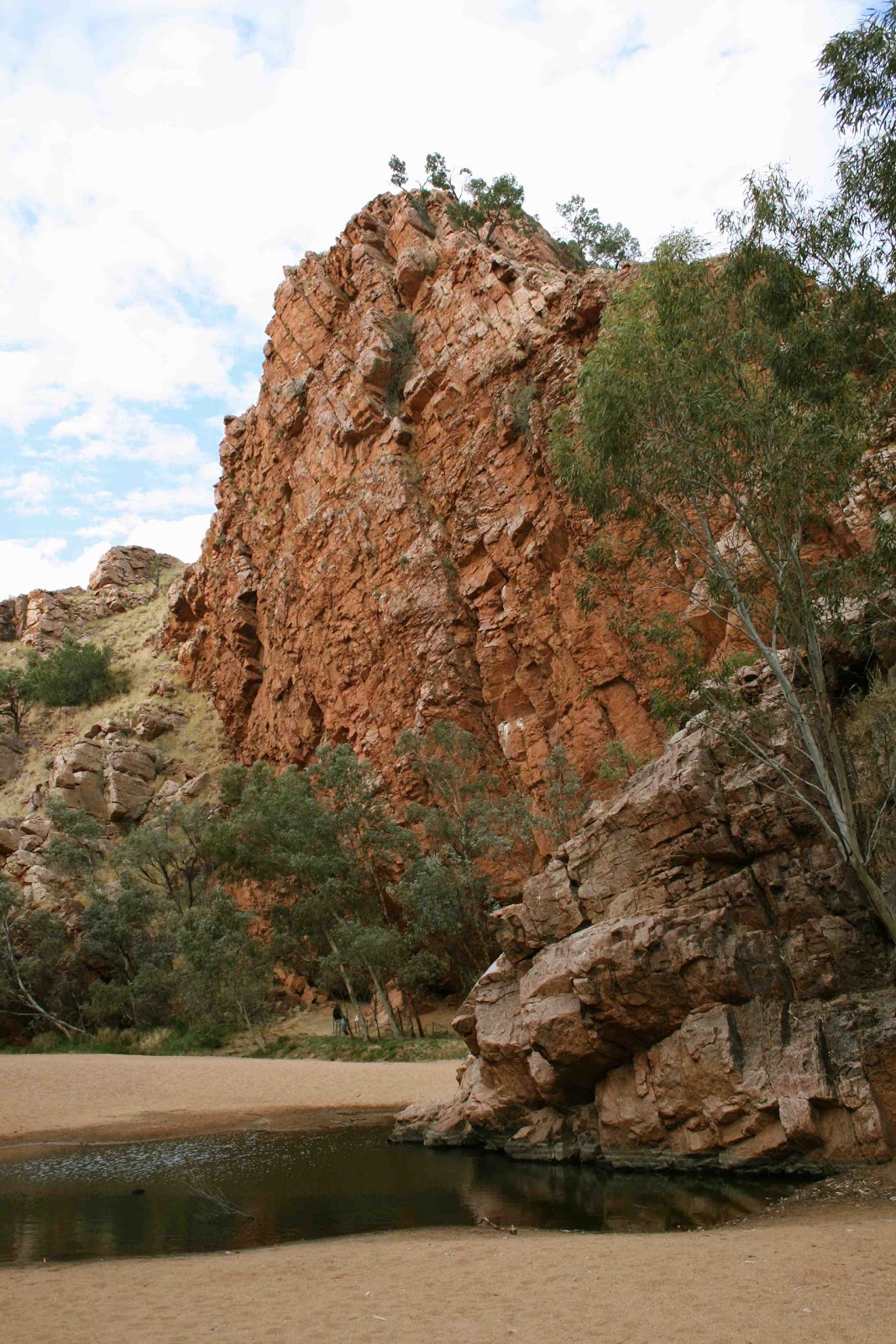
Emily Gap N.T.
An Introduction for non-Australians

Indigenous Australians were the original inhabitants of the continent we know today as Australia. They include Aboriginal Australians and Torres Strait Islanders. Together they make up 2.5% of Australia's population today.  It is believed that they are amongst the oldest races on earth with estimates suggesting that they first arrived on this continent between 40,000 and 125,000 years ago. They are an ancient people with a rich and unique culture. There is enormous diversity across the many nations and clans, with an estimated 250-300 spoken languages with 600 dialects. Sadly fewer than 200 of these languages remain and most are in danger of being lost.  Like many non-Indigenous Australians I see the preservation of Indigenous languages and their stories as of critical importance. Recently, while travelling in Central Australia this was brought into sharp focus for me.

An encounter with the 'The Three Caterpillars'

Mparntwe or Alice Springs is home to the Arrernte people, Indigenous Australians who have called this beautiful place home for at least 45,000 years.  It is at the geographical centre of Australia. The photo opposite is of a place called 'Emily Gap' that I visited in July while exploring Central Australia. At this place you will find Indigenous rock art that tells the story of how three caterpillars named Yeperenye, Ntyarlke and Utnerrengatye created the MacDonnell Ranges.

 The Arrernte people, believe the ranges were formed by giant caterpillars that entered this world through one of the gaps in the escarpment of the area. In traditional stories the caterpillar ancestors, Yeperenye, Utnerrengatye and Ntyarlke are the major creation forces of the Alice Springs area. These stories tell how they arrived from all directions, first stopping at Mparntwe, a particularly sacred site in Alice Springs, where they battled with the Irlperenye (green stink bug).

'Three Caterpillars' - Emily Gap
The Caterpillars fled when the Irlperenye (stink bug) started to kill them. The ranges around Alice Springs are the seen as the remains of the many caterpillars. The gaps in the ranges like Emily Gap indicate where the stink bugs tore the heads from the bodies of the caterpillars. The rock formations around the area are and the few surviving Yeperenye went on to sculpt the rivers and trees along the tops of the ranges.

'The Three Caterpillars' were painted on the cliff face at some point in time. The dark red and light orange stripes were created by red ochre and white lime blended with animals fats and applied to the rock surface.

Indigenous Dreamtime stories are associated with specific Indigenous clans and nations and their lands and these stories are passed on to younger generations by elders and storytellers. They have survived for thousands of years but the loss of traditional languages and the separation of many Indigenous people from their traditional land is a threat to their survival. While some of these stories are secret, or are seen as of such a sacred nature that they are only told by specific people to certain people (e.g. told by men to men, or by women to women), in the last 40 years many Indigenous Dreamtime stories have been shared through children's books.

As a non-Indigenous Australian I love these stories and would like to see more of them written down by the people who own these stories so that others can enjoy them. Thankfully, many are being recorded but just as many aren't. For example, to date I haven't come across a written version of 'The Three Caterpillars' that I learned of when exploring Alice Springs.

Some of my favourite Indigenous Stories

Some of my favourite Indigenous Dreamtime stories have been passed down to all Australian children through the storytelling and wonderful art of Dick Roughsey (1924-1985) or Goobalathaldin to use his tribal name. He was from the island of Langu-narnji in the Gulf of Carpentaria in northern Australia. His first picture book 'The Giant Devil Dingo' received wide acclaim for the richness of the storytelling, the distinctiveness of his painted illustrations, with their vibrant colours, fascinating detail, and the integration of art and word. It tells of Old Eelgin, the grasshopper woman who was evil and had taught her giant dingo Gaiya to kill men for food. But one day Gaiya meets his match in the Chooku-Chooku (butcher-bird) brothers.

Another of my favourite works by Roughsey is 'The Rainbow Serpent' first published in 1975 and still available. It won the Children's Book Council of Australia award for best picture book in 1976. Goorialla (the Rainbow Serpent) travelled across Australia to find his tribe. As he travelled his tracks formed the mountains, the creeks, lagoons and rivers. The Bil-bil brothers plot to kill him. When Goorialla's anger is spent and he disappears into the sea the world is changed.

Dick Roughsey and Percy Trezise (1923-2005) formed a strong partnership to produce many wonderful books together. While Trezise was not Indigenous he became Roughsey's brother in a traditional Aboriginal ceremony and was given the name 'Warrenby'. Roughsey lived with his wife and their six children on Mornington Island, but often spent half the year on the North Queensland mainland. He and Percy Trezise discovered and studied the art of Aboriginal cave galleries in the Laura region of Cape York. The Quinkin gallery inspired the award-winning books 'The Quinkins' and 'Turramulli' the 'Giant Quinkin'.
'The Quinkins' is a wonderful story that tells of the Yalanji tribe of Cape York and their encounters with the Quinkins, spirit people of the land with two tribes: Imjim and the Timara. Imjim were small fat-bellied fellows who stole children while Timara were funny and whimsical spirits who like to play tricks. They were tall and very thin and lived in the cracks of the rocks, and they didn't like the Imjim. This is the story of two children, Boonbalbee and Leealin.  This book was an IBBY Honour book in 1980, and was the Children's Book Council Book of Australia Picture Book of the Year in 1979.  As I travelled through northern Australia and looked at the crevices in the rocks the echoes of this story made me think, "could these be Quinkin rocks?"

There are so many of their titles that I love and have enjoyed sharing with children. These include 'The Cave Painters' by Percy Trezise (1988) which tells of the experiences of two Bullanji children Nonda and Mayli as they travel to visit their mother's people, the Yalanji who live in 'Quinkin Country'. 'The Magic Firesticks' (Trezise & Roughsey) is another story of the Yalanji people in Cape York and tells how the people discovered the way to light fires, not simply sustain fires once they were alight. After monsoonal fires quenched all their fires two young men (Bandicoot and Curlew) travel to a far off Fire Mountain where it was said Didmunja (a wise man) had magic sticks which could produce fire when you wanted it.

'Banana Bird and the Snake Man' (Trezise & Roughsey) tells of a time when people who were later to become birds, animals, plants and reptiles were still in human form. The snake men of Cape York were cannibals who would kill people and hang them in trees to be collected later when they were hungry. This story tells of the triumph of Coucal the brother of Banana Bird man who avenges his brother's death and destroys the Snake men. 

Another wonderfully simple book is 'When the snake bites the sun' told by David (Bungal) Mowaljarlai, which was retold and illustrated by Pamela Lofts. This delightful story of the Ngarinyin tribe of Western Australia, tells the story of the sun and why it is as it is today. This was one of a series of simple picture books for preschool children produced in the 1980s some of which are still available. Other books in the series included 'Dunbi the owl', 'Echidna and the shade tree' and 'How the birds got their colours'. We owe Pamela Lofts (who lives in Alice Springs) a great debt for recording and illustrating many Indigenous stories. You can find a full list here.

Tiddalik Rock (Wollombi NSW)
'What made Tiddalik Laugh' has been produced in various versions of varied authenticity. It is based on the 'Cylorana platycephala' (or Water-holding Frog) that swells as it swallows water. It is sometimes referred to as 'Molok' as well as 'Tiddalik'. The version I first read was Joanna Troughton's beautifully (and amusingly) illustrated version, although this might not be the most authentic traditional version of the story. Tiddalik woke up one morning with an unquenchable thirst. He began to drink all the fresh water he could find till he was satisfied and every creek and billabong was dry. All the creatures and plant life began to die, so the other animals decided to do something about it. But how could they get the water back? Wombat had the answer, make him laugh? But how? The amusing solution involved Platypus in Troughton's version of the story. The story is said to have originated in South Gippsland Victoria but is common along the Eastern seaboard of Australia, so this is unclear. The photo of this rock (opposite) known as Tiddalik rock is located near Wollombi in NSW.

'Enora and the Black Crane', by Arone Raymond Meeks is another fine example of a traditional story being turned into a picture book. Arone Meeks is a member of the Kokoimudji tribe from the Laura area of far North Queensland. This story tells of Enora and how his killing of a crane led to birds acquiring their colours and him becoming the black crane. Winner of Australian IBBY Award for Children's Literature (1994), CBCA picture book of the year (1992) and UNICEF Ezra Jack Keats International Award Silver medal (1992). Arone Meeks also illustrated Catherine Berndt's wonderful book 'Pheasant and Kingfisher' (1987) that was shortlisted by the CBCA in 1988 and won the Crichton Award for Meeks in the same year.


A more recent book which I love is the 'Papunya School Book of Country and History' (2001). This isn't really a Dreamtime story, it is the story of the Anagu people of Central Australia. It offers a balanced telling of the people, their place, their culture and history. It does a good job in speaking of some of the difficult issues arising from the impact of white settlers. It is a wonderful collaboration between well-known non-Indigenous advocate Nadia Wheatley and Indigenous writers, storytellers and artists from the staff and students of Papunya School.

Another more recent community collaboration is 'Our World: Bardi Jaawi: Life At Ardiyooloon' (2011) by One Arm Point Remote Community School.  Ardiyooloon is home to the Bardi-Jaawi people and sits at the end of a red dirt road at the top of the Dampier Peninsula, 200km north of Broome in the north-west of Western Australia. 'Our World: Bardi-Jaawi Life at Ardiyooloon' takes readers inside the lives of the children of a remote Indigenous community; lives that are very different to those experienced by most Australians. Worthy Honour book in the CBCA awards for 2011 in the 'Eve Pownall Award' for Information Books.

Yet another wonderful collaborative book is 'Playground' (2011) compiled by Nadia Wheatley with illustrations and design by Ken Searle, has been short-listed for the 2011 Children's Book Council of Australia (CBCA) Awards. This is an unusual book isn't quite a graphic novel, but then again, it isn't simply a reference book.  Drawing on the stories of 80 Indigenous Australian Elders, 20 Indigenous secondary students and with Indigenous Historian Dr Jackie Huggins as adviser and critical friend, Nadia Wheatley has created a unique collaborative work.  The book offers a wonderful insight into experiences of childhood for Aboriginal and Torres Strait Islander people from 1900 to the present.

With stunning photographs and illustrations, it takes us into the daily life of Indigenous children (past and present) who are connected with their land from birth. The stories and drawings help the reader to understand Indigenous life in all its facets - learning, playing, understanding and respecting the earth, the first days of life, relationships in families, what 'home' was, languages, daily food gathering and hunting, the place of song, dance, art and ceremony.  With the arrival of European people there have been adaptations, but Indigenous children remain embedded in their culture. Daily life is different, but Indigenous children are still learning from country and community. This book would be a good introduction for readers who want to know more about Indigenous people not simply read their stories.

Some other great resources


Based on an Aboriginal Dreamtime story of Waatji Pulyeri (the Blue Wren)


Lovely example of Indigenous Storytelling, 'How the Kangaroo Got its Pouch' A Wirrajuri tale


Some brief further notes on Indigenous Australians

In Central Australia the Indigenous people are called the Anangu. Within this group there are many different language groups including the Pintupi, Warlpiri, Anmatyerre, Pitjantjatjara and Arrente. All Indigenous Australians come from different 'Ngurra' (homelands or traditional countries) and within their rich cultural traditions have stories, drawings, dances other cultural practices that have been passed down through the generations for millennia.  There has been a wonderful balance and 'bond' between people and their land. They see their ancestors as their teachers and for thousands of years they have taught their children the knowledge of ancestors and a history seen within the very rocks, water courses, hills, fauna and flora of their place. This has been passed down often (but not exclusively) through story. Often these stories are told in the context of place and have been oral, but in the last century some of these stories have been written down so that they can enrich all people, even if perhaps not understanding their full significance.

There is a deep sadness that many non-Indigenous Australians feel that there has been some loss of language and stories of these unique people. It was with a mixture of joy and sadness that I caught glimpses of the rich connection between Indigenous people and their land while I travelled across Central Australia.  The joy comes from the richness I could see in this connection, but the sadness is that for many Indigenous Australians this connection is made more difficult by their dislocation from traditional lands. My hope is that more Indigenous stories will be captured in written and spoken forms.