Monday, March 19, 2012

The Critical Place of Fantasy in Children's Literature

As I've written before on this blog, story and literature have great power to teach, enrich and transform us (see here & here). Stories provide access to other world's and experiences with the potential to change us and deepen our understanding of what it means to be human. Stories help to bind us together as people, whether families, communities, races or even nations. They also offer us insights into the fullness of the human condition. We rejoice in the images and stories of human loyalty, valour, forgiveness, faithfulness, courage, patience, love, devotion, sacrifice and so on. But stories also offer us windows into experiences that are not our own. Experiences of death, cruelty, hatred, betrayal, genocide, murder and so on.  And while it is difficult for us to come face-to-face with the dark side of humanity, story helps to grasp, understand and appreciate life's joys, but also its sorrows and tragedies. It also does more. For through fantasy, myth and legend we are led to contemplate worlds and dimensions well beyond the bounds of earth and the physical. Through the power of human imagination we contemplate the metaphysical; things not yet understood or experienced directly. Mystery and wonders not perhaps thought possible when limited by reason.

There have been many writers, philosophers, mystics and theologians who have observed the relationship between the imagination and reason. To be human is to be a creature that doesn't just reason unemotionally in the light of the available data encountered in life.  From birth we learn from our mistakes as we encounter our world. The first touch of a hot surface gives us data that will shape future actions. We learn to ride our first bike by gathering knowledge and elementary understanding of physics and we practice till we cease to fall. We begin to 'read', observe and learn from the books, images, sounds, tastes and smells of our world to expand minds and apply learning. But we also look beyond ourselves and wonder is the physical reality all that there is? We learn to love as we are loved and imagine a future with expectation and doubts. We are creatures that imagine and hope, not just beings who reason. We attempt to envisage our futures, and imagine if material existence is all that there is. We imagine and make meaning; we don't just 'reason' the world.  Children's authors seem almost intuitively to know this.

C.S. Lewis was one author who thought a great deal about these things and reached the conclusion that imagination and reason are related human qualities. Lewis. like others, argued that imagination is a key to meaning. We derive meaning as we encounter signs within our world - words, images, sounds, tastes, experiences and of course stories. Imagination he saw as ‘the organ of meaning’ and reason as the organ to determine truth or falsehood. Meaning he argued is part of our journey towards determining truth or falsehood. So imagination is no dispensable frippery, able to be encouraged or discouraged on the basis of whim or fancy.  No, it is vital to humanity and its well being.

Some books that tap this need

Some of the most popular children's books in history have been fantasy novels written in the last 100 years. J.R.R. Tolkien's 'Lord of the Rings' has sold over 150 million copies, J.K. Rowling's 'Harry Potter' books have sold over 500 million copies, 'The Chronicles of Narnia' by C.S. Lewis have sold 130 million copies. Of course the trail blazers before these were the likes of 'Alice in Wonderland' by Lewis Carroll,  'A Christmas Carol' by Charles Dickens', the fairy tales of Hans Christian Andersen and of course The Brothers Grimm.  And centuries before these, Homer's 'The Odyssey' and other great Greek myths and legends inspired generations with tales of giants, witches, gods and superheroes. Modern collections like 'Greek Myths' by Ann Turnbull and illustrated by Sarah Young bring these to life for new generations.

However, in recent times there has been an explosion of writing for children and young adults that not only embraces fantasy but sub genres of horror, magic, the occult and so on. Some of this writing seems altogether too dark and perhaps an appeal to the darker side of the human condition. This is a question for us to consider. Nevertheless, fantasy in its broadest manifestations stimulates the imagination, creativity and wonder, and we need more, not less of it. As a parent or teacher there are careful responsibilities to be considered here and choices at times to be made.

There are many places to start if you wish to broaden your children's experience of fantasy. My personal preference is to begin with those examples of fantasy tied most closely to the known world before branching out beyond it. Here are a few suggestions.

Fantasy for Younger Children (0-6 years)

For most children under six years, the first experience of fantasy will be via traditional fairy tales and fantasy rooted in the real world. Beatrix Potter's 'Tales of Peter Rabbit' will captivate preschool children from a young age. Roald Dahl's less gruesome tales may be appropriate for some. 'Fantastic Mr Fox', and 'Charlie and the Chocolate Factory' are but two good places to start.  Kenneth Grahame's 'The Wind in the Willows' is timeless and authors like Dr Seuss with tales like 'The Lorax' and Bill Peet with illustrated stories like 'Cowardly Clyde' offer a first step from the safety of the known world to others yet imagined. 

E.B. White's 'Charlotte's Web' is a classic that in the most gentle and elegant of ways introduces ideas of death, new life and the metaphysical.

Classics like 'Alice's Adventures in Wonderland', 'The Wizard of Oz' and 'Peter Pan' will also work with children aged as young as 6 years. 

Modern classics like Ted Hughes' wonderful story of 'The Iron Man' will captivate young boys.

All of these and many more examples will stimulate the imagination and lead young readers to imagine 'What if...?'.

Fantasy in the Primary Years (7-11 years)

I have already mentioned J.K. Rowling, Tolkien and C.S. Lewis who offer a perfect way to expand the appetite for fantasy amongst readers in the primary years.  But there are many other options for children aged 7-11 years.

Tolkien's 'The Hobbit' is worthy of special attention in this age category. This is of course the pre-cursor to 'Lord of the Rings' and is a masterpiece. It is a magical adventure that appeals to children and adults.  Bilbo Baggins was a hobbit who wanted to be left alone in quiet comfort. But the wizard Gandalf came along with a band of homeless dwarves. Soon Bilbo was drawn into their quest, facing evil orcs, savage wolves, giant spiders, and worse unknown dangers.

Emily Rodda has multiple series for independent readers including the popular 'Rondo', 'Rowan of Rin', 'Deltora Quest' and 'The Three Door' series.

Then of course, there are the historical novels that venture through time-slip to worlds beyond. Books like Brian Caswell's 'Merryll of the Stones', Gary Crew's story of the Batavia in ‘Strange Objects’, Ruth Park's 'Playing Beatie Bow' and many more.

Fantasy for Older Readers (12-14 years)

'The Life Of A Teenage Body-Snatcher' by Doug MacLeod is about sixteen-year-old Thomas Timewell who discovers an occupation and world not previously known to him. Set in England in the 1820s this is NOT a bland horror story. Rather it is a complex tale filled with suspense, humour, action and even some romance.

'The Bartimaeus' Trilogy by Jonathan Stroud is a little darker and tells the story of Nathaniel, a young magician with only one thing on his mind, revenge. Nathaniel is an apprentice to the great magician Underwood and is gradually being schooled in the traditional art of magic.

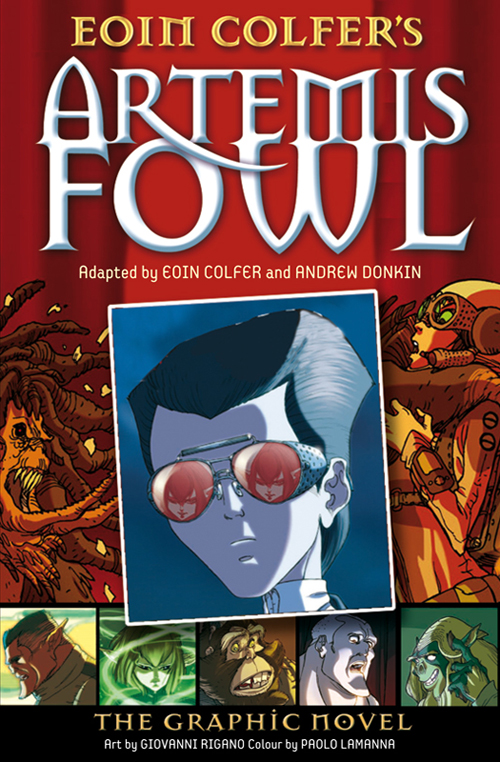
'Artemis Fowl' by Eoin Colfer has been popular with boys aged 12-14. Artemis is an unusual anti-hero, who while the 'bad guy', is a likable boy-genius criminal. This is darker then Harry Potter but very funny at the same time.


Philip Pulman's 'His Dark' trilogy has also been popular with older readers. 'Northern Lights' (i.e. 'The Golden Compass' in the USA), 'The Subtle Knife' and 'The Amber Spyglass' tell the story of two children, Lyra Belacqua and Will Parry as they wander through a series of Parallel universes against a backdrop of epic events.

One of Australia's most prolific writers of fantasy for older readers and adults is Garth Nix. Those of his books suitable for older children include 'The Ragwitch', the six books of 'The Seventh Tower' and 'The Keys to the Kingdom' series. 'The Seventh Tower' sequence of six books follows two children from distinctly different societies in a world blocked from the sun by a magical Veil that leaves the world in complete darkness. His 'Keys to the Kingdom' series chronicles the adventures of a 12 years old asthmatic boy Arthur Penhaligon who is chosen to become the Rightful Heir of the 'House' that is the centre of the universe. The core storyline involves Arthur attempting to defeat the Morrow Days, the criminal trustees of the House.

There are many classic older series that must not be forgotten. One of my favourites is Susan Cooper's 'The Dark is Rising' series of five books that depict a struggle between forces of good and evil called 'The Light' and 'The Dark'. The series is based on Arthurian legends, Celtic mythology and Norse mythology. 

At the outer edges of this genre are books that take readers to places darker than I would care to go with most readers but which some older readers will find engaging. Books like Neil Gaiman's acclaimed 'The Graveyard Book' come to mind.

A last word

While there has been criticism at times that fantasy is used by authors to push morality and religion (C.S. Lewis was regularly criticised for his Christian allegorical tales of Narnia), it is important to recognise that all fantasy projects beliefs, values, morality and at times deeply religious or spiritual ideas. There is a strong argument for accepting the claim by many that modern fantasy has usurped ancient myths, legend and religiously inspired fantasy and literature. While some who see little meaning and significance in traditional religious tellings of the human story, we must not delude ourselves that non-religious fantasy exists. It doesn't. For all fantasy, in a sense, is religious in that it generally assumes, discusses or promotes a set of beliefs, actions and emotions reflecting at the very least some speculation of an ultimate reality, power, order or being beyond the material world as we know it. As such, parents and teachers have a responsibility to understand the books that their children read and to engage with them as they encounter this rich material.

Thursday, March 8, 2012

Enrichment for Gifted & Talented Children

What do I mean by Gifted & Talented?

There was a time when giftedness in children was narrowly defined in terms of intellectual skills and knowledge that could be tested by a narrow range of intelligence tests. However, in recent decades our understanding of giftedness has broadened based on our growing understanding that intelligence can have many manifestations (see for example my post on Howard Gardner's Multiple Intelligences). And so, while we know some gifted children can demonstrate exceptional abilities across a wide range of capabilities (e.g. memory, language, mathematics, problem solving etc), others are extremely gifted in narrower and more specific ways (e.g. visual arts, music, leadership, sport etc).

The Queensland Government's document 'Framework for Gifted Education' offers a helpful broad definition of giftedness:
Students who are gifted excel, or are capable of excelling, in one or more areas such as 
a) General intelligence,
b) Specific academic studies,
c) Visual and performing arts, Physical ability,
d) Creative thinking,
e) Interpersonal and intrapersonal skills.
Giftedness in a student is commonly characterised by an advanced pace of learning, quality of thinking or capability for remarkably high standards of performance compared to students of the same age. 

In relation to the narrower understanding of general academic giftedness, the following well-known definition by Joseph Renzulli is helpful.

Giftedness consists of an interaction among three basic clusters of human traits:
Above average general abilities
High levels of task commitment
High levels of creativity 

How do I recognise giftedness in my children?

6yr old drawing of Blue Tongue via eyes of a predator
If you live with a gifted child or have one in your class there is a good chance you will begin to recognise a number of characteristics that tend to differentiate them from most children, even most capable children.  While many parents feel their children are gifted purely due to their observations of the pace of their development in the early preschool years, extreme giftedness is much more rare. While some teachers tend to assume that gifted children can take care of themselves and so require less attention, this can be a dangerous assumption. Life for the highly gifted child can be an extremely frustrating, confusing and at times lonely experience if their giftedness isn't identified and supported. If your child demonstrates, to a significantly greater extent, a large number of the following characteristics, they may be gifted and will need support, encouragement and some adaptation by teachers and parents:
  • The ability to invent or create novel or original things, or look at their world in unusual ways. 
  • The desire and ability to investigate their immediate world, to see the unusual and observe things that others don't notice.
  • Extreme curiosity demonstrated by experimentation, investigation and in depth study.
  • Using extended vocabulary, complex sentence structure and varied language forms.
  • Understanding and using imagery and metaphorical language at a young age (often under 5 years).
  • Exploring varied interests often at depth, well beyond their years.
  • Being able to learn rapidly and easily compared to other children.
  • Gaining great pleasure and excitement when they are learning new and difficult things.
  • Outstanding memory demonstrated by encyclopaedic recall.
  • A desire to spend time with older children or adults and to learn with and from them.
  • Being able to cope with the introduction of many new ideas, sometimes simultaneously.
  • Wanting to spend large amounts of time learning about a favourite topic.
  • Capable of generating many solutions to verbal or mathematical problems.
  • Enjoying and seeking out frequent intellectual challenges.
  • Demonstrating unusual imagination that is stimulated easily and sometimes independently.
  • Ability to generate multiple ideas and solutions to problems.
  • Showing preparedness to question assumed knowledge or ways of doing things.
  • Often preferring individual work rather than group work and able to work well independently.
  • Demonstrating a highly mature and unusual sense of humour.
  • Sometimes having expectations of themselves that are too demanding and unrealistic.
  • Demonstrating single-mindedness and extreme determination when pursuing interests.
If you think about the above characteristics it should be easy to see how they might well be misinterpreted by teachers and parents who don't understand giftedness. For example, wanting to work independently could be seen as anti-social, single-mindedness can be seen as self-focussed, questioning the assumed knowledge of the teacher could be seen as rudeness and so on. This is why the gifted need to be understood and supported; they are different.

How do I support a gifted child?

There are two main approaches to meeting the needs of the gifted.

a) Acceleration - This involves allowing students to complete curriculum faster, or to advance through school more rapidly, based on their readiness, motivation and capability. It allows the pace of instruction to be adjusted to meet their needs and, it offers new more appropriate challenges.

b) Enrichment - This involves the modification of the curriculum to allow gifted learners to explore topics in greater depth or breadth, to permit the use of varied skills and generally to promote a higher level of thinking, investigation and exploration. It often involves integration of varied learning areas, creative outcomes and products, and the use of supplementary materials beyond the normal range.

Above drawing by Jacob aged just 4 years after a trip to aquarium. His drawing from the unusual vantage point of the fish shows his of Grandad looking into the pond

While there are classes set up for extremely gifted children and some schools that establish specific groups for gifted and talented children, for most gifted children, the mainstream classroom is where they spend most of their time. Both acceleration and enrichment usually occurs within mainstream schools and at times under the sponsorship of external organisations.

Joseph Renzulli's Triad Model has been influential for schools and parents that have tried to provide enrichment for children. His Enrichment Triad has three types of enrichment:

Type 1 - General Interest/Exploratory Activities. These offer a wide range of experiences, e.g. excursions, guest experts, clubs, special classes etc.

Type 2 - Group Training Activities. These aim to develop thinking skills and include activities that facilitate experimentation, analysis, classification skills, critical thinking and communication. 

Type 3 - Individual & Small Group Investigation and Problem Solving. This type allows children to apply the skills acquired in Type 1 & 2 to real life problems of interest to them. They then present their findings in some form to other, e.g. written reports, video presentation, website, debate, a journal etc.

The reality for many parents of gifted children is that they end up having to make a lot of effort themselves to provide for their gifted child. In future posts I will look at various aspects of how we might support the gifted. In the rest of this post I will suggest a number simple ways to enrich the education of the gifted. While all of these ideas could be seen as relevant for children of average ability, they offer additional opportunities for the gifted.

1. Ensure that the child experiences a rich and stimulating life outside school. 

This could include:

  • Opportunities to play and learn with other gifted children, older children and adults who have similar interests and can stimulate their imagination, offer new experiences, and challenge them with new areas of learning.
  • Lots of first-hand experiences, including visits to museums, zoos, galleries, musical performance and drama, film, outdoor exploration, keeping and studying pets, nature walks, and gardening.
  • Providing opportunities for hobbies that offer depth of new learning, for example, collecting rocks, stamps, chess, photograph, movie making, astronomy, and animation.
  • Introducing them to varied ways to respond to learning or present knowledge (e.g. creative arts, drama, video and audio presentations, public presentations etc).

2. Provide opportunities for children to extend their knowledge in areas of special interest.

This might include:

  • Project-based work.
  • Library research.
  • Digital Storytelling (see my previous post here).
  • Webquests.
  • Learning a musical instrument.
  • Learning a new language.
3. Introduce a variety of enrichment activities at regular intervals

While it isn't possible for any teacher or parent to offer individual activities for gifted children there are many wonderful activities that all children will enjoy which can also accommodate the needs of the gifted. The following are some examples of the types of enrichment activities I mean.

a) Story in a Box strategy

This involves placing 5-6 objects in a box that have some relationship to one another. Sometimes I might include a single object that is unrelated, to allow additional creativity. Children are then encouraged to talk about the objects and then create stories that relate to them.  The teacher or parent would usually need to model the process of story creation before asking children to do it.  You might also jointly construct a story or two with children before letting them do it independently. With that proviso, here are just some of the ways I'd suggest you might use the strategy:

1. A group of 5-7 year-olds might explore the objects in a box and try to tell a joint story or simply take turns creating individual stories. You could allow them to supplement the box with a dress-up box if there is a need for children to become specific characters or take on roles.

2. A group of 6-12 year old children might discuss the objects and then prepare a joint monologue to be presented to others (with the objects used as artefacts or aids). Alternatively, a group story or picture book could be produced based on the objects.

3. The box of objects might simply be used to create a digital story (individually or in groups). Have a look at Daniel Meadows' 'Scissors' video to see what might be produced, as wells as my previous post on digital storytelling (here). This approach could also be used with high school children.

You can read a longer post on this topic here.

b) Using a book as the focus for an excursion to its setting


I wrote a post back in January 2009 (here) about a family excursion to explore part of Sydney that was the setting for the wonderful book 'My Place' (Nadia Wheatley & Donna Rawlins). 'My Place' was published in 1987 for distribution in Australia’s bicentennial year (1988) and makes a strong statement about the fact that Indigenous Australians were here for thousands of years before white settlement (there isn't space to unpack this). It is a very clever book that takes one suburban block (and the surrounding area) and tells the story of this place in reverse chronological sequence, decade by decade, from 1988 back to 1788 when the first British Fleet landed at Botany Bay. The overall meaning of the book is shaped by multiple narrative recounts of the families who have lived in this spot, 'my Place' and the changing nature of the physical landscape and built environment.

Our excursion as a family around the streets of Tempe and St Peters in Sydney enriched my appreciation of the book and my grandchildren's sense of the place. As well, it gave my grandchildren a great introduction to Australia's history since white settlement in 1788 and it deepened our understanding of the book. The book has been used as the basis of a television series that screened recently in Australia (here).

There are many other wonderful books that are situated in specific places that can be explored after, before or during the reading of a book. Here are three more.

c) Offering Stimulating Firsthand experiences

I have written previously about the 'The Language Experience Approach' to literacy on this blog (here). Typically, it occurs when a teacher or parent opportunistically seizes an experience as a basis for learning. Many are basic:
  • The squelch of mud between toes on a wet day in the back yard
  • Running on a sandy beach for the first time
  • Watching a worm wiggle in the palm of a small hand
  • Building a cubby house from boxes in the back yard
  • Watching a bird build its nest in a tree in the playground in spring
  • Doing hand painting
  • Observing chickens as they grow bigger day by day
The experience becomes a focus for discussion and exploration and eventually is recorded as a written text in some way. There is great power in new experiences to enrich learning - seeing new places, doing things for the first time, tasting new food, finding yourself immersed in a significant event - new experiences have a major impact on learning and our use of language to describe these events. Such experiences teach us new things and move us to use language to make sense of the experience and tell others about it.

The approach has four main elements:
  • Sharing an experience
  • Talking about the experience
  • Making some record of the experience (words, pictures, sound recording, photographs, video)
  • Finally, using the recorded experience for further reading, discussion and the stimulation of further writing
d) Using blogging to stimulate children's learning

As a keen blogger I know the various benefits of blogging as I'm sure do the readers of this blog. But how might we make better use of blogging with children? Many teachers have already experimented with blogging for children, as have some parents. Most children don't need to be convinced of the wonder and worth of the Internet, but could we make better use of the Blogosphere?

There seem some obvious reasons for using blogs in the classroom or at home:

1. The act of writing a blog post can lead to significant research and related learning. For example, it is an excellent way to develop web comprehension and research skills.

2. Blogs offer authentic readers and audiences for children. So much classroom writing is simply for the teacher 'as examiner', but blogs offer 'real' readers who will respond as learners and fellow writers. This is powerful.

3. Blogs can offer a means for children of many nationalities to communicate and share their ideas across the globe.

4. Blogging can offer a wonderful means for children to practice a second language.

5. Using blogs as creators as well as consumers highlights the need for children to consider issues such as truth and fiction, privacy, copyright and so on.

You can read a full post on 'Children as Bloggers' here.

e) Using film making and animation

Filmmaking and animation is another wonderful way to enrich the learning of gifted children. I have written a previous post on some varied resources for animation. One of them was 'The Klutz Book of Animation' by John Cassidy and Nicholas Berger. It is excellent aid for young filmmakers. The book provides step by step guidance to primary aged children to make simple animations using a video camera (as simple as a web cam), a computer and a variety of props, objects, plasticine and so on. The publishers provide a number of videos online that teach children the fundamentals of animation and filmmaking (here). At the Klutz site you can download free instructional videos (here), free sound effects (here) and sample videos made by children (here). Below is a sample using the Klutz methodology. This is a great resource for young filmmakers. Steven Spielberg would have loved to have this as a child.

You can read a full post on animation and film making tools for children here.

Summing Up

It is important that truly gifted and talented children be identified and supported. I will return to this topic in future posts.


Monday, February 27, 2012

Make & Do Books: Engaging readers in different ways

My focus in this post is on books that engage children by getting them making, exploring or manipulating things. The books I mention are generally just as appealing for girls as boys. Books of this type can also sometimes act as 'breakthrough' books for boys to get them reading. I've written previously about the role of non-fiction, cross section and diagrammatic books,  science & technology, and generally how to make reading exciting for boys. 'Make and Do' books require a different type of comprehension to that used with narratives. In summary, why are they important? They require readers to:

Follow sequences
Comprehend specific instructions
Learn subject specific vocabulary
Become familiar with the language of instruction
Use their body, not just their heads
Be creative and use problem solving
Can encourage reluctant readers to read

'How Machines Work: The Interactive Guide to Simple Machines and Mechanisms' by Nick Arnold & Allan Sanders, published by Quarto Children's Books and distributed in Australia by Walker Books.

This book is a unique interactive guide to understanding simple machines and mechanisms. It introduces basic physics both in words and through models that the reader manipulates. It has 9 double-page spreads that introduce the reader to a key mechanical principle that you then put into practice by building one or more working models. The text and illustrations offer an easy to understand description of the mechanical principle and how to make a model that demonstrates it. This hands-on approach makes it easy to understand how these principles work and how they can be applied to everyday objects, such as cars, bicycles cranes and seesaws. Everything that you need is within, or attached to the book. The concept is brilliant

'The Book of Potentially Catastrophic Science: 50 Experiments for Daring Young Scientists' by Sean Connolly, published by Icon Books and distributed in Australia by Allen & Unwin.


I wanted this book as soon as I saw it.  Well, as soon as I saw the title!  The book is all about igniting interest in science. Sean Connolly achieves this with lively, hands-on activities that suggest excitement and "danger". Simple experiments that pop, ooze, surprise and teach will delight boys and girls in upper primary. He also leads the reader through the history of science, and uses simple experiments to demonstrate key scientific principles.

The reader can rediscover the wheel and axle with the ancient Sumerians, or perform an astounding experiment demonstrating the theory of angular momentum. Children can build a simple telescope like Galileo's and find the four moons he discovered orbiting Jupiter.  They can experiment safely with electricity and avoid the more risky approach of Ben Franklin with his Lightning experiment. They will also learn how to re-create the Hadron Collider in a microwave with marshmallows, calculator, and a ruler to demonstrate the speed of light. Or they might simply crush a can using Stephenson's steam can experiment. This is a wonderful book for children aged 9-12 years.

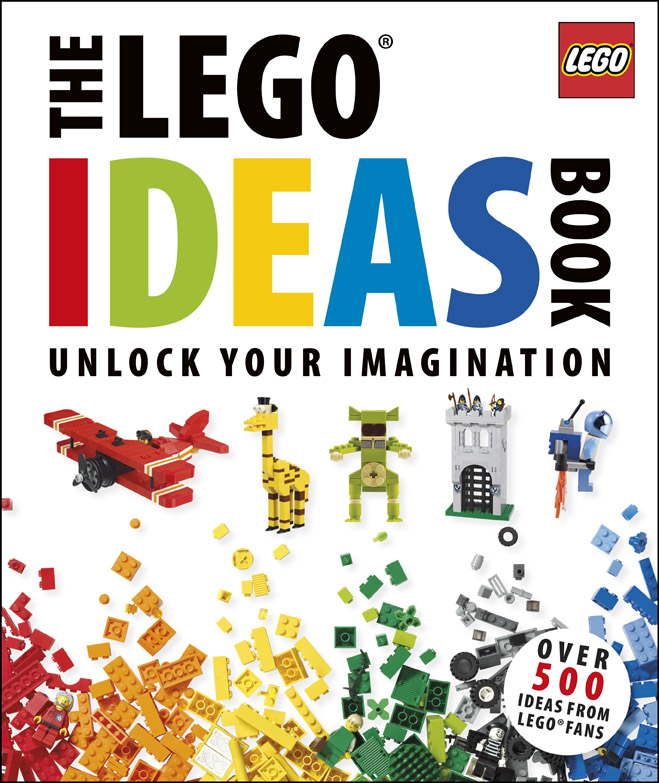
'The Lego Ideas Book' by Daniel Lipkowitz and published by DK Publishing 

If you have a box of Lego pieces resulting from your purchase of dozens of Lego sets, then you need this book. The book has 500 ideas for how you can make new things out of your box of Lego pieces. The book has six themed chapters—transportation, buildings, space, medieval history, adventure, and useful things to make. Each section has templates for models and ideas for how you might create your own. The book has 200 pages of tips and advice, illustrations and ideas.  It is well illustrated and beautifully designed. This book will keep children aged 7 to 70 years busy for hours.

'Sewing School: Hand-Sewing Projects Kids Will Love' by Amie Plumley & Andria Lisle and published by Storey Publishing.

Photo courtesy littlerockmamas.com
If you'd like some simple designs for sewing projects that don't require a machine, then this might just be the right book for you.  This beautifully designed book has 21 projects suitable for children aged 7 and up.  All of the ideas have been tested with kids and most only require basic hand stitches. The book has numerous illustrations and clear instructions as well as quotes from children who were part of the author's sewing camps where the ideas were developed and tested. 

The 150-page book has 12 chapters that cover basic instructions and foundational sewing skills. It then has a variety of projects arranged in categories. These include items to hug (e.g. blanket, pillow, doll), things to hold (e.g. wallet, tote, apron, pouch), gifts (e.g. coasters, pot holder, toy mouse), things to wear (e.g. hat, dolls dress), repairing clothes (e.g. patches, fixing rips, hems) and repairing soft toys (e.g. sewing eyes back on). Each project has step-by-step instructions at a reading level of about 7 years, photos of every step, and also a photo of the final project. The book also has some full-size patterns and instructions for how grownups can help.

'Usborne Complete Book of Art Ideas' by Fiona Watt and published by Usborne

The Usborne Art book has almost 300 pages of original ideas for painting, drawing and making collage. This fantastic book is ideal for children of varied (and minimal) artistic ability. It is also suitable for just about any age (but it's ideal for 7-12 year olds). The book will help children to explore varied artistic forms and materials, including chalk, pencil, paint and watercolour. It offers ideas that require the use of a wide variety of artistic techniques, including painting, drawing, sticking, ink, ripping, rubbing, smudging and colouring. Each of the many ideas is illustrated with very easy to follow step-by-step instructions. The book also offers tips on brushwork, mixing colours, thinning and thickening paint, how to shade and add patterns, using oil pastels, acrylics and more. 

'Children's Quick and Easy Cookbook' by Angela Wilkes and published by DK Publishing.  

The Children's Quick and Easy Cookbook has 60 simple recipes that children will enjoy. The recipes are easy enough for most children to use, and are mostly suitable for the whole family. It contains a mix of healthy snacks, full meals, and delicious treats and sweets. The meal recipes include pita pockets, falafel, pizzas, Turkish meatballs, tacos, Thai satay kebabs, lemon fish sticks, filled crepes, chicken curry and rice. There are also many wonderful sweets including simple baked bomb Alaska, Tiramisu, parfaits, carrot cake, cookies and many more.  

The book also outlines cooking techniques, good food hygiene, kitchen safety, and step-by-step instructions. Full colour photographs are used throughout the book 


The Dangerous Book for Boys. by Conn Iggulden & Hal Iggulden and published by Harper Collins

This book offers a range of ideas for making and doing things. For example, how to make the greatest paper plane in the world, building a tree house, all about dinosaurs, making a G0-cart, how to go fishing, juggling, all about Australian snakes, skimming stones and so on. This isn't a simple book (about grade 4-5 standard) but the content will help boys to 'stretch' themselves. It is also a great book for boys to read and 'do' with an adult. I've reviewed it in more detail here.


'The Daring Book for Girls' by Andrea J. Buchanan & Miriam Peskowitz and published by Harper Collins is a companion volume to 'The Dangerous Book for Boys'.

Like its predecessor, it is designed for children aged 7-12 years. It includes a mix of things to make and do, information about things that girls might like to know, biographical material, poetry etc. It has been produced again by Harper Collins and has a similar layout, size and range of contents. Even the cover is similar in design, to build on the success of the previous book. Andrea Buchanan and Miriam Peskowitz have written the book. The Australian edition was released in 2008 and mirrors the US edition released by Harper Collins in 2007, but it includes some different Australian content.

Saturday, February 18, 2012

Children's Picture Book Reviews - February

This is another of my regular reviews of children's books. In this post I review some wonderful recent Australian and British picture books for younger children.

All but the last book are written for children from birth to age five years. The final book will appeal to slightly older readers.

1. 'The Cat and the Fiddle: A Treasury of Nursery Rhymes' by Jackie Morris and published by Frances Lincoln Children's Books and distributed in Australia by Walker Books. This is a wonderful collection of 40 traditional rhymes that all children should experience. Jackie Morris has chosen some wonderful examples, some familiar like 'Hey Diddle, Diddle' and some less common like 'Jumping Joan'.

Here am I
little jumping Joan,
When nobody's with me,
I'm all alone.

The watercolour plates are wonderful, rich in detail and with a style that will capture interest. If you don't have a 'treasury' of rhymes, then surely this is a good place to start.

2. 'Hop, Skip and Jump, Maisy!' by Lucy Cousins and published by Walker Books. This is a 'Maisy First Science Book' that kids will enjoy. Every preschool child loves Maisy books and this one will only expand the number of fans. This energetic little mouse has fun outside, in the park, at all times of the day and she can do many things. Children love this 'pull the tab' book, they can make Maisy do star jumps, roll over, skip, drink, kick a ball and much more. Lots of fun for the 0-3 year old readers out there who love the simple stories and want to explore their books.

3. 'Ten Scared Fish' and 'Kangaroos Hop' both by Ros Moriarty and illustrated by Balarinji. These two delightful Indigenous Australian picture books from Allen & Unwin are a wonderful introduction to this genre for children under three years as well as being wonderful language concept books.

'Ten Scared Fish' focuses on the number 1 to 10, while offering an encounter with Australian animals and the wonderful art of Balarinji. Ros Moriarty is the founder of the 'Indi Kindi' pre-literacy project as well as her own memoir 'Listening to Country'. Beginning with 'One turtle by the waterhole', we travel to the sea meeting turtles and fish until 'Ten fish in the salt water' meet 'One big mouth'!

'Kangaroos Hop' introduces the reader to a variety of common verbs and increasing sentence complexity as we meet Australian animals with lots to do and add them incrementally each page to an expanding story. 'The kangaroos hop and the birds fly', 'The kangaroos hop the birds fly the echidnas shuffle and the butterflies dance', and so on. Wonderful!

Both books are beautifully and simply striking and as you'd expect combine bright colours, traditional Indigenous artistic techniques and a fresh and engaging illustrative style. I love these books!

4. 'My Green Day' by Melanie Walsh and published by Walker Books. This is another simple book for preschool children. But it has a twist. It introduces children to ten things that they can do to protect the planet. Each simple sentence has a fine print explanation for teachers and parents that helps them to explain why each thing will help to 'green' your day.

'I eat a free-range egg for my breakfast'
'I put my eggshell in the compost bin ..'
'I help empty the washing machine... and peg our clothes out to dry'. And so on.

The illustrations are simple but eye-catching, use simple tonal variations, strongly contrasting colours and many variations in page shape, cut-outs and so on, to capture attention. The book has the look and feel of recycled paper 

5. 'Mole's Sunrise' by Jeanne Willis and illustrated by Sarah Fox-Davies and published by Walker Books. This is a charming book due both to its story and the illustrations. Mole never thought he'd ever get to see a sunrise until one day his friends show it to him.


Mole had never seen the sunrise.
"It's beautiful," said Vole.
"I'd like to see it," said Mole.
"Come with me," said Vole.
Off they went hand in hand.

With simplicity of language and simple sentence structure, Willis tells a delightful tale of friendship, innocence and imaginative exploration of the world. The illustrations of Fox-Davies exquisitely detailed pen and wash drawings that are as soft and gentle as the story. This is a wonderful book that children aged 0-5 will just love. You can also buy a touch, sound and picture book for blind children. What could be more appropriate for a book about a mole? Find out more HERE.

6. 'Bom! Went the Bear' by Nicki Greenberg, published by Allen & Unwin. I love this book and so does every child I read it to. In fact, I almost forgot to review it because I have one granddaughter who insisted on it being read so many times that it was buried with all my older children's books. Nicki Greenberg is a fabulous illustrator and writer who after the epic dimensions of her acclaimed graphic novel 'Macbeth' (see my review here), has produced a delightfully simple story of a little bear and an unlikely band of animals. The dog went 'strum strum strum' on the banjo, the singing was covered by giraffes who 'hit the high notes' and the turtles who sang low, the rabbit played the "Clarinet quick-quick", the koala played the sax "s-l-o-w". But it was the bear who brings a dramatic end to this simple story about a procession of animals playing varied instruments - "BOM! went the bear on the big bass drum... BOM! BOM! BOM! BOM! BOM!"  Delightful brightly coloured illustrations and slightly stylised animals with clear personalities, marry perfectly with carefully chosen and crafted words.

7. 'School for Princes: Stories from the Panchatantra' Retold by Jamila Gavin and illustrated by Bee Willey. Published by Frances Lincoln Children's Books and distributed in Australia by Walker Books. This is a collection of five ancient fables taken from the 'Panchatantra' which is a piece of classic Indian literature from the 3rd century BC meant to offer wisdom for life. Gavin weaves five original stories in with them to tell the story of how three rude and badly behaved princes are shaped to become future kings.  The traditional tales focus on 'winning friends', 'losing friends', 'loss of gains', 'rash deeds' and 'the art of duplicity'.  Jamila Gavin was born in India and makes these unfamiliar stories of wisdom and moral advice relevant to a 21st century child. Bee Willey is an internationally acclaimed illustrator who doesn't disappoint in this book with a style that helps to makes sense of these culturally unfamiliar stories.  Suitable for readers 5-10 years and perfect for class read aloud to expand literary interests.

Friday, February 10, 2012

What are the 'basics' in the preschool years?

Creative water play
I am asked constantly by parents of preschool children should they be doing various things. Parents ask, should I:

"Make sure they know their sounds before schools?"
"Teach them the letter names?"
"Teach them to write their name?"
"Make sure they can write neatly?"
"Teach them to read some simple words?"
"Teach them about numbers?"
While the above are genuine questions about knowledge children will eventually need, most overlook the real 'basics' in the preschool years that will have a big impact on school success and later learning. If you want your child to succeed at school and in the workplace, become lifelong learners, be creative people able to solve problems and adapt to varied situations, who have varied life interests and a love of knowledge, then here are the things you want them to be able to do when they are five.
Enjoy playing with language - know unusual words, enjoy finding out new ones, play with rhyme and rhythm in language, love telling stories, jokes and talking with other people.

Creative story making with skills established early
Enjoy new stories with others in all their forms - stories you tell them of your life, stories read to them, stories watched together with others in the form of film and on television.

Have an interest in numbers, letters and words - wanting to learn about them (e.g. "Show me what a thousand is Mum"), trying to write them, including them in their creative play and drawing.

Be able to sit still for up to 30 minutes - being able to play alone or with others, complete a task they're interested in, listen to stories, engage in a play situation etc.

Have an expanding vocabulary - learning new words, trying to invent their own, asking you about words and what they mean.
Learning from experience

Enjoy knowledge and the gaining of it - being curious about some area of interest (e.g. insects, dragons, horses, pets) and having a desire to know more and share it ("Did you know Mum that a stick insect is called a Phasmid, and there are lots of types").

Have a love of books - while I've already mentioned stories above, there is a particular place for the love of books, I'd want my children to see books as some of their most special possessions because of the knowledge, stories and wonder that they hold.

Have an emerging knowledge of words, letters and the sounds associated with them - a five-year-old doesn't need to be able to read before school, but I'd want them to have some knowledge of letter names, some concepts of print and an interest in knowing how to read and write.

Show an interest in technology - not just to play games, or sit for hours transfixed in front of a TV, but a desire to explore their world with computers, an interest in the knowledge and learning that technology can deliver and how it can expand our world.

An ability to be creative and inventive - drawing and making things inspired by a story, TV show, movie or experience. Wanting to dress up and act out characters and experiences. Making shops, cubbies under the table, giving names and characters to their dolls and toys, using toys and other objects for creative story telling or recreation.

Creative play in action, the foundation of imagination & problem solving

Have an interest in problem solving - working out a way to spread the sheet over the table and hold it there for the cubby, trying to see how things work, trying to fix things that are broken, coming up with ideas for how the problems of his or her world can be solved ("Mum, if we could knock off three palings on the fence I could make a gate to Cheryl's house").

Have the ability to listen to, learn and comprehend - stories, lifestyle programs, movies, television shows, stories you tell them, recipes and how they are structured, instructions (spoken or pictorial). 

The above are the real basics that children need to know to succeed at school. The problem with them is that you can't cram in the year before school to develop them. These basics are things that take time and effort by parents and preschool teachers. Each requires knowledge of the child, an interest in their learning and interests and the ability to observe our children to scaffold their learning.

Thursday, February 2, 2012

Seven New Children's Story Apps

I recently reviewed a list of my 25 top children's apps in 2011 (HERE); this is my first review of new apps for 2012. Most of these were released late last year and are suitable for children aged 4-8 years. Of the many new releases, the following seven are worthy of consideration. It's pleasing to see that many of the negative things that have been commented on in previous reviews seem to be being addressed in some newer apps. While developers still need to work hard at maintaining a priority on the quality of the story, they have been using more engaging material with rich language and more complex story. There is also more evidence of use of sound, image and word in more effective ways, without simply producing an app with cute and fun interactive elements.

I've used the same rating scale as for some of my earlier app reviews, with four key categories and a 5 point rating scale - 1 (Very Poor), 2 (Poor), 3 (Average), 4 (Good), 5 (Excellent). The higher the score out of 20 the better the rating.

1. 'Cozmo's Day Off' from Ayars Animation

'Cozmo's Day Off' is one of my favourite new story apps. It has a cute story in simple rhyming verse that is complemented by a 'quirky' reader. Ayars Animation developed the wonderful 'Jack and the Beanstalk' app that I reviewed last year (here). It tells of Cozmo the alien who is having a bad day as he tries to get to work. 

It also has some brilliant and very funny interactive elements. Children love exploring the many interactive elements on each page, and yet because it's a fun rhyming story they also come back to the text.  The quality of the images is high, as is the rendering of every page. The app also has just about every option for reading it. You can listen to the story, read it yourself and record your own reading of the story. A fun device they've added is the ability to speed up or slow down the reading of the story. While this is a bit of a distraction once children discover it, they do come back to the story.

The app is also easy to use. It doesn't have a page swipe function (just a back and forward button) but this isn't a problem. It does have a scroll bar that allows you to move quickly from page to page or back again if you've lost your place. Overall, this is an app that makes good use of all that there is to offer in an eBook, including sound, image, movement, colour, language and text devices. A big pat on the back to the developers for using phrase highlighting in the read along option rather than word-by-word reading as is the case with many apps. This encourages reading for meaning, not just reading words.

Rating

a) Fun & interactivity (5) - Sets new standards for fun and creative elements
b) Ease of use (4) - Complex, with many options, but not hard to work out
d) Benefit for literacy & learning (5) - An enjoyable story, with rich language and an engaging storyline
e) Value for money (4) - at $4.49 US it is excellent value. 

Total =18/20

2. 'Ellison the Elephant' by Eric Drachman and illustrated by James Muscarello
Oceanhouse Media

This is a simple and enjoyable story about a little elephant who is different from other elephants because he can't trumpet properly. He is helped by Weasel to find his trumpet and in the process manages to invent jazz music. 

Oceanhouse Media has been developing apps primarily for previously published books. This strategy ensures that they end up with some quality stories. There is little animation, but the movement of screen focus across images works well and gains attention and increases interest. In this app they also include some good (and subtle) use of sound to support, rather than overpower the story. The interactive devices are limited, but that doesn't bother me, as it means there is more emphasis on the story. This is supported by the use of multiple voices for the storytelling mode that are excellent. Two minor quibbles. Ellison's mom seems to call her 'Alison' whenever she speaks, but maybe this is her accent. There is also one page with three font sizes for no obvious reason.

Rating

a) Fun & interactivity (3) - The level of interactivity is limited but acceptable (and not distracting)
b) Useability (5) - Very simple and easy to use
c) Benefit for literacy & learning (4) - Great story, rich in language and vocabulary and well written
d) Value for money (4) - Great value at $2.99 US. 


Total = 16/20


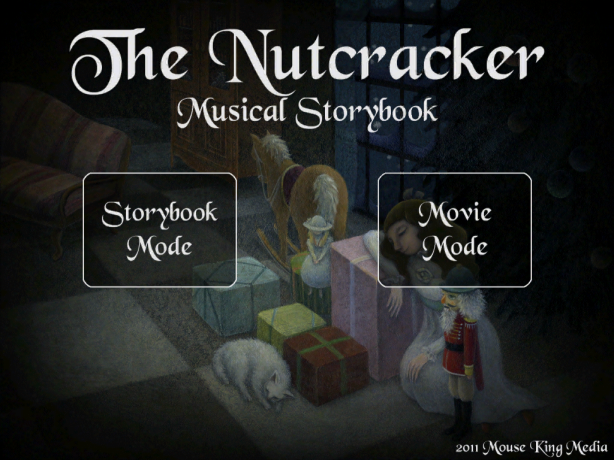
3. 'The Nutcracker Musical Storybook', artwork by Joko Janaka animator Andy Zibits & music audio Paul Zibits. Developed by Mouse King Media.


This story app is based on E.T.A Hoffman's classic story of 'The Nutcracker and the Mouse King' (1816) and the music from the famous ballet 'The Nutcracker' that was based on the story.  It comes in story or movie mode. Each has a single line of text at the bottom of the screen that presents the simple narrative. In the read-only option the user can control page turning and tap pictures for a number of simple effects (mainly sound and some movement). In the movie mode the story moves automatically from one screen to the next. Both modes make use of segments from the opera. The read only page is controlled from an initial Christmas tree image with numbered baubles allowing different paths through the story. The reader can swipe the pages and interact with a number of visual elements on the way.

The images are delightful and capture the mood of the 19th century winter setting with wonderful variations in colour, light, movement, animated figures (puppet-like), sound and of course Tchaikovsky's wonderful music. The well-known scenes are all there with the 'Waltz of the flowers' and the 'Dance of the Sugar Plum Fairy' brilliant!


Rating

a) Fun & interactivity (4) - The elements are simple but they fit well with the story and music.
b) Useability (4) - The app is simple, but I found the story sequence that was triggered by touching the right bauble on the Christmas tree a little confusing until I found the reset button.
c) Benefit for literacy & learning (4) - A wonderful introduction to a famous ballet and another period in history
d) Value for money (5) - at $2.99 US this is excellent value. 


Total = 17/20

4. 'Monkey Business', by Christopher Cheng and developed by Kiwa Media (New Zealand)

This is a simple story about a runaway monkey and his adventures while free from his confinement. It is in HD format but has unusual images for a young child's app. The zookeepers all look as if they're on steroids. The monkey images are simple and effective, but I wonder how 3-6 year old children will respond. Those I tested it with seemed to enjoy the story more than the images.  The language was also adult-like, e.g. "He was checked for injuries but the only visual evidence of Erwin's escape was a grazed foot". The app has many of the common features including ready alone or listen to, record your own reading, and a painting option. This is a cute feature that allows the reader to paint all illustrations on the way through. While children I tested the app with enjoyed the painting option, it does little for engagement in the story.

I can't say this is one of my favourite story apps; I'd encourage the developers to work on better texts for children and to think carefully about the appropriateness of their images for the age group. They might also consider more interactive elements to elaborate on text or enrich story elements and sequences.

Rating

a) Fun & interactivity (3) - Pretty basic with very minor interactive elements, the painting option was fun
b) Useability (4) - Fairly easy to use
c) Benefit for literacy & learning (3) - Limited in my view. The story does offer rich and complex vocabulary, but this seemed strangely inappropriate in places.
d) Value for money (5) - at $0.99 US you can't argue on value, this is a very cheap app 


Total = 15/20


5. 'Tacky the Penguin' by Helen Lester and produced by Oceanhouse Media.

I love this little story app. Tacky is a lovable character and the illustrations of Helen Lester are simple pen and wash with vibrant colours. She manages to create images that project different personalities for all the penguins. I like the fun names that Lester chose - 'Goodly', 'Lovely', 'Angel', 'Neatly', 'Perfect' and of course 'Tacky'. The introduction of the story complication (the bear and two wolves) with a repetitive verse adds to the fun of the story. But of course, Tacky, the crazy little penguin manages to confuse them with numbers and then send them packing.

As with other Oceanhouse apps, the use of quality literature means that they have a head start and don't need to use as many tricks and gadgets to engage young readers. The app also allows the reader to tap each image with the name of the object shown in word and sound. I'm not a fan of this feature because it often seems to distracts readers from the storyline as they play with the app trying to look for interactive elements. In my view, this simple app doesn't need this feature, which confuses the purpose of reading whole stories with word recognition drills.  


Rating


a) Fun & interactivity (3) - As indicated above, this is a simple app with only minor interactive elements. I'm glad to see sound used in this app to add to the reading experience.
b) Useability (4) - The app works well and is simple in format.
c) Benefit for literacy & learning (4) - The story is rich in language and elegant in plot and structure.
e) Value for money (4) - at $2.99 US it is good value. 
 
Total = 15/20

6. Some more Dr Seuss magic from Oceanhouse Media

(i) 'And to Think That I Saw It on Mulberry Street' by Dr Seuss, Oceanhouse Media

This is another Oceanhouse production to mark the 75th anniversary of the Dr Seuss classic story 'And to Think That I Saw It on Mulberry Street'. This was the first story Dr Seuss managed to have published.  It uses the images from the book and is not animated. The template used by Oceanhouse is the same as for the app reviewed above for 'Tacky the Penguin' and has the same basic features.

The simple sound effects work well and add to the experience of the story for the reader. These include music, footsteps, horse hooves, sounds of the wagon and the grand parade. Kids will love this story app.

Rating

a) Fun & interactivity (3) - A simple app with enough to interest the reader
b) Useability (4) - Simple and easy to use.
c) Benefit for literacy & learning (5) - Wonderful and timeless story from Dr Seuss with the usual richness of rhyme and language.
d) Value for money (4) - at $2.99 US it is good value. 


Total = 16/20

(ii) Dr Seuss Beginner Book Collection #1

This is a fabulous collection of Dr Seuss classic stories just released by Oceanhouse media. Each story in the set is ideal for beginning readers. The titles come in one app and include:

'The Cat in the Hat'
'The Foot Book'
'One Fish, two fish, red fish, blue fish'
'Mr Brown can Moo! Can You?'
'Fox in Socks'


All these books use the same design template as for 'And to Think That I Saw it on Mulberry Street'. So you can read it yourself, have it read to you, or have auto play. It also uses the same picture tap function that primes the words and name for each separate image on each page. However, while I see this as a distraction in some of the apps in which it is used, it works well in this collection because all are fine examples of how Dr Seuss plays with words and language. Hence, the tapping of images to hear and see the label makes more sense.  One other feature in this app is that the sound works so well to support the experience of the story. This is seen particularly in 'Fox in Socks'. I should also add that the reader on the app is brilliant. Try reading '...they call this a muddle puddle tweetle poodle beetle noodle bottle paddle battle' with fluency and interest.

You can't go wrong with this collection; at about $2.50 per story, you should add it to your collection.

Rating

a) Fun & interactivity (4) - A simple app with enough to interest the reader. The word tap option works well with the repetitive language, use of nonsense words and rhyme
b) Useability (4) - Simple and easy to use.
c) Benefit for literacy & learning (5) - Five wonderful stories from Dr Seuss with the usual richness of rhyme, language and silliness.
d) Value for money (4) - at $11.99 US for 5 stories, it's great value.

Total = 17/20

Some previous reviews of apps

'Alice', the iPad and new ways to read picture books (HERE)

'Literacy and the iPad: A review of some popular apps' (HERE)

'Literacy and the iPad: A second review of children's apps' (HERE)

'25 Great Children's Apps to Stimulate Literacy, Learning & Creativity   (HERE)